
How The Internet is CHANGING Your Brain
How the internet is changing your brain?
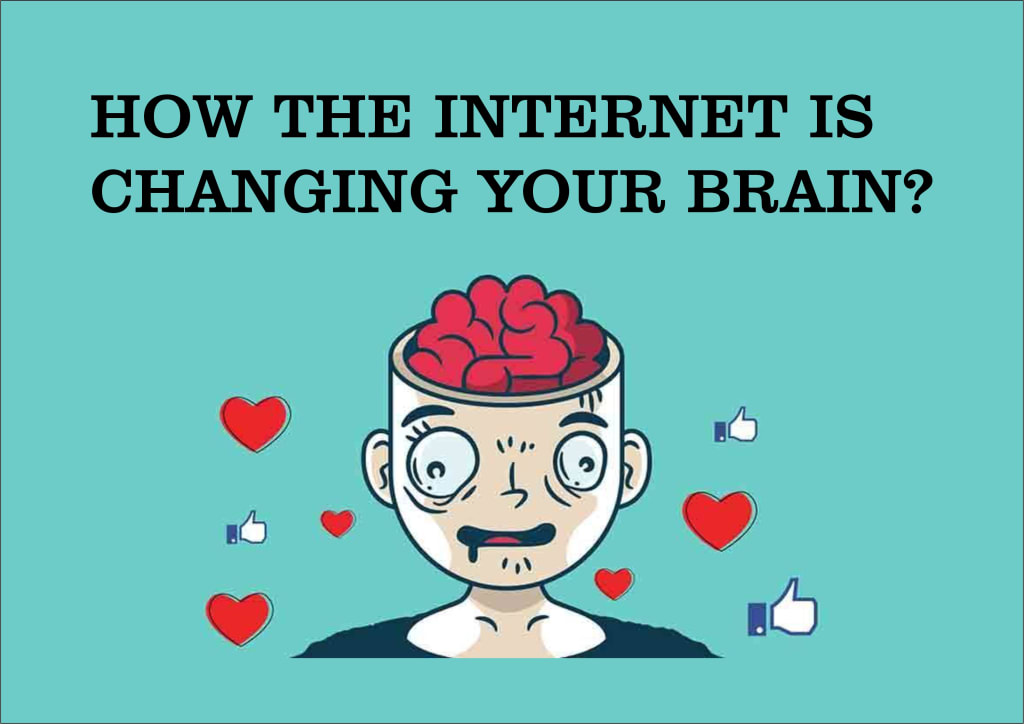
Can you imagine life without the internet? Some of us remember a time before everything was connected, but the idea of living without smartphones and instant access to maps and search engines now feels completely alien. However, our growing dependence on the online world is bringing about significant changes in our lives, relationships, sources of information, and how we interact with one another. Moreover, these changes are not limited to external factors but are also affecting our brains.
As more and more devices rely on the internet, global access continues to expand. In 2016, approximately 3.5 billion people worldwide accessed online services. The top three countries in terms of internet users were China, with 721 million users, followed by India and the US with 290 million users. English emerged as the most commonly used language online, followed by Chinese and Spanish.
The reliance on the internet is shifting across generations, primarily influenced by those who had to adapt to new technology and those who grew up with it readily available. Generation X internet users, born between the mid-1960s and early 1980s, spent an average of 110 minutes per day on mobile internet usage. In contrast, Millennials, born from the early 1980s onward and immersed in the internet from a young age, logged an average of 185 minutes per day. Social media and messaging apps have become crucial in our daily lives, with over a billion people regularly using platforms like WhatsApp, Facebook, and Twitter. As internet services gain more prominence, our behavior naturally adapts to these changes.
Communication through online platforms has become more common, leading to a decline in the popularity of phone calls and text messages. Likewise, the rise of online shopping and services has significantly impacted traditional brick-and-mortar stores, resulting in visible transformations in our towns and cities. These changes can be attributed to the possibilities offered by the online world.
But how does our increasing reliance on the internet affect our brains? With a wealth of information at our fingertips, the prevalence of the internet is altering the way our brains function. Millennials, for example, have been found to be more forgetful than previous generations, likely due to constant distractions caused by connectivity. The basic principle of memory involves repeated exposure and contemplation of information in short-term memory, which strengthens its storage in long-term memory. However, constant exposure to new information hinders this process, resulting in less information being permanently retained. Moreover, the knowledge that information is readily available online reduces the need to commit it to memory. While previous generations would have memorized directions on a map, for instance, nowadays there is a reliance on GPS apps on our smartphones.
Additionally, we are becoming increasingly addicted to our smartphones. Constantly checking for messages and updates reinforces a habit of distraction, making it more difficult for our brains to engage in deep thinking when necessary. Research has shown that the continuous flow of information leads to a loss of cognitive control. Consequently, not only does our ability to control our minds diminish, but our ability to determine what we think about also weakens. The more we rely on our phones and apps to provide us with information, the less agency we have in choosing what deserves our focus. We find ourselves increasingly concerned with new information rather than what is truly important.
However, it is important to note that although technology is clearly influencing the way our brains work, it is not necessarily negative. Throughout history, inventions have allowed us to spend less time on certain tasks, freeing up our time for other activities. For example, washing machines significantly reduced the time spent on cleaning clothes, enabling us to allocate those extra hours to work or other pursuits. Similarly, the ability to communicate and find information faster on the internet grants us the additional mental capacity for other processes.
Nevertheless, reducing screen time
About the Creator
Top tipple tricks
Been thinking a lot about drinking, lately. Not least because of a recent episode of over-indulgence and the inevitable after effects. Some readers may recall the earlier articles I wrote about beating the booze. Here I set out an experiment in techniques for cutting down on my alcohol intake. The experiment was successful, the techniques worked, and I have armed myself with an arsenal of weapons in the war against the demon drink. I have yet to fire the first round however. It's all a question of timing (perhaps procrastination).
By Raymond G. Taylor2 days ago in Psyche
Guard Your Battery
Why are some people so attractive just by standing there? It’s not because they are "likable," but because they don’t need everyone to like them. I realized later that truly charismatic people allow themselves to be criticized, but they never criticize themselves. They never try to please the world; instead, the world stops to watch them.
By Emily Chan - Life and love sharing7 days ago in Poets




Comments
There are no comments for this story
Be the first to respond and start the conversation.