
How My Wife Taught me about Mental Health
How I Learned to Learn

I have always considered myself an intelligent person, and I strive to be open-minded. I am smart enough to realize that there are things I don’t know, and don’t understand. I know my limits, but have always strived to broaden my horizons by learning that which I do not know. I was always taught to push myself. If I came across a word I didn’t know, I’d look it up. If someone offered an opinion different than mine, I’d look into the facts. If it turned out that the facts had changed, I’d change my opinion rather than argue. This outlook has served me well in life, at least until recently. I have finally come up against something that I just can’t seem to wrap my head around: Mental Health.
I grew up in a time where we didn’t have labels for everything. You were either normal, or you were Special Education. And you weren’t Special Education unless you had the biggies, where you were clearly handicapped in some way, so for the rest of us we were either normal, gifted, or troubled in some way. Teachers weren’t equipped to handle us, nor did they have any clue as to how.
For some, that meant you didn’t reach your full potential in school. For others, such as myself, we didn’t know any different and had to find ways to work around our problems. I know now that I suffer from dyslexia, and ADHD, but back then I just had trouble with reading, math, and keeping focussed in class. I was lucky and had good teachers who recognized my love for books and that I wasn’t a bad kid, I was just distracted easily in class. They taught me how to work around my issues so that I wasn’t disruptive, and fostered my love for literature. I taught myself how to speed read so that I didn’t get stuck on individual words, but still took in the meaning and atmosphere of what I was reading. I learned to manage despite my disabilities, and flourished.
I always looked down on others who used their disabilities as an excuse to not learn, work or further themselves. I considered them lazy. I am not proud to say that this is one of the few things I just couldn’t open my mind up to, that someone could not learn to work past their ADHD or dyslexia or anxiety.
Over the years, the stereotypes and stigmas of Mental Health have changed, and we know a lot more now than we did back when I was a sprout. There are so many levels of Mental Health, and so many different ways in which people deal with their illnesses.
This was really brought home to me recently. Eight years ago I married a beautiful, smart, compassionate woman, who just so happens to suffer from Mental Health issues. About three years ago, we really started to have problems. She would sleep until afternoon, and then sit and watch TV all day. Dishes wouldn’t get done, laundry would pile up, and she just wouldn’t have any motivation to do anything. She was already on disability for a physical issue, so she didn’t work, but it got to the point she wouldn’t leave the house for much of anything. Her friends dwindled, as people just stopped bothering with her. We argued constantly, because I kept calling her lazy and got mad because on top of working full time, I would have to come home and clean as well. Our whole relationship felt very one sided to me, and it was causing friction.
Eventually, my wife did something that, to a normal person, would be considered unacceptable and I ended up leaving her. Essentially she cheated on me. I was heartbroken. I moved out, leaving everything behind. My wife ended up checking herself into the hospital after attempting to self-harm. I’m leaving out a lot, but you really don’t need the details, just the story.
After being checked into the Mental Health facility, months of therapy led to a diagnosis of BPD, or Borderline Personality Disorder, with other diagnoses on top of that. Basically, because of this disorder, my wife literally had no control over her mind. She would literally become a different person. This is simplifying her diagnosis, and I encourage you to read up on it if you feel someone in your life may suffer from this or something similar.
She reached out to me, not trying to get me back, but kind of like an Alcoholic would while going through the program to make amends. She apologized, and tried to explain her diagnosis. Being the avid learner I have always been, I researched. I read book after book on BPD and some of her other issues.
My brain exploded. In my research I realized the reason behind some of her actions. Not all, Mental Health is not an excuse for some of the ways she treated me, but it did explain a lot. I also learned something that changed my views on things forever: a LOT of my learned behaviour was actually harmful to her Mental Health and I was in fact perpetuating a lot of her problems!
Of course I still loved my wife. I decided to join her in some of her therapy sessions to see if we could save our relationship, and for the most part we have. It’s hard work, and it’s an ongoing process, but we are trying.
My main issue is that I can’t seem to shed my original views on Mental Health, despite my constant effort to learn and accept more about it. I have an innate lack of understanding when it comes to so many of her issues, that I find myself feeling frustrated a lot of the time. However I have learned, much like my own disabilities, to work around these shortcomings rather than to try and force them into preconceived notions of acceptable behaviour, which I have come to see that we as a society tend to do.
For example, I am the type of person who has learned to deal with my stress and anxiety. If a situation arises in which I am stressed, I sort it into one of two categories: it is either something I can find a solution to, or it is not! If it is something that I can find a solution to, I work out steps to deal with it, therefore removing the stress. It is something I can take control over. If it is something that I have no control over, which I understand would stress many people out, I look at it like this: I can’t control the outcome, therefore there is no point in stressing because it will happen whether or not I stress over it. I will deal with whatever happens as it happens.
My wife on the other hand stresses about everything, be it big or small. Everything is a catastrophe. Her Mental Health issues make it impossible for her to differentiate between things the same way, so she lashes out. As you can imagine, this leads to a lot of friction between us. However, because of my research and our therapy, I no longer attempt to make her see that it’s “no big deal” and to “calm down.” Instead, I get her to use her coping skills and to talk it over, allowing her to see the solution on her own. In this way she is able to calm HERSELF down, and she feels like she has the control her mind keeps trying to tell her that she doesn’t have.
Learning about my wife’s Mental Health has not only changed the way I see Mental Health, it has also made me see her in a different light. She is so strong and brave to be dealing with some of these issues on a daily basis. I can’t honestly say I would be able to handle some of the things she does. I now realize how lucky I am to be ABLE to compartmentalize and work around my disabilities. I also realize how narrow minded and ignorant I have been, thinking that it would be so easy for everyone else.
It has not nor will it ever be smooth sailing. There is no cure for her BPD, only ongoing treatment. This means that our relationship will never be “normal” and that I will constantly be relearning my behaviour and debunking some long held beliefs on how both myself and my wife should act. I still struggle over my ideas of laziness. Even though my wife is home all day there are days I come home to dinners out of a box (which I detest), and I have to stop myself from giving her a hard time and questioning why she couldn’t peel a potato. It’s NOT laziness, it’s just she is having a hard mental day and just can’t bring herself to do anything. And sometimes I have to realize that the fact that she made dinner at all is an accomplishment for her. The fact that she got up out of bed AT ALL is an accomplishment.
There is a difference between enabling behaviour and understanding a person’s limits. I do not ignore when my wife is having a bad day. I acknowledge it. I remind her of her coping skills. I ask her if there is anything I can do to help. If it turns out to just be laziness, I put a stop to it before it becomes a habit. But if it’s a bad Mental Health day, I acknowledge it as such. My wife is learning to communicate with me, so I know what is going on and how I can help.
There are days when I feel I cannot deal with my wife and her issues, but then I remember what she struggles with every day, and I realize how lucky I am to be with someone who DOES struggle every day. Every day she wakes up and fights herself to live. She argues with herself over every little thing. She tries her best to be the woman I married.
My wife has taught me so much, and I hope that in writing this I can give somebody else a beacon of hope, and a lesson that just because we don’t completely understand something, there is also room for growth and learning. Don’t be afraid to learn about something. Don’t be afraid to change your opinions. You don’t know everything, and you CAN open your mind and be accepting.
I’m glad I gave my wife, and our marriage, that second chance.
About the Creator
Keep reading
More stories from writers in Psyche and other communities.
Top tipple tricks
Been thinking a lot about drinking, lately. Not least because of a recent episode of over-indulgence and the inevitable after effects. Some readers may recall the earlier articles I wrote about beating the booze. Here I set out an experiment in techniques for cutting down on my alcohol intake. The experiment was successful, the techniques worked, and I have armed myself with an arsenal of weapons in the war against the demon drink. I have yet to fire the first round however. It's all a question of timing (perhaps procrastination).
By Raymond G. Taylor7 days ago in Psyche
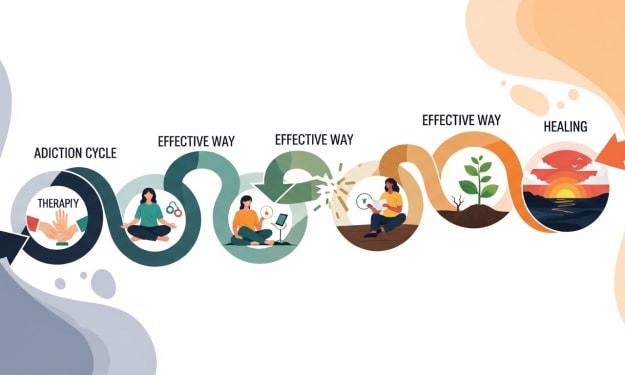
Effective Ways to Break the Cycle of Addiction and Start Healing
Addiction can feel like a repeating cycle that is difficult to escape. Many individuals struggling with substance use experience patterns of cravings, temporary relief, and relapse that can make recovery seem overwhelming. However, breaking the cycle of addiction is possible with the right support, treatment strategies, and long-term commitment to healing.
By Jordan Blake5 days ago in Psyche



Comments
There are no comments for this story
Be the first to respond and start the conversation.