
Chapter IV: The Fool’s Lament Beneath the Comet’s Eye
How the Jester’s Silence Screamed Louder Than the Ball’s Delirium — A Portrait of Foreseen Ruin

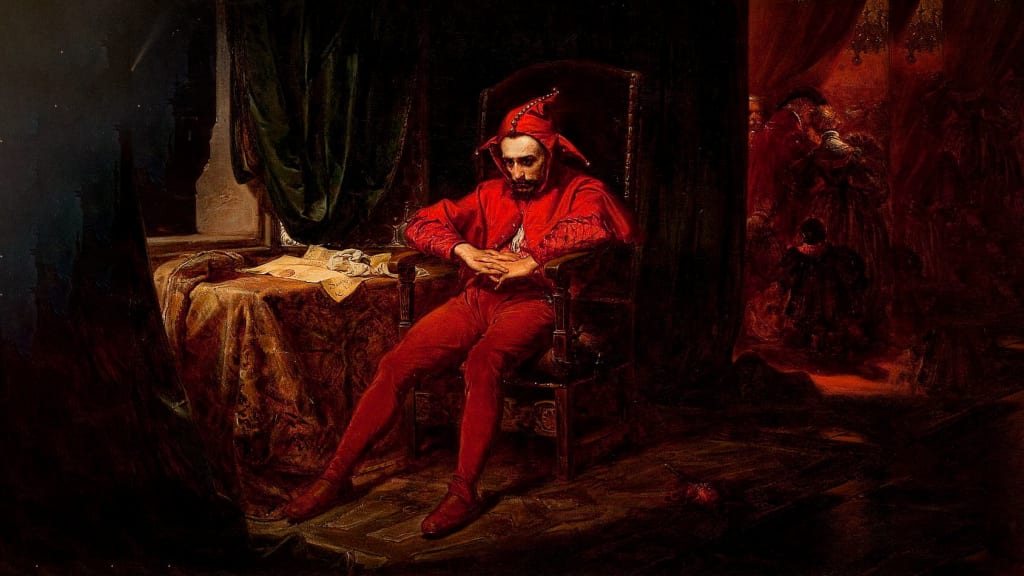
Kraków was engulfed in night like a heavy coat that thickened and resisted shedding, as if there were an invisible force rejecting all life around. Inside a chamber dark as the depths of a comet’s tail spilling through a window, glowing a faint grey, sat a man alone. His clothes were a strange mixture of bright red and black, adorned with jingle bells that rang out laughter, as though whatever once caused them to do so was simply an echo now devoid of sound. This man was Stańczyk, the court jester, yet the expression on his face was anything but jovial. He appeared astonishingly forlorn, his haunted gaze lost deep within the throes of a letter weightily spread open on the table before him. All Stańczyk could notice was a broken, worn wax seal that appeared flaccid like human desire, and the letter whispered softly with the simple phrase 'Smolensk is lost.'
Just past the door, muffled sounds of joy and unwavering noise were transformed into a swirl of noise—a lutes' right hand plucking yellow-hair girls' laughter and goblets clinking, coming from the Ball, unconscious of the comet igniting the sky over Wawel Cathedral. Stańczyk gave no more than a slight longing to gaze back at the merriment of the Ball. Instead, he leaned forward in his chair, his spine bent in the shape of a question mark, compounded by the previous administration, as if he carried the weight of the entire kingdom on his shoulders. His hands, pale and shaking, clasped the edge of the table tightly, his claws pressing into the wood as if he were trying to find some semblance of stability in the conflicted, contradictory chaos coiled into a hurricane inside his mind.
"Does any of this even matter?"" scorned a voice in his head, harsher than his own, belonging to the young painter Matejko. Matejko had painted Stańczyk's soul, a secret neither had confessed, in the spirit of that sacred narcissism. ""You're only a fool,"" the voice croaked. ""You perceive too much, feel too strongly, and what can you do about it?"" Like putting a mirror in the face of putrefaction.
His gaze shifted to the window, where the comet's light poured into the room, and saw a small creature scurry past, clutching a lute. It was a dwarf—so contorted that the smile on its face felt like mockery. For a moment, Stańczyk perceived the significance of that picture: the dwarf represented Poland, haggard and woebegone, holding on to the spectre of its former greatness, while the court danced heedlessly and feasted upon the remnants of their once-future.
He clamped his eyelids shut, and it felt as though the enveloping darkness congealed until it took on a palpable quality almost like they were alive. The memories remained abrupt flickering images in the coils of his mind: Sigismund’s bell ringing out, Prussian envoys leering with puffed smoke-saturated breaths, the Queen’s fingers—cold as ice and laced with treachery—tracing the maps of territory that were quickly slipping away from their grasp. In his mind floated dates, years like 1514 and 1533, and yet there was nothing there; they held no meaning whatsoever. The temporal reality is a liar, waiting for kings to not take their crown. The dates on that letter capsule of notation meant nothing, for the truth has not lived there for a long winter. The truth is of the earth and draped here in the confines of his room with this heavy silence.
A loud burst of laughter broke through, and Stańczyk flinched. There had been a time when it was Stańczyk on the other side of that roaring laughter feeling like a heaving engine of warm air, cracking jokes like a butcher cracking meat. He would say things like, Life is like a slice of bread – only edible when topped with and coated in a nice layer of butter. But now it made him want to gag. To laugh in the face of calamity – come on, really? Wasn't that betrayal? Maybe even the definition of surrender?"Why aren't you out there joining them, fool?" the dwarf spat out like a cow swatting a pesky fly with its tale for that mattered. "You should be dancing! Singing! Does the world not seem like one almighty joke to you?"Stańczyk did not reply. His throat felt worn and sore from holding on to a welter of words that wouldn't come out. It wouldn't matter; even if he said something they would not hear him. They had ears only for semi-heraldic music.
On the corner, the mirror captured the comet's light, and in that moment, his reflection changed. No longer the jester, he was a young guy with his hair messy and skinny frame, holding a paintbrush instead of a scepter. It was Matejko, looking back at him, dark deep eyes like ink. "You see, we are the same," the painter seemed to say. "You bear my despair as well as I bear yours. Seeing the darkness and feeling you must paint it, must laugh about it, is its own burden."In later years, academics dubbed it the Sad Clown Paradox. Stańczyk's spirit was laid bare and uncaring for social conventions under the jester's mask. His lips moving were not in laughter, but in a shared understanding. How many nights had Matejko endured at the easel, channeling his own loneliness into Stańczyk's form? How many times had he asked if painting was just another act, another scream into the unrelenting void?
As the comet slipped beyond the horizon, dawn began to rise softly, almost gray, though the gathering did not pause its revelry, loud and obnoxious.Stańczyk heaved himself up, creaking as he did so and moving awkwardly like an old tree, headed towards the window, his shadow swallowing the room. Outside, the Vistula River spooled through the city, blue black like a stream of ink. Tusking past it, Smolensk burned, and it was torn, the future was torn.He did not weep. Tears were the province of men who held onto hope. Instead, he yielded to the heavy silence, a silence that no joke could breach.And there, in that heavy silence, the tune mourned for Poland began.
About the Creator
LUCCIAN LAYTH
L.LUCCIAN is a writer, poet and philosopher who delves into the unseen. He produces metaphysical contemplation that delineates the line between thinking and living. Inever write to tellsomethingaboutlife,but silences aremyway ofhearing it.
Keep reading
More stories from LUCCIAN LAYTH and writers in Psyche and other communities.
Chapter XVII: The Sovereign of Shadows
The wind shrieked, calling me through the hollow arches of my empire, and shared the whispers of those from which I had long departed. They did not capitulate, they did not bend the knee—those stubborn flames in their unyielding commitment who were steadfast in grisly devotion to my cause even while I drifted into infinite nothingness. I stand now before the stripped down bones of my empire, their magnificence reduced to chambers of resonating echo and thrones of dust. *Why have I returned?* The question coils in my heart like the serpent of eternal regret. Perhaps it is the burden of promises I once scarred into the flesh of memory now bleeding through the cracks of time. Or perhaps it is the truth that solitude, even from this frayed kingdom, is a reprieve from the honeyed mumble of humankind. Humanity—how shameless a pantomime! They murmur constantly of virtues they loathe, and in the very next breath, dive into the sins of their own disdain. Their laugh, a knife—that roasts, and their kindness, a mask stuck to rotten flesh. I have tasted their "compassion," a goblet of vinegar, and spit it back into oblivion. They are the architects of their own suffering, bringing offerings of opinions about the innocence of gutting like lambs to a slaughterhouse. Weakness masquerades as strength in their world—a monstrous breeding from the bones of gentle chitterers.
By LUCCIAN LAYTH12 months ago in Psyche
Broken Pieces
It's been almost three months. I tried to fall for you slowly, easily, so I could protect my heart. Those attempts failed. You are so kind, considerate, and empathetic. I felt that when you looked at me, you saw me all the way to my soul. The physical attraction was immediate and intense. Two lost and broken souls just trying to find their way home. The first time I looked into your sky-blue eyes, I saw sadness, I saw exhaustion, and the vast emptiness that comes from just giving up. However, in each other, we found hope. I could see that spark of hope in your eyes. That you wanted this to be real just as much as I did, something to hold onto, something true, something that could last a lifetime and not just until things got too hard. We moved in together pretty quickly due to life and circumstances. Honestly, we needed each other to hold on to at night. I know now that your life has been riddled with demons, pain, depression, anxiety, ptsd and so many triggers from your past. You have never been given the right mental tools to move through your pain and torment. So, you have just remained silent and swallowed your pain. No one should have to hold that much pain alone. It has been a task trying to help you, but also hold space for my own well-being, but I want you to know that you are worth it to me. You are not too broken and will never be too broken. I want to show you that I can hold space for both your mental health and my own. We both have so much going on in our minds, and we both try to hold each other up as best we can. When your demons come out to play, I try to slay them or at least make them shut the fuck up, and you do the same for me. We can hold each other, cry, scream at the world, go break shit together, or just sit in silence. I'm trying to learn what you need in your moments of mental health crisis, and I can tell you're trying to learn what I need as well. Have you ever heard of the term "hot mess"? That describes us perfectly. But we are perfectly imperfect. I am your Juliet, and you are my Romeo, as cheesy as that sounds. I swear we're going to be okay. I swear we're going to get healthy together. I've already done some work myself, but we are a team now, and we have to work together. I'm not leaving you. Where you go, I go, together forever. Mental health is a cruel mistress that holds no prisioners. You are such a beautiful soul that has come into my life, and you've helped me in so many ways. You help add structure in my life, you help with my daughter, you're my friend I can talk through my day and emotions with, my partner I can figure out life with, my lover, when I can't breathe because of a panic attack, you hold me and talk me through it. I wouldn't go back to being alone. I want you, all of you, even the broken pieces, because you take me and my broken pieces. Life is full of broken pieces, but what makes it better is to find that special someone who will hold both you and your broken pieces and still say I love you no matter what.
By Lindsey Altom7 days ago in Psyche


Comments
There are no comments for this story
Be the first to respond and start the conversation.