
The Forgotten Guardian of the Mountains
The remarkable story of Lal Pari, a woman who carried hope across the snow


Introduction: The Silence of History
History is often obsessed with the loud and the visible. It records the names of generals who conquered nations, politicians who drew borders, and poets who sang to crowds. But there is a different kind of heroism, one that exists in the absolute silence of the world’s forgotten corners. It is a heroism that seeks no applause and leaves no statues.
Today, we turn our gaze to the high, frozen frontiers of Pakistan, to uncover the life of an unsung hero. She was a woman whose quiet courage did not just change lives—it saved them by the hundreds. Her name was Lal Pari.

To many, the name is unfamiliar. But in the remote valleys where the earth meets the sky, that name is whispered with a reverence usually reserved for saints. Her story is not just a biography; it is a testament to the endurance of the human spirit against the harshest elements on the planet.
The Isolation of Shimshal
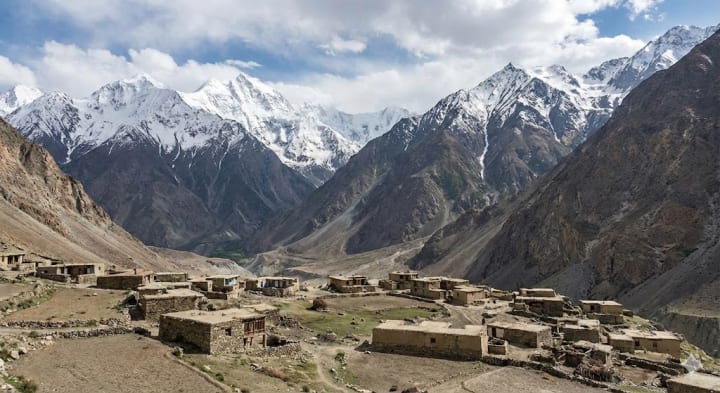
To understand Lal Pari’s sacrifice, one must first understand her world. She belonged to Shimshal, a village nestled deep within the Hunza Valley of Gilgit-Baltistan. It is a place of breathtaking beauty, where jagged peaks pierce the clouds, but it is also a place of unforgiving isolation.
In her time, Shimshal was a small community of roughly two hundred modest homes, housing a population of about twenty-five hundred souls. It was a world cut off from the conveniences of the modern age. There were no hospitals. There were no surgical theaters. The medical facilities were almost nonexistent, consisting of a single dispenser for the entire population. Even today, the region remains so harsh and inaccessible that doctors refuse to be stationed there.
For a pregnant woman in Shimshal, this isolation was not just inconvenient; it was terrifying. Complications during childbirth didn't mean a trip to the emergency room—they often meant death.

A Choice That Changed Everything
In the face of this grim reality, Lal Pari made a decision that would alter the destiny of her people. She refused to let the women of her valley suffer alone. She resolved to become their guardian.
However, the knowledge she needed was not available in Shimshal. To gain the basic medical training required to assist in childbirth, she had to travel to Hunza. This was not a simple commute. This was an odyssey.
Reaching the Karakoram Highway from Shimshal required a grueling three-day trek on foot. These were not paved roads, but treacherous goat paths winding through dense forests and clinging to the sides of rocky, unstable mountains.
The Burden on Her Back

Picture the scene: The air is thin, making every breath a struggle. The temperature plunges well below freezing as the sun sets behind the granite peaks. Lal Pari is walking. She is not alone; her husband is by her side, guiding a horse laden with their meager supplies.
But Lal Pari carries the heaviest burden of all. Strapped to her back, wrapped in layers of wool against the biting wind, are her two young children.
She walked for hours, day after day. She later recalled moments where the physical agony was so intense that tears would stream down her face, freezing on her cheeks before they could fall. The cold gnawed at her bones. The path was slippery with ice and threatened to crumble into the abyss below with every step.
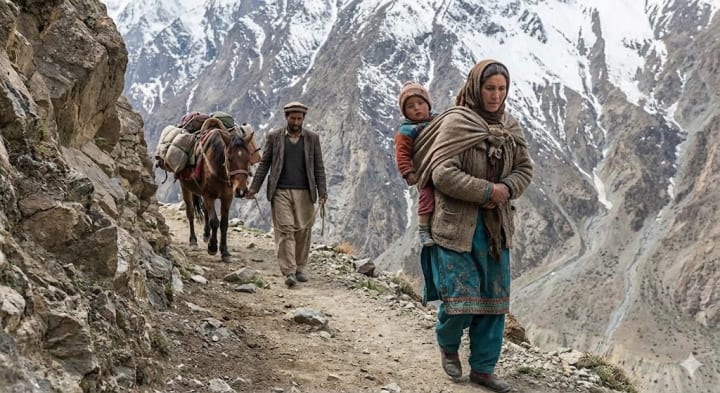
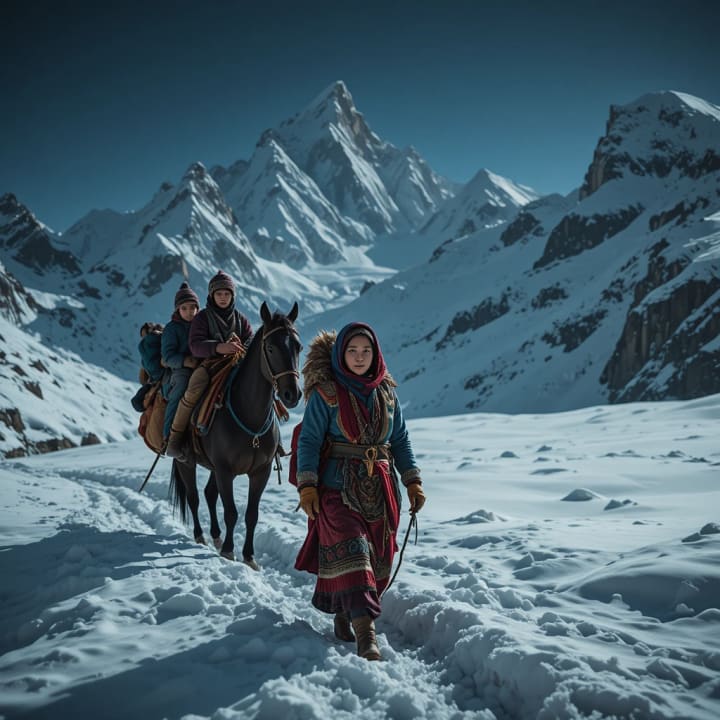
Yet, she never turned back. She kept moving, one painful step after another. She kept moving because she knew that somewhere far ahead, back in the frozen isolation of her village, a mother was waiting in fear. Lal Pari walked so that others wouldn't have to grieve.
The Miracle of the Valley
Upon completing her training, she returned to Shimshal, transforming into a beacon of hope. For decades, she traversed frozen rivers and climbed dangerous cliffs to reach homes where labor pains had begun.
The statistics of her career are nothing short of miraculous. In a region with zero modern medical infrastructure, under conditions that would terrify a modern obstetrician, Lal Pari assisted in seven to eight hundred births.
In a world where maternal mortality is a tragic reality, her record stands as a defiance of the odds:
Not a single mother died under her care.
Not a single newborn was lost.
It is a record of perfection that defies medical probability. When asked how she achieved this impossibility, how she managed to safeguard so many lives with nothing but her hands and her training, she refused to take credit.
She would simply look down, her face weathered by the mountain sun, and say, “Maybe the people were lucky, or maybe God was kind.”
Conclusion: A Legacy of Humility
There was no pride in her voice. No demand for recognition. Just a profound, quiet humility.
When you reconstruct her story in your mind, a powerful image takes shape. You see a woman who possessed the stillness and strength of the mountains that surrounded her. Her personality stood taller than the 7,000-meter peaks of the Karakoram.
In a world that celebrates celebrities, generals, and influencers, Lal Pari reminds us of what true greatness looks like. Her courage outweighed that of any soldier; her compassion ran deeper than any poet's verse.
We never celebrated her name while she was active. We never gave her the global stage she deserved. But her legacy lives on in the eight hundred beating hearts of the children she brought safely into the world, and the hundreds of mothers who lived to raise them.
Lal Pari was extraordinary. May her soul find the same peace she brought to so many others, and may her story inspire a new generation to walk with the same courage, compassion, and resilience across the snows of life.
🧠 Learning Review
To reach this length and depth, we used three specific narrative techniques. Which of these do you think added the most value to the story?
Atmospheric Contrast: Describing the beauty of the mountains against the brutality of the cold.
Physical Empathy: Focusing on the pain of her walk (the tears freezing, the weight on her back) to make the reader feel her struggle.
Scale of Impact: Framing the "zero deaths" statistic not just as a number, but as a miracle.

About the Creator
Salman Writes
Writer of thoughts that make you think, feel, and smile. I share honest stories, social truths, and simple words with deep meaning. Welcome to the world of Salman Writes — where ideas come to life.
Keep reading
More stories from Salman Writes and writers in Pride and other communities.
When the People Only Took the SLAPS…
Once upon a time, in a vast and ancient kingdom, there lived a king. He possessed all that a ruler could ever desire: a shining golden crown that sparkled in the sunlight, a grand throne carved from the rarest wood, and a palace whose marble halls echoed the footsteps of servants and soldiers alike. His empire stretched far and wide, and thousands of people bowed before him, offering loyalty and obedience.
By Salman Writes2 months ago in Motivation
Thailand girl boy
Thailand, often called the “Land of Smiles,” is celebrated worldwide for its breathtaking beaches, vibrant street food, and rich cultural heritage. Yet, one of its most profound and culturally significant facets is its unique and accepting perspective on gender diversity. The phrase Thailand girl boy often points to the country’s famous kathoey or “ladyboy” community, but this only scratches the surface of a deeply nuanced social landscape. This article delves into the history, culture, and modern realities of gender diversity in Thailand, offering a respectful exploration of what makes this aspect of Thai society so remarkable.
By David Femboy3 days ago in Pride
What state has the most femboys
In the vibrant tapestry of American society, expressions of gender identity and presentation continue to evolve, challenging traditional norms and embracing a fuller spectrum of self-expression. Among these expressions, the term “femboy” has emerged in popular culture, referring typically to individuals who identify as male but embrace feminine presentation, style, or mannerisms. A curious question often arises in online communities: What state has the most femboys? While this query seems straightforward, the answer opens a deeper conversation about visibility, community, and the geographic hubs of progressive gender expression.
By David Femboy6 days ago in Pride
If You Love Me, You'll Do It
I met Jason when I was five years old. I could say that I loved him from the moment I saw him. He was so handsome to me and I felt in awe by his presence. When they introduced him as the new kid in school, I wanted to be his friend right away. I remember it like it was yesterday. I remember his smile and how he didn't seem shy. He appeared confident and ready to learn. I waved at him and said "hello," before anyone else could even say a word. He sat next to me, and I asked him if he wanted to be friends. He looked so happy as he said, "Yes!"
By Sidney Smith (Sid Smith)6 days ago in Fiction




Comments
There are no comments for this story
Be the first to respond and start the conversation.