
The Empty stomach of lion.
When Hunger Roars Louder Than the King’s Pride
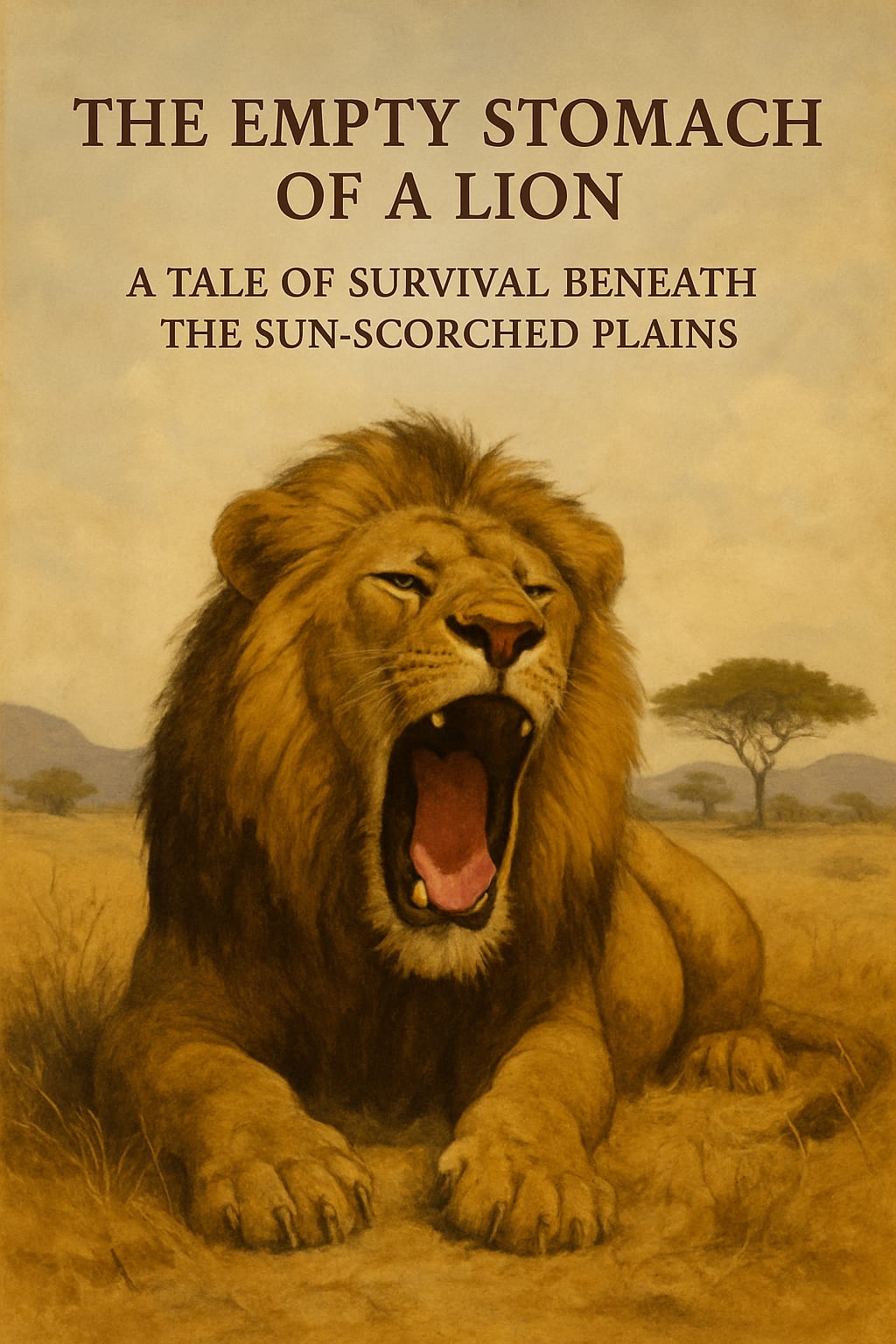
In the heart of the vast, sun-baked savannah, a lion named Kovu wandered alone. Once the feared leader of the Roaring Pride, Kovu now walked with a limp and a sunken belly. His mane, once thick and golden, had begun to gray around the edges, and his ribs pressed against his skin like the bones of a broken cage.
For three days, Kovu had not eaten. The antelope had moved to greener pastures after the rains failed. The wildebeests, once plentiful, now migrated in distant herds. Even the warthogs, usually slow and unaware, had learned to keep their distance. Hunger gnawed at Kovu like a second predator — constant, cruel, and silent.
On the fourth day, he came to the dry riverbed, hoping to find some sign of life. Instead, he found the bones of what had once been a zebra, picked clean by vultures and hyenas. He sniffed the bones, but there was nothing left. His stomach growled, louder than his voice had in days.
A jackal emerged from the nearby brush, cocking its head at the lion. “You look thin, king,” it said with a smirk. “Lost your crown with your meal?”
Kovu didn’t answer. Pride was a heavy thing, and he no longer had the strength to carry it.
The jackal continued, circling the lion. “I’ve heard stories. You used to take down buffalo with your brothers. What happened?”
“My brothers are dead,” Kovu said flatly. “And the herds are gone.”
The jackal’s grin faded. Even it, a scavenger, knew the weight of loneliness.
That night, Kovu lay beneath an acacia tree, the stars above flickering like distant fires. He remembered the days when his pride lay around him — cubs playing, lionesses grooming, the warmth of kin. Back then, an empty stomach was rare. Now, it was all he knew.
The wind carried a faint scent — something alive. Kovu lifted his head. A herd of impala grazed in the distance, unaware of his presence. His muscles tensed. Despite his weakness, instinct surged. Hunger gave him a sudden strength.
Silently, he crept forward, one paw after another, through the tall grass. The herd remained calm, heads low. He got within striking distance, his body coiled like a spring. Then — a twig snapped.
One impala raised its head. Then another. In a flash, the whole herd scattered, bounding away in a blur of legs and dust. Kovu gave chase, but his legs betrayed him. He stumbled and fell, the effort too great. He lay in the dirt, panting, the world spinning around him.
When he opened his eyes again, the sky was lighter — dawn creeping in. A vulture circled above, already sensing weakness. Kovu let out a weak growl, but the bird was not impressed.
Just as the sun peeked over the horizon, Kovu heard a sound: a cry, sharp and frightened. He dragged himself to his feet and limped toward it.
Beneath a bush, he found a young antelope, its leg caught in a snare — a trap left by humans. It kicked and thrashed, eyes wide with terror. Kovu approached, and the antelope froze, knowing death had come.
The lion stared at it. Here was food — helpless, fresh. But as he stepped closer, something strange stirred in him. The antelope was a child. He saw his own cubs again, long gone, in its frightened eyes.
His empty stomach growled. His instincts screamed. But instead of biting, he reached down and used his teeth to pull at the snare. It took effort, but the rope eventually gave way.
The antelope leapt up, unsure, then darted away. Kovu watched it go, then collapsed beside the bush. Hunger overwhelmed him. He closed his eyes, knowing that he might not wake again.
But fate is a curious thing.
Later that morning, the same antelope returned, followed by its mother. They stood at a distance, cautious but curious. The mother looked at Kovu, then at her child. The young one stepped forward and dropped a few fruits from a nearby bush in front of the lion. Then they vanished into the grass.
Kovu blinked in disbelief. He sniffed the fruits. They were not meat, but they were food. Enough to give him strength.
Days passed. Kovu regained some energy, enough to move with purpose. He never saw the antelope again, but he remembered its eyes — the look of mercy, returned.
One evening, as he lay watching the horizon, he saw movement — lionesses. A small pride. They stopped when they saw him, cautious. One of them, younger and strong, stepped forward.
“You're alone,” she said.
“I am.”
“You hunt?”
“When I can.”
She looked him over. “You have the eyes of a survivor. Maybe we could use one.”
And so, Kovu rose again, not as king, but as something rarer — a lion who knew hunger, mercy, and the price of life.
About the Creator
Abdul Malik
I am a student and I am writing stories on vocal.media earn money and continue my study.
Keep reading
More stories from Abdul Malik and writers in Pride and other communities.
The Road to Success: A Journey of Determination and Growth
Once in a small town lived a boy named Arman. He was 16 years old, curious, and full of dreams. Arman came from a simple family. His father was a mechanic and his mother was a school cook. They didn’t have much, but they gave Arman everything they could—especially love and support.
By Abdul Malik8 months ago in Families
Punishment for greed
Dear children, this is a moral story about fairness, wisdom, and the importance of sharing. In a small village lived an old farmer with his two sons, Ahmed and Muhammad. Ahmed was clever and sharp-minded, while Muhammad was innocent, simple, and not very intelligent. The farmer owned only three things: a cow, a fruit-bearing tree, and a warm blanket. Though these possessions were few, they were very valuable for the family’s daily life.
By Sudais Zakwana day ago in Pride



Comments (1)
A wallah