
Finding My Ruling Identity
Celebrity Representative


The television screen is dark, with the outline of a performer standing on stage emitting through. Amongst the quiet cheers, popping sporadically, the iconic organ chord pours out of the speakers. “Dearly beloved,” the opening two words of the song greet the audience. They respond with a frenzied cheer. He goes through the whole speech talking about how life and crazy and the afterworld. One minute later, after instructing us to “punch a higher floor,” he dives into a guitar riff accompanied by the synthesized sounds of an electric keyboard. Purple lights flood the stage. He is majestic. Purple jacket, white laced bloused and high heels. Though the beat it rhythmic, I reach for the remote and quickly change the channel.
My mom is the first to speak, anger laced in her words.. “Hey, what are you doing?”
“I can’t stand him,” I say. Disdain painted on my face.
“It’s Prince. How can you not like Prince?”
“Everyone at school says he’s gay.”
“So what if he is?”
“They say I look like Prince. Everyone thinks I’m gay too.” I storm out of the room and into the sanctuary of my bedroom. I stare in the mirror hanging on my wall. Sure, our skin color is the same, and my hair is curly and black, very similar to Prince. I scoff at my image and dive into my bed.
How can people like Prince? His music is not that great. Michael Jackson is better. The great 80s debate inundating the school halls. The majority consensus is with Jackson. My vote cast to the king of pop because the Prince of pop creates a nightmare in my life. What is he trying to prove with his outfits on stage? Is he trying to be a man, a woman? What? There is no word to describe who he is. What he is. Everyone questions his sexuality because gender roles are strictly dichotomized, as they have always been. Men are like He-man: powerful, tough, strong. Women are Jem: cute, flashy, outrageous. Prince is neither.
I fall asleep, angry. Knowing the next day at school is going to be hell. I mentally prepare for the unescapable derogatory digs about my sexuality.
Mom walks in. She sits on my bed next to me.
“You know, they’re just jealous of you,” she whispers.
Jealous? Jealous of what, exactly? My lack of muscles? Of manliness? I doubt they are jealous of my facial features being similar to his Musical Majesty. I wish everyone would just shut up about him.
Prince. How can I choose to see myself in a person who I was unwillingly associated with throughout my childhood? Since elementary school, I spent a quarter of my life walking in his shadow. Constantly being compared to him. Having my sexuality questioned. He and I were the punchline in every gay joke I heard in high school. Yes, I hated the man. Similar to Jackson, I loved his music, but not the artist. How can he ever be the celebrity I feel who perfectly represented who I am?
I spent most of my life discovering who I am as a person, like most people. Depression submerged within during my traumatic childhood because I could not develop strong, deep connections with my peers. Why would I? They mocked my appearance and never looked beyond the surface to the person who I really am. It created self-hatred because I could not grasp my personal identity, which was like Prince. What was he? What am I?
It was during the mid-2010s; I realized I needed to change attitude towards myself. With the rise of RuPaul and the emphasis on self-love, it was time to face my depression head on. Who am I? What do I identify as? I began my journey of self-discovery with many blogs on gender and sexuality. However, the most beneficial came from a small blue app called Facebook. My research lead me to a facebook group called Genderfluid.
Where did this come from? What the hell is genderfluid? I knew the term androgenous and even metrosexual (which I felt I was neither). Eventually, sociologists speculated the perhaps Prince was genderfluid because he was fluid with his fashion choices.
I came to understand gender as a social construct. Powerful industries with clever marketing strategies impose fashion. Finally, there were a small percentage of people who embrace being outside of the binary. The nonexistent words of my teens finally appeared through multiple facebook posts. Maybe I was genderfluid. Neither hailing male, nor female. Comfortable bending the norms or fitting in both, while being in neither social role? Was that what Prince was in the 80s?
I cautiously donned the label, taking both a literal and figurative step into his heels. Despite the teasing and hazing I suffered in elementary school, I want to be as courageous and independent as Prince. Able to wear what I feel and ignore the scrutiny surrounding my choice. Unlike him, I lack the fame, finances, and liberty to do so. However, as new words entered our social vocabulary, spotlighting gender identity, I discovered my true self.
Presently, my animosity towards the purple donning performer vanished. I know Prince represented the person I wanted to be in the 80s. As I grew older, I secretly appreciated him as the kind-hearted person he truly was. He easily became what I aspired to become: inspirational to other artists. The threat posed to me in school when I was younger forced me to hide who I was. . I masked it under the expectations of what the 80s gender roles were. As an adult, I understand the intent of Prince’s fashion choices and music. It makes me proud that he was both my representation and inspiration to become my true, authentic self today. Because of his courageousness to stand out and be himself, we know so much more about gender identity today. It paves the road of acceptance for so many people in the future while washing away hatred with purple rain.
About the Creator
Iris Harris
An aspiring novelist. I enjoy writing ghost, horror, and drama. Occassionally, I dabble with some essays. You can find more of my work with the link below:
Keep reading
More stories from Iris Harris and writers in Pride and other communities.
Transformative Row
You row slowly over the sparkling crystal blue lake. Every muscle straining to pull further away from the shore. A cool breeze tussles your brown, curly hair. You grin at the ticklish touch. The row boat gradually comes to a halt, suspended by a light current of the waters below. You stare into the sky. Admiring how the boat is drifting towards no particular destination. Silence encases you. Lost time. You furrow your eyebrows. There is something on your mind. Words that want to escape through your lips.
By Iris Harris2 years ago in Pride
The Pride Flag and the Diversion
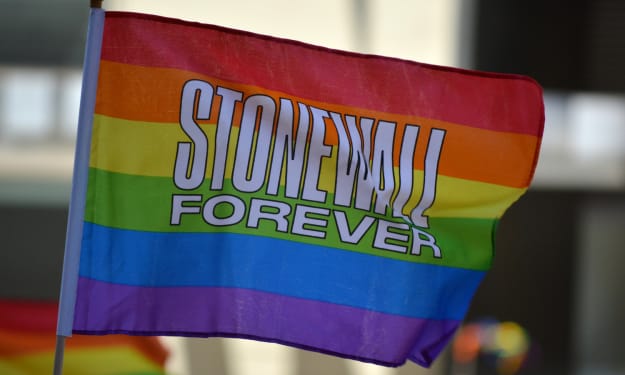
For nearly a decade, the LGBTQIA Pride Flag rippled in the wind at Christopher Park, a kaleidoscope of color staked into the soil of America’s first national monument to LGBTQIA+ liberation. That flag came down this week. Federal officials, citing new guidance from the Trump Administration, silently lowered the rainbow flag from its pole across the street from the Stonewall Inn. The birthplace of the modern gay rights movement now flies only the United States flag.
By Tim Carmichael22 days ago in Pride
I wanted to title this something different, but worried that my chosen title might cause problems entering the United States in the future so this is the new title. It's the greatest title. No one has ever written a title better than this. (All titles unrelated to content).
Let me be honest. I am finding this difficult. Now, I like a challenge, a stretch, a bit of an obstacle course. “Write about the decline of the British Empire in the form of a narrative poem in which your protagonist is an artichoke” I read, and flex my fingers. “Write a haiku to evoke the sensation of sibilance using only the first half of the alphabet.” “Well”, I think to myself, “this should be fun.” But “write about a system that isn’t working”? A system that isn’t working? Now? In 2026? ONE system? My favourite system that isn’t working? The sexiest system that isn’t working? The one giving me the most angst day to day? The one giving me the most existential dread? I am, as I say, finding this difficult. I will own that I have contemplated writing a thousand words on why the steady “all on” setting on my fairy lights is the EIGHTH of seven options which must be sequentially activated to get there, because that is a system that some fool came up with and it definitely doesn’t work, and now who is paying the price, eh? But how can I write about my fairy lights when…. When…. When….
By Hannah Moore7 days ago in Humans


Comments (2)
well done
Heartfelt and inspirational!