
Daria Morgendorffer: The Ace-Coded Icon I Never Knew I Needed
Daria Morgendorffer from MTV's 'Daria' was the ace-coded character I never knew I needed.

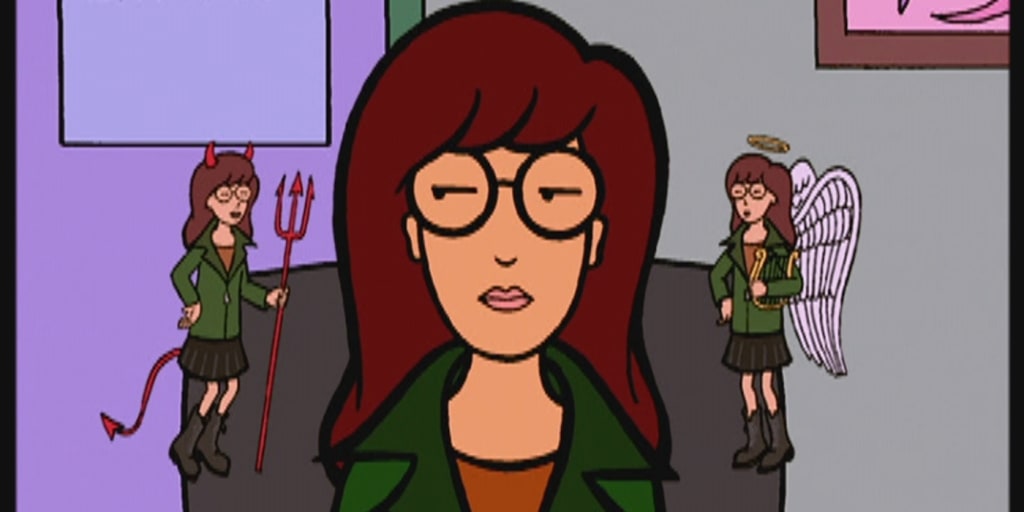
When I think about asexual representation in media, the first character that always comes to mind is Daria Morgendorffer. Watching Daria for the first time felt like staring into a mirror—her cynicism, her sharp wit, and her disinterest in romantic entanglements echoed so much of what I had felt my whole life. She wasn’t detached or emotionless, she simply didn’t care about the things that seemed to consume everyone else around her—things like dating and sex. For the first time, I saw a character who reflected the way I move through the world, and it was profoundly validating. It was in Daria Season 1, Episode 13 "The Misery Chick" that I realized Daria was a character I didn't know I needed; she's not a misery chick, she just not quick to emotions like most people are, and that's okay.

I’ve never struggled with societal pressure to conform. From a young age, I was comfortable in my own skin, and I’ve always known who I am. When situations with potential partners came up, I didn’t hesitate to tell them that I’m ace. I don’t feel the need to explain it or justify it. It’s not that I lack self-esteem—I just have low esteem for everyone else, as Daria would say.
But seriously, it’s never been an issue for me. I’m not actively against dating or romance; it’s just not something I seek out. The thrill that excites so many of my peers simply doesn’t resonate with me, and I’m okay with that. When I do find myself drawn to someone, it’s not because I’m sexually attracted to them—it’s because I’m intellectually stimulated by them. The highest form of intimacy for me is a deep, intellectual connection, where we can talk for hours about everything and nothing. But that never translates into sexual attraction.
Asexuality on the Spectrum
Asexuality, like all identities, exists on a spectrum. For some ace people, romantic or even sexual entanglements are tolerable, often for the sake of a partner, but those things aren’t actively sought out. That’s a reality for many on the ace spectrum, but it’s never been mine. I’ve never felt the need to fill a void with a partner. I’m perfectly content with myself, and I consider myself my own true love. If someone were to come into my life, they’d have to fit seamlessly into it. But until then, I’m perfectly happy with the intellectual and emotional connections I have with my friends and the world around me.

Because of that, it was disappointing to see Daria’s storyline shift toward a relationship that caused a rift between her and Jane. I always imagined her as ace, or at least someone leaning in that direction. For her to get involved in romantic drama felt impulsive and out of character. Although things worked out in the end, that storyline never sat right with me.
Breaking Free from Misconceptions

Asexual people often face misconceptions. People assume we’re cold, unfeeling, or somehow robotic. Characters like Sherlock Holmes only reinforce the stereotype that ace individuals are detached or emotionless, but that couldn’t be further from the truth. In fact, the intellectual and emotional bonds I form are the highest form of intimacy for me. I have deep, meaningful friendships that enrich my life far beyond what mainstream society deems necessary for happiness.
There’s no void in my life because I’m not seeking romantic relationships. I’ve always found it easier to identify as ace rather than explain to people why I’m not dating. When someone asks why I’m not pursuing a relationship, it’s like they expect me to feel like I’m missing something. But I don’t. I’m not. I’m content with where I am and who I am.
Intellectual Attraction vs. Romantic Pursuits

The few times I’ve felt “smitten” by someone, it’s never been sexual or romantic attraction. It’s always been intellectual. I’ll come across someone with a fascinating mind or an outlook on life that challenges me, and I feel a strong pull to know them better. I’m drawn to their thoughts, their ideas, the way they see the world. For me, intellectual stimulation is the highest form of intimacy, but that pull has never once led me to crave physical intimacy with them. In fact, when things have started to get serious with someone, I’ve made it clear upfront that I’m ace.
The media would have us believe that romantic and sexual relationships are the ultimate goal for everyone. But that’s not the case for people like me. We can have deeply fulfilling lives without ever seeking out those experiences. The narrative that ace people are somehow broken or incomplete without a romantic partner simply isn’t true. Some ace individuals may still enjoy romance, while others, like me, prioritize intellectual and emotional bonds. What we need is more representation in media that reflects these diverse experiences.
Living Life on My Own Terms
When I was younger, people assumed I was somehow "abnormal" because I didn’t have crushes like everyone else—or if I did, they were usually on fictional characters. That part is true, but the reality was my crushes didn’t have any romantic undertones. It was more about admiration, what the ace community might call a "squish" (though I still prefer calling it a crush).
In high school, much like Daria, I was pretty involved. During my third year, I was the Vice President of the student council, competing in science quiz bees, and active in campus journalism. On weekends, I practiced taekwondo—not to become a champion (although I did compete once at a Mayor’s Cup)—but mainly to stay fit and learn self-defense.
One day, this somewhat popular guy, who I’d known since elementary school, joked in front of his girlfriend that he would’ve “courted” me if I wasn’t “manlier” than him. Without missing a beat, I responded, "Who said I would’ve wanted you?" Everyone laughed—even his girlfriend—and he was caught off guard. I knew he meant it as a joke, which is why I fired back with humor, but that moment gave me insight into how people, especially male peers, saw me.
For most women, I’m just like them—into fashion, geeky interests like the paranormal, and unapologetically myself. But for some of my male peers, I was a "domineering," "emasculating" personality. Was it because of my jock side? Maybe, but I’d lean into that masculine energy sometimes just to poke fun at the stereotypes.
Back then, I didn’t have the language to express that I might be on the ace side of the queer spectrum, and even if I did, I doubt it would’ve made much difference. I’ve never felt tied to any specific gender, though I’m keenly aware of how I present and how I can use that to my advantage.
If someone were to ask about my sexuality or romantic preferences, I’d say I’m just "me." I’ve never felt more or less myself, regardless of gender. And if I ever find myself drawn to someone—like I once was with this magnetic manic pixie dream girl I spotted in a train station—it wouldn’t matter what gender they were.

But all of this is a very long-winded way of saying that Daria has always been an important representation for me because, like her, I never fit neatly into society's expectations or labels (even if she wasn't explicitly stated to be ace). She embodied a sense of independence and nonconformity that I related to deeply. Daria wasn't concerned with fitting in, dating, or following the same path as her peers, and that’s a lot like how I’ve navigated my life. She showed me that it’s okay to carve out your own identity, to be cynical and self-aware in a world that constantly tries to define you.
Through Daria’s lens, I realized it’s not necessary to mold myself to societal expectations, and it’s more than okay to just be—even if it means embodying whatever traits people think don’t “fit” together. Daria’s wit and quiet rebellion gave me permission to embrace my own complexities, to laugh at the absurdity of people’s perceptions, and to confidently say that I’m simply me—not "the misery chick".
About the Creator
Karina Thyra
Fangirl of sorts.
Twitter: @ArianaGsparks
Keep reading
More stories from Karina Thyra and writers in Pride and other communities.
The Pride Flag and the Diversion
For nearly a decade, the LGBTQIA Pride Flag rippled in the wind at Christopher Park, a kaleidoscope of color staked into the soil of America’s first national monument to LGBTQIA+ liberation. That flag came down this week. Federal officials, citing new guidance from the Trump Administration, silently lowered the rainbow flag from its pole across the street from the Stonewall Inn. The birthplace of the modern gay rights movement now flies only the United States flag.
By Tim Carmichael25 days ago in Pride
Tatt~Master
— Assembly Line Tatt Machine ~ Impressions to Impress — As I begin to understand more about the Tattoo Phenomenon. I've written silly, yet verbatim, dating site anecdotes in 'Frazzled.' So let me ask you: Would you be More attracted to someone slathered with tattoos, or Less?
By Jay Kantor7 days ago in Humor



Comments (1)
lovely really love this