

She started in Nashville with a guitar almost too big for her and songs written like letters you never send. Back then, nothing truly set her apart from the countless other young artists trying to carve out a space in the American country music scene—except for one rare intuition: that music alone wasn’t enough. By 2026, Taylor Swift is a billionaire, a cultural entrepreneur, a narrative strategist, and an indirect yet potent political influencer. The contrast is striking—but it would be misleading to see this as just another success story. Her journey reveals something deeper: the emergence of a new kind of power—diffuse, emotional, yet extraordinarily structured.
From the very beginning, Swift understood that the modern artist can no longer simply produce songs; they must produce meaning. In Nashville, she learned the rules of an old system—but more importantly, she studied its cracks: the dependence on record labels, the loss of ownership over one’s own work, the growing distance between creators and their audiences. So she chose a different path—one slower, more demanding, but ultimately more solid: building a direct, intimate, almost contractual relationship with her listeners. Her songs became fragments of lived experience; her albums turned into chapters; and her entire career evolved into a continuous narrative in which millions saw themselves reflected. By 2024, when her net worth officially crossed the billion-dollar mark, that number wasn’t a flashy climax—it was the logical outcome of a strategy built on consistency, longevity, and mutual trust.
Between 2025 and early 2026, Taylor Swift reached a form of cultural sovereignty rarely seen in the entertainment world. She no longer structurally depends on the music industry; instead, she uses it. That’s the key to her power. She is no longer a product of the system—she’s an anomaly that exposes its limitations. This position allowed her to carry out one of the most significant gestures in contemporary cultural economics: the Taylor’s Versions project.
Beginning in 2021 but reaching full force in 2024 and 2025, this initiative involved re-recording her first six albums to reclaim control of her master recordings—sold without her consent to a private equity firm. On paper, it was a legal battle. In practice, it became something far more powerful: a collective narrative. Listening to these new versions became an act of solidarity, almost a symbolic vote. Each release turned into a global event, proving that a work doesn’t belong solely to whoever holds the legal rights—but to those who carry it emotionally.
This move resonated far beyond music. It sent a clear message to an entire generation of creators: value isn’t fixed in a contract; it’s built through relationships. By 2026, Taylor’s Versions were being studied not just in marketing courses, but also in law schools and sociology departments. Swift didn’t just get her songs back—she redefined what it means to “own” a creative work in the age of streaming platforms and algorithmic culture.
This logic reached spectacular dimensions with The Eras Tour. As early as 2023, the tour was billed as a celebration of every phase of her career. But by 2024, it had become a full-blown cultural and economic phenomenon. Cities hosting the concerts reported economic impacts comparable to major international sporting events. Hotels booked out weeks in advance, public transport overwhelmed, local businesses thriving—the term “Swiftnomics” entered mainstream economic discourse, even appearing in government reports.
Yet reducing The Eras Tour to an economic success would miss the point entirely. At its core, the tour is a staging of collective memory. Each “era” corresponds not just to a phase in Swift’s life, but to a chapter in the lives of her audience. The teenage girls who cried to Fearless in 2008 are now women in their thirties—and every song performed live reignites precise memories, old heartbreaks, long-forgotten hopes. The concert becomes a ritual, almost a pop liturgy, where millions replay their own emotional histories.
In a cultural landscape still scarred by the pandemic—marked by isolation, fragmentation, and distrust toward institutions—Swift offered something rare: a total spectacle that is profitable, emotionally rich, and entirely artist-controlled. She proved that it’s still possible to create globally unifying events—as long as you offer more than mere entertainment. You have to offer meaning.
It’s precisely this capacity for mobilization that pushed her influence into the political sphere starting in 2024. Until then, her activism had been subtle—woven into lyrics or limited to occasional statements. But as her audience matured and her cultural authority solidified, she chose to speak openly. Her support for LGBTQ+ rights was no longer subtext; it became central to her public identity. She used her platform not just to express beliefs, but to give visibility and safety to marginalized communities.
That same year, her explicit endorsement of Kamala Harris marked a turning point. For the first time, a pop star of this magnitude willingly positioned herself as a player in the American political conversation. In a deeply polarized country, this choice was anything but neutral. It meant taking sides, risking part of her audience, and abandoning the illusion of neutrality that many celebrities cling to.
The backlash came swiftly. In September 2024, Donald Trump posted a now-viral message: “I HATE TAYLOR SWIFT.” Beneath the crude phrasing lay a deeper truth: the fear of a cultural figure capable of mobilizing a youth demographic that traditional parties struggle to reach. When Trump returned to the White House in 2025, conservative media outlets routinely labeled Swift a “major cultural opponent.” She held no office, led no party—but her influence was real, measurable, and, crucially, impossible to control through conventional political channels.
What’s remarkable is how she handled this new role. She refused the posture of the perpetual activist. Instead, she chose her moments—her silences as carefully as her speeches. This strategic restraint allowed her to maintain her artistic credibility while wielding diffuse but potent political influence. By 2026, she embodied a new archetype: the cultural actor who can shape public discourse without becoming a politician, who can mobilize without an apparatus, who can unsettle without holding formal power.
This is where an illuminating comparison emerges. One might be tempted to see Taylor Swift as a modern, global counterpart to Coluche in 1980s France. The comparison may seem surprising, but it’s intellectually fruitful. Beyond entertainment, both shared a rare ability to mobilize people directly—bypassing traditional political structures.
Coluche used humor to expose the absurdity of power. Swift uses storytelling, emotional identification, and mass loyalty to build community. Both represent the paradoxical figure of the outsider who becomes so powerful that the system has only two options: try to discredit them—or learn to fear them.
Swift’s advocacy for LGBTQ+ rights fits perfectly within this logic of coherence and calculated risk. She accepted the possibility of losing part of her audience in order to strengthen a core base deeply committed to shared values. While brands and celebrities often seek neutrality to avoid backlash, Swift chose clarity. This wasn’t cynical calculation—it was a natural extension of her artistic identity. Her songs have always been about love, rejection, resilience. Standing with those who experience these emotions under conditions of discrimination isn’t a departure—it’s continuity.
In 2025 and 2026, this stance reinforced perceptions of her sincerity and transformed her concerts into symbolically safe spaces for many young Americans. This dimension—often overlooked in economic analyses—is central to the durability of her influence. Because what brings people together isn’t just the music, but the sense of belonging to a community that shares common values.
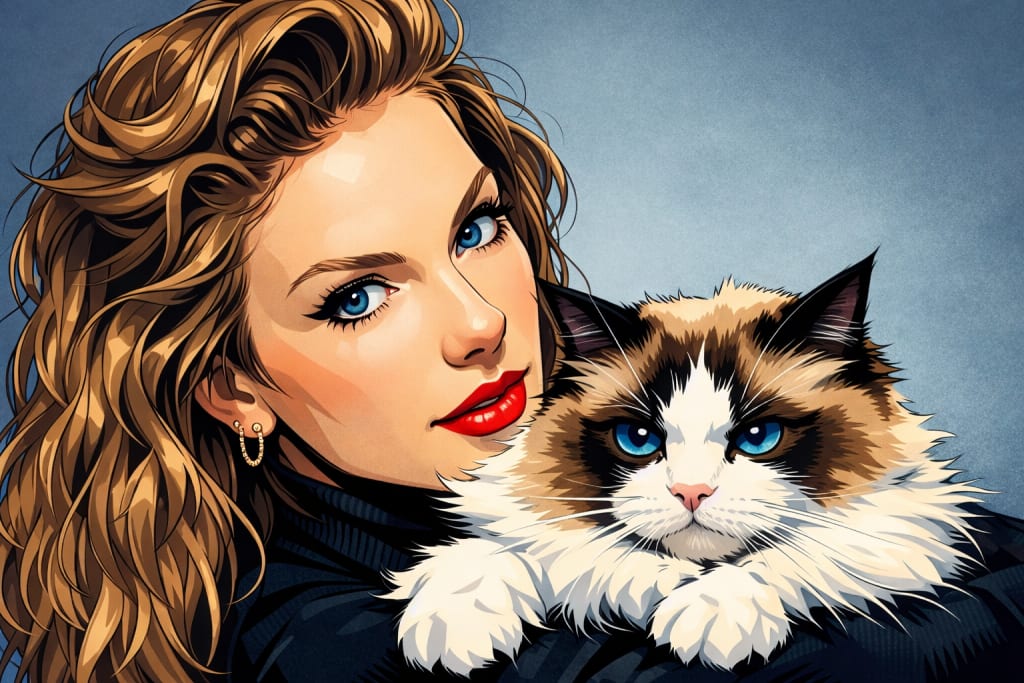
This article is part of a broader creative effort, accompanied by a series of animated comic illustrations designed to highlight the mythological quality of her career. This choice is deliberate. Comics can visualize what music only suggests: a modern heroine navigating industrial, media, and political trials. In these panels, she appears vulnerable at times, triumphant at others—always in motion. By 2026, this blending of formats reflects an era where information, art, and storytelling increasingly merge. The boundaries between journalism, fiction, and cultural analysis have grown porous—and Swift, as a subject, embodies this fluidity perfectly.
Ultimately, Taylor Swift is no longer just a pop star. She is a total case study. Her journey—from Nashville to billionaire influencer—illuminates a profound transformation: we now live in a world where influence is measured not only in sales or streams, but in the ability to shape collective narratives, guide behavior, and mobilize communities.
What unsettles the giants—industries, platforms, political powers—isn’t just her wealth or popularity. It’s her mastery of cultural codes, her strategic intelligence, and her enduring identity as a storyteller. She knows people don’t just buy songs—they buy pieces of their own story. And by giving those pieces back, rewritten on her own terms, she’s not only rebuilding her legacy—she’s rewriting the rules of the game.
Taylor Swift is not a passing anomaly. She is the advanced symptom of a new age of cultural power—an age where emotion becomes strategy, storytelling becomes infrastructure, and a woman with a guitar can, without ever holding official office, change the course of things.
JLP
About the Creator
Laurenceau Porte
Chroniqueur indépendant. J’écris sur l’actualité, la société, l’environnement et les angles oubliés. Des textes littéraires, engagés, sans dogme, pour comprendre plutôt que consommer l’information.
Keep reading
More stories from Laurenceau Porte and writers in Potent and other communities.
Europe in the Vise: Chronicle of a Continent Facing the Three Wills of the World
Every morning, Europe wakes up with the lingering sensation of having shrunk during the night. Not geographically, nor demographically, but symbolically, strategically, and existentially. Around it, three distinct "wills" have risen—three ways of wielding power and relating to the world that have little to do with European slowness, its internal debates, or its moral hesitations. Vladimir Putin, Donald Trump, and Xi Jinping do not form an official alliance, let alone a coordinated conspiracy. Yet, they embody something deeper and more unsettling for the Old Continent: the brutal return of raw, unabashed power, while Europe continues to view itself as a historical exception—a "post-tragic" space that has supposedly moved beyond the law of the strongest. The rest of the world, however, never signed up for this fiction.
By Laurenceau Porte2 months ago in Potent
TUS NUA - ch 53
TUS NUA – ch 53 New Beginnings – Mia and Midnight (*)(*)(*) Finola knew Ali’s brother-in-law needed to put his mind at rest. She fed her arm through his and led him outside. “We’ll sit here. If you like, I can put a block around us so our conversation will be private.”
By Margaret Brennan3 days ago in Fiction




Comments
There are no comments for this story
Be the first to respond and start the conversation.