
Running and Marijuana: Is It the New Runner’s High?
Edibles, trail running, and how the two can impact your life


Author’s note: Marijuana is legal for recreational purposes in Arizona, where I reside. Please check your local laws regarding medical or recreational use in your area. In the United States, the federal government still considers marijuana illegal. This article is not intended to give advice. Each person is unique, and this is my personal experience only. The use of marijuana is known to cause a high heart rate, anxiety, and impairment among other side effects for some users. As always, speak with a medical professional before starting any type of exercise program and regarding the use of marijuana.
Is marijuana addictive? Yes, in the sense that most of the really pleasant things in life are worth endlessly repeating.
― Richard Neville
Before I experimented with marijuana and running, I took a deep dive into the science, the benefits, and the disadvantages of running while high. Even though it is possible to get a natural runner’s high, I wanted to see what it was like to reach it with a little boost: in my case, edibles. Given I hadn’t used marijuana in 30 years, I wanted to be sure it was something that would be safe, and since so much has changed since that time, I also wanted to be educated. And though the research I conducted had a huge impact on my decision, what helped convince me to try it was a line in a book aptly named Runner’s High: How a Movement of Cannabis-Fueled Athletes Is Changing the Science of Sports, by Josiah Hesse:
“I’m reluctant to claim that running high is 100 percent guaranteed to instantly transform the life of everyone who attempts it. Though I will proudly admit, it’s a lot of fucking fun.”
Running high wasn’t my original intention, however. I have difficulty sleeping and have tried everything to help. A friend told me they took THC (the intoxicating chemical in cannabis) gummies to help them sleep, and I thought it was worth a shot. After speaking with others who have a lot more experience than I do in using marijuana, I nervously took a trip to a local dispensary.
I find dispensaries weird because of how they are set up, and honestly, I feel like I’m doing something wrong. Partly because of the demonization of the drug — after all, I was a child of the ’70s and ’80s and grew up with the message of “Just Say No” and was told that drugs fry your brain — but also because I worked at a correctional facility for work-release participants in my early twenties. When I first walked into the dispensary, the security there reminded me of that time. I couldn’t just walk in and pick up edibles off the shelf; the place is secure, and I had to check in.
The entrance is a small room with a couple of old recliners that look like they’ve been handed down from various retail establishments over the years — worn, cracked leather, and as comfortable as you can get. Newer furniture just doesn’t compare. There are three windows with an opening to talk to the attendant, and another opening to slide my identification under the glass. To my left, there is a secure door plastered with small marijuana leaves and the name of the dispensary.
I’m honest with the person behind the glass that I have no idea what I’m doing — I’ve found that vulnerability goes a long way with others when you need help. She is suddenly friendlier, requesting my ID and giving me a brief overview of what’s about to happen. After giving back my license, she pushes a button that releases the lock and tells me to go through the marijuana-emblazoned door.
The inner door opens into a large waiting room filled with couches, sofas, a vending machine, free water, and several televisions hung around the space. There’s also an ATM in case anyone somehow forgets to bring cash. It’s nice, and other than the cannabis-themed decor, it feels similar to a waiting room at a doctor’s office. My nervousness dissipates.
I sit down, waiting for my name to be called. The couches definitely aren’t as comfortable as those worn, cracked recliners at the entrance, but they aren’t bad. I settle in, not knowing how long it will take, and try to act like I know what I’m doing. A few minutes later, my name is called. I walk through a different door as the budtender tells me we will be at register three. This room is about half the size of the waiting room, with large jars of marijuana buds, various cartridges and other paraphernalia lining the shelves, and a variety of edibles behind the glass counters. It’s a little overwhelming for someone who hasn’t tried marijuana in three decades.
The budtender asks me what I’m looking for, and I’m honest when I tell her I really don’t know. She asks if it’s my first time in a dispensary, and I tell her it is. Like the attendant when I first walked in, she perks up and is excited to help a newcomer. I say I want something for sleep mostly, but I’m also looking to experiment. Being an avid runner, I choose edibles since I don’t want to smoke or impact my lungs by inhaling. With this information, she leads me toward the back of the room where they keep edibles. She explains the difference between sativa and indica and also gives me an overview of cannabinol, or CBN. CBN helps with sleep, and therefore, this is the first package I buy.
I inform her I’d also like something uplifting and, if possible, to help with creativity. After all, I struggle to write, and anything to help in that area is welcome. She then points me to a sativa blend of gummy that has the word “uplift” on its face. I can do the same with an indica blend with the word “chill,” which should help me relax, she explains. After I’ve chosen my three products, we move to the register where she gives me a rundown of how to take them. “Start low and go slow,” she says while ringing up my purchases. Given there are strict regulations on how banks are involved with the cannabis industry, this dispensary only takes cash (hence the ATM in the waiting room). Since it’s my first time, she gives me a 10 percent discount on everything and my total comes to $54 — not a bad amount I think, but I’ve never bought recreational marijuana before so I have nothing to compare it to.
In Arizona, they limit the potency of edibles to 100 mg per package and 10 mg per edible, so each package contains ten 10 mg gummies. Per Arizona laws, “Recreational consumers are allowed to purchase up to 28 g per dispensary transaction, and of the 28 g total, 5 g can be concentrated form: edibles, vaporizer cartridges, extracts, etc.” So I am well under the limit of what is available to purchase recreationally.
I’m leaving with a bag full of marijuana-filled gummies with such flavors as blue raspberry, peach, and jamberry. I’m excited. But I’m also nervous as I’m not sure what to expect.
And I don’t think I could’ve ever imagined how those three packages of edibles would impact my life.

The Endocannabinoid System
Most of us have heard of the runner’s high. It’s a naturally occurring phenomenon where, after a certain period of time running, there is a brief but deep euphoric state of bliss. It’s something not everyone experiences, and I have only felt that deep state once before — prior to trying marijuana.
Originally thought to be connected to endorphins, research is showing the runner’s high is actually from endocannabinoids, which are naturally occurring neurotransmitters within (endo) the body.
In 2012, then University of Arizona professor David Raichlen and his team studied the relationship between endocannabinoids and running. In the study, ten participants (six men, four women) who self-reported as being regular runners either walked or ran on treadmills for 30 minutes at varying intensities over four days. They took blood tests prior to and after the activity. The findings resulted in a tripling of anandamide, a type of endocannabinoid that is also known as the “bliss” molecule.
A 2021 study also supports the idea that endocannabinoids cause the runner’s high, not endorphins.
Endocannabinoids help promote homeostasis and are a part of the vast Endocannabinoid System (ECS). According to Harvard Health Publishing, “The ECS regulates and controls many of our most critical bodily functions such as learning and memory, emotional processing, sleep, temperature control, pain control, inflammatory and immune responses, and eating.”
“The ECS comprises a vast network of chemical signals and cellular receptors that are densely packed throughout our brains and bodies. The ‘cannabinoid’ receptors in the brain — the CB1 receptors — outnumber many of the other receptor types on the brain. They act like traffic cops to control the levels and activity of most of the other neurotransmitters. This is how they regulate things: by immediate feedback, turning up or down the activity of whichever system needs to be adjusted, whether that is hunger, temperature, or alertness.
To stimulate these receptors, our bodies produce molecules called endocannabinoids, which have a structural similarity to molecules in the cannabis plant. The first endocannabinoid that was discovered was named anandamide after the Sanskrit word ananda for bliss. All of us have tiny cannabis-like molecules floating around in our brains. The cannabis plant, which humans have been using for about 5,000 years, essentially works its effect by hijacking this ancient cellular machinery.
A second type of cannabinoid receptor, the CB2 receptor, exists mostly in our immune tissues and is critical to helping control our immune functioning, and it plays a role in modulating intestinal inflammation, contraction, and pain in inflammatory bowel conditions. CB2 receptors are particularly exciting targets of drug development because they don’t cause the high associated with cannabis that stimulating the CB1 receptors does (which is often an unwanted side effect).”
Although there is still a lot to be learned about the ECS and endocannabinoids, what we know is fascinating. Except for insects, nearly all animals have an ECS. And when the receptors within this system are blocked, there can be dire consequences, especially for humans.
In 2006, the drug rimonabant was approved for use in Europe by the European Commission. Hailed as a weight-loss drug with brand names Acomplia and Riobant among others, its use was short-lived due to the adverse side effects. The drug was pulled only two years later after officials determined that “the risks of Acomplia outweighed its benefits due to the risk of serious psychiatric problems, including suicide.”
Rimonabant blocks endocannabinoid receptors, which is an effective way to suppress appetite. However, when you block these receptors, changes in mood, including significant increases in anxiety and depression, occur. In the short time the drug was in use, there were four suicides and nine attempted suicides. The rates of both depression and anxiety when compared to placebo skyrocketed, with a significant percentage of patients quitting the drug because of the increased psychological side effects.
If endocannabinoid receptors are blocked, anxiety, depression, and suicide rates increase. What happens when cannabis floods these receptors?
I’m about to find out.
Sleep Is Underrated

I find it quite ironic that the most dangerous thing about weed is getting caught with it.
— Bill Murray
I wouldn’t say I have insomnia, but I’m not the best sleeper in the world. I toss and turn, thinking of conversations I’ve had and mistakes I’ve made, wondering what the future holds. It can be maddening living with a brain that is always questioning but never seems to give the answers. My goal was to turn the chatter in my head down without the side effects and addictive properties carried by Lorazepam, a drug I took for many years prior.
But similar to how I felt when I entered the dispensary for the first time, I also felt a bit of trepidation prior to taking an edible. Again, it had been over 30 years since I used and feared how it would impact me — I still had some of that old programming about the drug from my childhood. After all, it is the “Devil’s Lettuce.”
However, after all that nervousness, my first edible experience was underwhelming. I took one at home when I didn’t have to work the next day because I wasn’t sure how it would affect me. Once a heavy drinker, I assumed wrongfully that the hangover from marijuana would be the same as it was with alcohol.
Since my initial purpose of trying edibles was for sleep, I tried the one that came with CBN. Remembering the budtender’s advice of “Start slow and go low,” I cut the 10 mg gummy in half. Knowing that it can take up to two hours for an edible to kick in, I chewed the jamberry cannabis-infused gummy about an hour before bed. It was good.
And nothing really happened.
I slept like I normally do, which includes tossing and turning, waking up, and then having trouble getting back to sleep. However, I knew that marijuana affects everyone differently and maybe it wasn’t the right dosage. I also told myself I needed to tame my expectations — that it would knock me out and I would dream the best dreams and figure out all of my problems while under marijuana-assisted sleep.
Okay, that’s not what I expected, although it wasn’t far off.
So with a new attitude and vast experience under my belt, I upped the dosage to 10 mg, and under the same conditions.
Although it didn’t solve all my problems or help me dream the best dreams, I slept well, woke up refreshed, and other than one less gummy, had no side effects. Mission accomplished.
Now it was time to test it on the trails.
The Growth of the Marijuana Industry
I have always loved marijuana. It has been a source of joy and comfort to me for many years. And I still think of it as a basic staple of life, along with beer and ice and grapefruits — and millions of Americans agree with me.
— Hunter S. Thompson
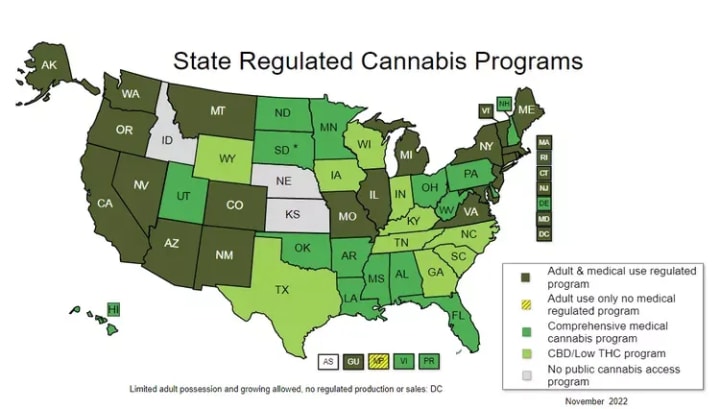
In 1996, California passed Proposition 215, which allowed the use of medical cannabis for qualified patients and was the first such law in the United States. Since that time, the number of states that allow medical marijuana has increased to 38, plus 3 territories and the District of Columbia. Recreational use is now legal in 23 states, 2 territories, and the District of Columbia. While being legal in many states, cannabis is still illegal under federal law in the United States.
With so many states and several countries adopting laws allowing the use of both recreational and medical marijuana, the global legal cannabis industry has seen tremendous growth since that initial California law. Just from 2020 to 2022 (which includes a pandemic), the global industry went from $6.3 billion in value to $16.7 billion and is projected to be at $102.2 billion in value in 2030, a 25.4 percent rate of growth. Most of that value comes from the medical marijuana segment, which accounts for 82.6 percent of the total market. North America, including the thriving cannabis industry in Canada, held a 78.8 percent share of revenue globally in 2022. Legal recreational sales, the fastest-growing segment within the industry, are forecast to grow by over 35 percent by 2030.
A large part of why states allow legal cannabis is because of the tax revenue. Money is a huge factor for many governments, and allowing marijuana while controlling its use and charging for its convenience is just one way that municipalities generate revenue.
One state that has overwhelmingly benefited from marijuana sales is Colorado. Since February 2014, when Colorado started collecting taxes on marijuana, the total tax revenue through April 2023 is almost $2.5 billion. These funds benefit local governments, schools, health care and education, substance abuse prevention and treatment programs, and law enforcement.
In my home state of Arizona, which passed Proposition 207 in 2020, the total tax revenue since the first recreational dispensary opened in January 2021 is almost $600 million (through May 2023). The use of medical marijuana in Arizona was approved by voters in 2010 by passing Proposition 203, with the first sales occurring in December 2012. Tax revenues go toward community colleges, police and fire districts, highway improvement, and justice programs.
In the United States, tax revenue from just recreational use totaled over $3.7 billion in 2021, with several states not included since they hadn’t begun collecting tax revenue. This figure does not include medical use.
These large numbers are due to marijuana’s popularity, it being the most-used illicit drug in the world.
According to the UN’s World Drug Report in 2021, cannabis is the most prevalent illicit drug used across 107 countries and territories, with 220 million users worldwide. The US is one of the leading countries of users with an estimated 16 percent of Americans who say they use marijuana. That figure is up 4 percent from data gathered between 2016 to 2021.
Not only has use increased but so has public support for the drug, especially in the United States. According to a Gallup Poll taken in 2022, 68 percent of Americans support legalizing marijuana, with nearly half of Americans saying they have tried cannabis. When the poll was first taken in 1969, only 12 percent were in support.
It’s safe to say that cannabis is here to stay.
Rocky Mountain High?

The mountains are calling and I must go.
― John Muir
The trails are like home to me. I spend most of my free time in the mountains, the desert peaks looming large in the distance. It’s meditative in a way that regular meditation could never fulfill. There’s peace in the moments I’m barreling down the mountainside after struggling to get up it. There’s joy in the movement, the physical exertion, the scenery, and the experience. I love the aloneness while simultaneously feeling connected to everything around me. The selfish side of me wants to keep it all to myself while also wishing that everyone in the world could experience it. It’s freedom in its purest form.
As wonderful as a trail run is on its own, I wanted to experience something more. I wanted to experience what professional trail runner and cannabis enthusiast Avery Collins describes as “…a spiritual happening.” “Everything is perfect, everything is pure bliss.” And while that sounds incredible, I also wanted to do it safely.
Since I wanted to be safe, I went to a trail I’m intimately familiar with to ensure I wouldn’t get lost. I’m not sure how many people have gotten lost when using marijuana, but I certainly didn’t want to be the first. Being a highly experienced trail runner, I wasn’t too worried about falling or being out of control either, even with the effects of the edible. And if I did fall, it wouldn’t be the first time.
I’d say 50 percent of the runners I meet are avid cannabis users, whether it’s at night or all day or just during or after runs. I’d say almost none of them are open about it.
— Avery Collins
There is a route I take that gives me everything I want in a run — elevation, technical and rocky parts, smooth and fast single-track, views, and water (rare in southern Arizona). And most important, there is rarely anyone else on the trail. Being alone is peace, and I take advantage of it whenever I can. This particular spot is part of the Arizona Trail, a picturesque 800-mile trail that runs from Mexico to Utah. It gives me the option to run as far as I desire.
I like to take my time on trail runs — both pace-wise and also by stopping, taking pictures, and enjoying the scenery. I’ll spend anywhere from 30 to 90 minutes on each run, just taking it all in and not worrying about time. I’m in no hurry to get back to a world that lacks what the trail provides. And I’m hoping edibles will enhance my experience.
Marijuana edibles are processed in the body differently since they are eaten rather than inhaled. Eating a cannabis-filled gummy gets digested, absorbed, and processed in your stomach, intestines, and liver. When smoking, the cannabis gets absorbed through your lungs directly into your bloodstream. And the experience can be completely different.
The most abundant, well-studied, and well-known form of THC is Delta-9-THC, which is the cannabinoid that gives you an intoxicating effect and is more potent than the endocannabinoids our bodies produce. (Another well-known cannabinoid is cannabidiol or CBD.)
According to Nick Jikomes, the principal research scientist at Leafly and a PhD in neuroscience, “The real difference between edibles and smoking or vaping is that with edibles, a much larger fraction of Delta-9-THC makes it to the liver first. There it gets converted to 11-hydroxy-THC,” Jikomes says. “So in other words, if you smoke or vape, the ratio of 11-hydroxy-THC to Delta-9-THC is quite low, and if you take an edible it’s much higher.”
Many believe the effects of 11-hydroxy-THC are much stronger than Delta-9-THC, both in potency and length of high. There has been little research to back this up except for anecdotal experiences; however, one study from 1973 shows that when intravenously administered, subjects described the 11-hydroxy-THC high as stronger and “more intense than that previously experienced smoking marijuana.”
The study is small and 50 years old, but it suggests that edibles provide a unique experience compared to other forms.
Due to that difference and similar to how I experimented with the CBN gummy, I also tried a gummy at home to see how it affected me prior to running — I didn’t want any surprises while running down a rocky trail full of cactus and plants that want to stab me. My experience at home was a good one, and while I certainly felt “high,” I did not feel impaired in any way.
Since they are processed in the body differently, edibles take a while to kick in and from my experience, it’s anywhere between 1 to 2 hours. I took a 10 mg sativa (uplift) gummy about 30 minutes prior to my run so I could feel the difference between running before and after the edible took effect.
And what an effect it was.
The Joy of Running While High

Alcohol and marijuana, if used in moderation, plus loud, usually low-class music, make stress and boredom infinitely more bearable.
— Kurt Vonnegut
I grew up a fan of Bob Ross. His paintings were magical, and the way he painted and talked about his art drew me in. It fascinated me. My parents even bought me his Joy of Painting kit when I was a kid. However, painting waterfalls and snow-covered cabins by a stream was a lot harder in real life than on television. Nonetheless, the difficulty didn’t stop me from trying or being engrossed in his depictions and descriptions.
If you can imagine physically being inside a Bob Ross painting while he’s describing it — the happy clouds, the flowing river, the almighty and tranquil mountains, the trees (in my case cactus) that live in this world — that is one way I can describe what it feels like to be high while trail running.
It’s immersive. Nature and everything around me come alive. I’m in an entirely different world in my mind even though the physical world is the same. Everything is more vivid and I no longer take for granted the beauty that surrounds me. I’m more appreciative and grateful for the experience.
The run itself is fluid. Have you ever been so into something that you lose track of time? You become enveloped in the activity, and while you are obviously aware of what you are doing, it’s a lot more effortless. I’m in tune with my body and more relaxed. I liken it to a self-driving car or an airplane that is on autopilot — you are there in case something goes wrong, but the body is in motion without much input.
I also found that I really “settle” into a run when I’m high. Like if you sat down on one of those couches in the dispensary’s lobby, you would “settle into it.” That’s exactly how I’d describe running high sometimes, too. You settle into the run. It’s relaxing and comfortable. There’s no strain in my legs and my body is in perfect motion. My form seems better and my stride smoother. I texted my good friend Starla that I felt like a “deer galloping through the air effortlessly. Head in the clouds.”
Adding music to the mix makes the experience beyond visceral. Just like I settle into the run, I also settle into the sounds, the beat, and the lyrics. The rhythm of the run combined with the rhythm of the music is hypnotic. The combination of sound, the high, and movement mesh into a single experience that makes me feel like I’m floating along a mountain, not constrained by any sense of gravity or my own body. It’s truly freeing. It’s moving meditation.
Running high is the ultimate flow state.
I am convinced that there are genuine and valid levels of perception available with cannabis (and probably with other drugs) which are, through the defects of our society and our educational system, unavailable to us without such drugs.
― Lester Grinspoon
I find myself smiling at the lizard running across the trail in front of me. I laugh at how its little legs move so fast and wonder what it’s like for a lizard to see my legs moving so slowly compared to his. There’s more wildlife it seems, although maybe I’m just more aware of my surroundings. The cactus and trees are more fascinating, the sounds crisper, and the air cleaner. The scenery is breathtaking and I’m physically, mentally, and emotionally in the moment. I take it all in and I appreciate that I’m able to do this. It is happiness in its highest form — something I’ve struggled to find for most of my life.
Running high helps take the focus off me and puts it on the world around me. Everything that I think is wrong with me disappears. Realizations manifest while running high. On my last run, I finally recognized that I am happy with who I am and that I’m a good person. Growing up in an abusive household, I was labeled as a bad kid, and my actions were never good enough and most of the time, wrong. I have held that belief since that time, even into my fifties. I released emotions that I have held in for so long, and this time in a healthy way.
And though I could write descriptions for days about what I’m feeling, and I know the trope exists, you really do have to experience it for yourself to understand. It is beyond description.
I still have a lot to learn about cannabis, the ECS, and how they impact my brain, running, and life. It’s an ongoing experiment, but one that is proving to be life-changing. I’m not sure where this will take me or even if I’ll stick with it. I really don’t know what the future holds, but I’m optimistic — quite rare for my pessimistic self.
What I can conclude is this: While I was skeptical at first, I can now proudly admit that Hesse is right — it IS a lot of fucking fun.
It is pure fucking joy.
Interesting Side Notes:
- With music, I highly prefer to listen to one artist the whole time when I run high compared to putting music on shuffle. I can listen to the same album over and over and no matter how many times I play it, I never tire of it. The repetition is meditative.
- While I don’t particularly appreciate running in the wind when not high, I love it after taking an edible. It adds to the whole experience, making everything a bit more visceral. I can feel the wind on my skin. Its movement surrounds me, almost like it’s meant only for me.
- I haven’t had any stomach issues since I started running high.
- A sativa edible provides the best experience followed by a hybrid and lastly, indica. This is in line with what they are marketed as — sativa as an uplift, indica as a chill, and hybrid as a combination of the two.
©Copyright Jeff Barton, 2023, 2026. All Rights Reserved.
About the Creator
Jeff Barton
Dad, trail and ultra runner, aspiring recluse, a bunch of other labels. Writing online since 2017; creator and editor of Runner's Life on Medium. I write about mental health and depression, running, life, and subjects that interest me.
Keep reading
More stories from Jeff Barton and writers in Potent and other communities.
In This Dimly Lit Room Full of Emptiness
Some people never go crazy. What truly horrible lives they must lead. ― Charles Bukowski Nights are hard sometimes when my kids aren’t here. It’s not a loneliness, especially in the sense that I want someone here. Or want someone period. It’s a tiredness. I’m tired. Mentally and emotionally. Existentially.
By Jeff Barton2 months ago in Psyche




Comments
There are no comments for this story
Be the first to respond and start the conversation.