
Brands Race to Target AI Chatbots as Users Shift Away from Google Search
Artificial Inteligence

April 27, 2025 | New York —
A major shift is underway in how people search for information online, and brands are scrambling to keep up. As millions of users increasingly turn to AI chatbots like ChatGPT, Gemini, and Claude for answers, companies are rethinking their digital marketing strategies, moving beyond traditional Google search optimization to adapt to this new landscape.
For decades, success online was largely determined by how well a brand ranked on Google. Search engine optimization (SEO) firms flourished, and entire marketing strategies revolved around keywords, backlinks, and click-through rates. However, the rapid expansion of conversational AI tools is upending that model and compelling brands to compete for visibility in a brand-new and fundamentally different setting.
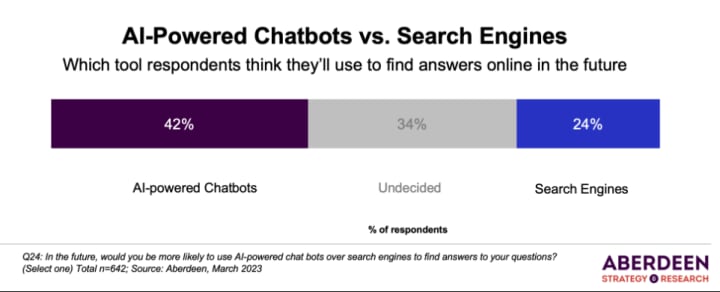
AI chatbots of today do more than just provide links; they also summarize, suggest, and synthesize information. Instead of presenting a list of web pages, they offer direct answers, often without prompting users to visit a website at all. As a result, the traditional "top spot" on a search results page has become less important than being included in an AI's response in the first place.
Major brands are reacting quickly. A lot of people are now focusing on what marketers are calling "AI Optimization," which is a set of tactics to make sure that AI systems reference brands, products, and services when they answer questions. Instead of just stuffing web pages with keywords, companies are working to become authoritative sources within the data sets that these AI tools are trained on or updated with.
The shift is already having measurable effects. Several major publishers and e-commerce platforms have reported a noticeable decline in organic traffic from traditional search engines over the past year. Websites that once relied on Google for the majority of their visitors are now seeing up to 25% drops in traffic, pushing them to find alternative methods for staying visible.
At the same time, new advertising models are emerging to meet the AI era. Some AI platforms are experimenting with sponsored responses, subtly weaving brand messages into chatbot answers. Instead of obvious banner ads or paid search results, these promotions are integrated naturally into the dialogue, aiming to feel less intrusive and more helpful.
Companies like Meta and Google themselves are adjusting by rolling out new AI-driven advertising services. These services allow brands to place their products or services within AI-generated content or offer brands higher visibility in AI summary boxes. The goal is to meet users where they are: inside chatbot conversations and AI-driven overview responses, rather than on traditional search results pages.
However, the transition is not without challenges. One of the biggest concerns for brands is the lack of transparency in how AI chatbots choose the information they share. Unlike traditional search engines, where ranking algorithms are complex but somewhat understandable, AI models operate in ways that are less predictable. A brand could be the top result on Google but barely mentioned by an AI, or vice versa.
To address this, a new industry of AI optimization specialists is emerging. These professionals work to make sure that brand content gets cited in reliable data sources, appears in reliable articles, and has a high credibility score. Some firms are developing tools to measure how often a brand is mentioned in AI outputs and what sentiment is associated with those mentions.
Despite the disruption, traditional search isn’t disappearing overnight. Google, for instance, remains enormously powerful and profitable. In fact, recent reports show that Google's search ad revenue continues to grow, even as AI chatbots become more common. Google is incorporating its own AI summaries, known as "AI Overviews," into its search results as a means of adapting. The company is attempting to combine conventional web links with AI-generated explanations in order to keep users a part of its ecosystem.
Meanwhile, new AI-native platforms like Perplexity and You.com are gaining traction by offering AI-first search experiences, combining chatbot answers with citations from across the web. As these platforms grow, brands are finding they must diversify their digital strategies to stay competitive across multiple AI search environments.
Consumer behavior is also evolving. Studies indicate that users referred by AI search tools are often more engaged—they spend more time on sites, view more pages, and are less likely to leave quickly. This suggests that AI tools may be better at matching users with the information they truly want, which could be a major advantage for brands that adapt well.
The future, however, remains uncertain. Some analysts predict that AI’s dominance in search will lead to a more fragmented internet, where users rely on multiple specialized AI tools rather than a single search engine. Some people are of the opinion that AI chat and traditional search will eventually combine, resulting in a hybrid experience where brands will need to master both types of optimization.
For now, one thing is clear: the rules of digital marketing are changing fast. Brands that are proactive in adapting to AI-driven discovery—investing in AI optimization, building trustworthy and verifiable content, and exploring new advertising models—will be better positioned to succeed in the coming AI era. Those that cling to old SEO tactics may find themselves left behind as users increasingly ask a chatbot, not a search engine, for answers.
About the Creator
Keep reading
More stories from Mayaz ahmed and writers in Potent and other communities.
Trump’s First 100 Days: Big Changes, But Tariff Focus Raises Concerns
April 27, 2025 | Washington, D.C. — During his first 100 days in office, President Donald Trump has implemented sweeping changes, fulfilling numerous promises to reform education, energy policy, and immigration. His administration has acted swiftly, pushing through a wave of executive orders and policy shifts aimed at redefining America's place at home and abroad. However, critics and economists alike warn that an overwhelming focus on tariffs and trade wars could severely undermine the momentum built during these first critical months.
By Mayaz ahmed10 months ago in Potent
When the Math Broke: How One LA Hair Studio Rebuilt Its Margins Without Raising Prices
I Don’t Believe in Miracle Suppliers — I Believe in Math In 2022, the math stopped working. I run a self-owned hair replacement studio in Los Angeles — CH Hair. Real clients. Real installs. Real expectations. At the time, we were generating somewhere between $30,000 and $60,000 a month.
By John Brown6 days ago in Potent
Where can I buy high-quality toupees and what should I watch out for?
It’s 2026: Buying a High-Quality Toupee Isn’t a Gamble — It’s a Supply Chain Decision From salon chairs to global factories, here’s what actually separates premium hair systems from expensive mistakes.
By Emma Smith4 days ago in Potent
"Scream 7" (2026): Running out of Fresh Screams
This is the seventh time we’ve had a Ghostface crisis. Scream 7 is the latest edition of the Scream franchise. Sydney Prescott and her family are under attack by another anonymous killer dressed in a Ghostface costume. While having issues with her daughter, Tatum, they run from the bloody murders, trying to determine who is behind it all.
By Marielle Sabbag7 days ago in Horror




Comments (2)
This shift in online search is really something. I remember when SEO was king. Now, with AI chatbots taking over, it's a whole new ballgame. Brands gotta adapt fast. I wonder how long it'll take for smaller businesses to catch up. It seems like they'll really struggle if they don't figure out this AI optimization stuff soon. And what about the long-term effects on user behavior? Will people rely less on traditional search engines altogether?
AI is definitely the Future