
Whispers of Humanity
The Healing Power of Poetry in a World That Still Believes
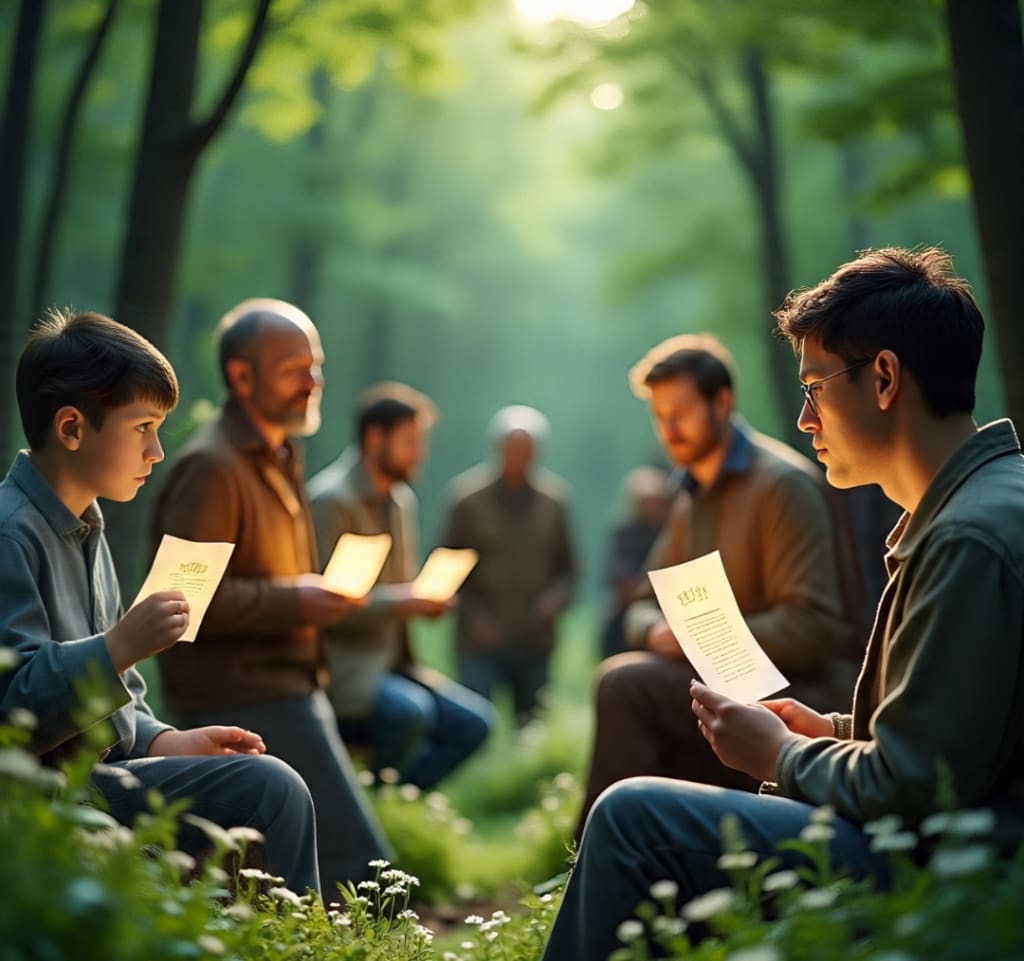
In a small valley cradled by ancient hills, there was a village where people rarely spoke in haste. Words mattered here. Every sentence was weighed like a stone before it was placed into the river of conversation. This wasn’t due to silence or fear—but reverence. The villagers believed that words, especially those shaped with care, held power.
At the heart of the village stood an old tree known as the Listening Oak. Its roots curled like open hands, and its branches reached skyward as if it were in constant prayer. Beneath it, once a week, the villagers gathered for the “Evening of Whispers,” a tradition as old as the village itself. On these evenings, people recited poetry—written by themselves, their ancestors, or passed down through memory—each verse shared like a seed planted in the soil of community.
Lina, a quiet girl of sixteen, had always attended but never spoken. She loved the way words danced in the air during the gatherings, how an old man’s rough voice could carry a tender truth, or a child’s scribbled rhyme could soften hearts hardened by time. She carried a leather-bound notebook everywhere, scribbling poems no one had seen.
Her mother, Mira, once the most eloquent poet of the village, had lost her voice years ago after Lina’s father died in a mining accident. Mira hadn’t spoken since. She sat each week beneath the Listening Oak, eyes bright with unspoken memories, hands resting on her lap like unopened books.
One golden autumn evening, the Evening of Whispers began like all others. The breeze was gentle, the air sweet with fallen leaves, and the lanterns flickered as villagers took turns speaking their truths. A boy read about losing his pet bird and the freedom it might now enjoy in the skies. A woman recited a lullaby written by her grandmother. An elder shared a haiku about the ache of growing old.
As the night deepened, silence fell.
Then, for the first time, Lina stood up.
Her knees trembled, but she held her notebook like a shield and walked to the base of the tree. People turned to watch, their expressions gentle but curious.
She opened her notebook, cleared her throat, and read:
> “We are made of breath and brokenness,
And yet we bloom.
In silence, we carry stories
That wait for the wind.”
Her voice quivered, but she continued:
> “I have watched my mother
Speak without words
Sing in her silence
And teach me the language
Of listening.”
People stilled. The breeze hushed as if the world leaned in.
> “Let us not forget
That pain, when spoken,
Can become a bridge.
And poetry—
Poetry is how we walk across.”
She closed her notebook. For a moment, all was still.
Then—soft clapping. A gentle rustle of approval. Some nodded, others wiped quiet tears. But Lina looked only at her mother.
Mira, still silent, had risen to her feet. Her eyes shimmered, and for the first time in years, her lips parted. A breath. Then a word:
“Thank you.”
Gasps rippled through the crowd. Not for drama—but for the quiet miracle of a voice returning home.
From that night on, Lina’s poems became a thread in the tapestry of the village’s tradition. Her voice, once hidden, helped others find theirs. Mira didn’t speak often, but she began to hum old songs, and when she did, others would join in.
Years later, people would still tell the story of the girl who whispered truth beneath the Listening Oak and reminded them that poetry isn’t just for beauty—it’s for healing, for remembering, for becoming whole again.
And every time a new voice rose in the circle, someone would smile and say, “Another whisper of humanity.”
About the Creator
Keep reading
More stories from Muhammad Saad and writers in Poets and other communities.
Whispers of the Heart: The Timeless Beauty of Love Poetry
From ancient stone tablets to modern Instagram posts, love poetry has always found a way to speak to the human heart. In every culture and every language, people have written verses to express the most profound of all human emotions—love. But why does love poetry endure, even in an age of quick texts and fast connections? Love, after all, is both universal and deeply personal. It’s one emotion that can bring together strangers across time and space. When someone reads a love poem written centuries ago and still feels moved, that’s the magic of poetry—its power to transcend time, to preserve emotions, and to whisper truth from one heart to another. A Journey Through Time Some of the earliest love poems come from ancient Sumeria, carved into clay tablets more than 4,000 years ago. Even then, people were trying to capture that fluttering feeling in words. In Egypt, lovers composed verses filled with longing and admiration, comparing their beloveds to stars and flowers. In ancient India, the “Gita Govinda” celebrated divine love with sensual and spiritual poetry, while in China, the “Book of Songs” collected folk poems filled with tenderness and yearning. Across the world, cultures independently turned to poetry as a way to say what couldn’t be said any other way. Then came the great romantics of the world: Rumi with his spiritual longing, Shakespeare with his sonnets, Pablo Neruda with his passionate declarations. They gave voice to love in all its forms—joyful, aching, patient, and wild. Why Poetry Speaks So Deeply Unlike ordinary speech, poetry distills feeling into rhythm, metaphor, and music. A simple line like “I love you” becomes, in Neruda’s words, “I love you as certain dark things are to be loved, in secret, between the shadow and the soul.” That’s what makes love poetry so powerful. It says the same things we all feel—but in a way that’s beautiful, timeless, and unforgettable. Reading or writing love poetry can be healing. It helps people express emotions they may not fully understand. It allows lovers to communicate deeper feelings than a simple “I miss you” or “You’re special.” And for those who’ve lost love or are waiting for it, poetry can bring hope and peace. Modern Love, Eternal Words Today, love poetry is still alive—and thriving. You can find it on greeting cards, in wedding vows, on social media, and in bestselling books. Poets like Rupi Kaur, Lang Leav, and Atticus have made poetry popular again, especially among young people. But what’s beautiful is that anyone can write love poetry. You don’t need to be Shakespeare. You just need to be honest. One woman, Maya, started writing poems for her husband when they were dating. Years later, she compiled them into a small book as an anniversary gift. Her poems weren’t famous, but they captured their love story—and that made them priceless. Teaching Us How to Love More than just expressing love, poetry teaches us how to love better. It reminds us to slow down, to notice the details, to cherish the small moments. When you read a poem about someone watching their partner sleep, or walking hand in hand through the rain, it encourages you to do the same. To notice. To feel. To be present. Love poetry celebrates tenderness in a world that often rushes past it. It reminds us that love isn’t always loud or dramatic—it can be soft, patient, and enduring. A Poem for Every Heart Whether you’re deeply in love, healing from heartbreak, or dreaming of someone you’ve yet to meet, there’s a love poem out there that speaks for you. Try reading Rumi when you feel a spiritual longing. Neruda, when you want passion. Emily Dickinson, when you’re exploring quiet affection. Or write your own—just a few lines from your heart can become a lifelong treasure. In a world filled with noise, love poetry offers quiet beauty. In a time of distraction, it offers presence. And in moments of doubt, it offers hope. Because love, like poetry, never goes out of style. And the heart will always find a way to speak—sometimes, through a whisper in verse.
By Muhammad Saad 6 months ago in Poets


Comments
There are no comments for this story
Be the first to respond and start the conversation.