
When Will I Be Seven Years Old by Kalebe Kossi Numedo
Behind The Scene: Patience and Relaxation
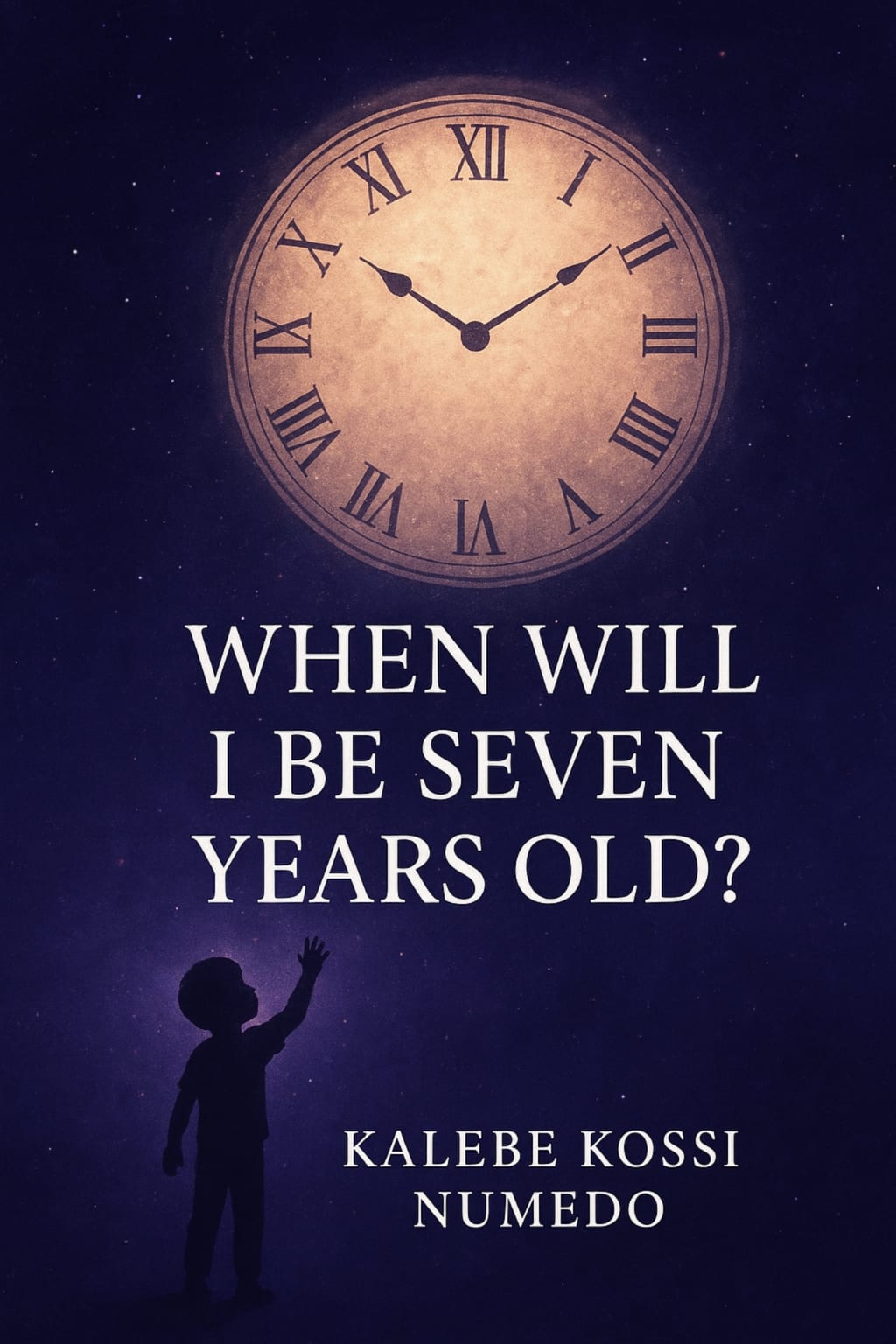
“In every life, there is a waiting. A waiting that feels endless. The world says: be patient, relax. But sometimes those words are not comfort—they are chains. They delay us, they hold us still, while our spirit longs to move, to grow, to rise. This is the heartbeat of the story you are about to hear: the tension between yearning and delay, between time itself and the dream of breaking through it.”
“This is When Will I Be Seven Years Old, written by Kalebe Kossi Numedo, and narrated by The Dee Emergence.”
Artist’s Note:
“This book was born from a place of deep questioning. I, too, have lived in the shadow of patience—sometimes misused, sometimes twisted into an excuse to stall destiny. This is not just about a child longing for seven years of age. It is about every dreamer who has ever asked: When will it be my time? I wrote this as both confession and challenge, so that readers may recognize their own struggle in mine—and rise above delay.”
“In When Will I Be Seven Years Old, a child’s simple question—When will I grow?—becomes a profound metaphor for life itself. The story moves through infancy, childhood, and into the world of work, where the refrain of patience, relax echoes again and again. But patience here is not a virtue. It is a cage. The book explores how society often delays us with empty words, and how the journey to seven years old becomes the universal struggle to claim agency over time, growth, and destiny. Through lyrical prose and layered paradox, Kalebe Kossi Numedo confronts the tension between waiting and becoming, leaving us with a haunting question: in the dance of life, who truly embodies patience—the year that passes, or the human being longing to catch it?”
“You are now entering the labyrinth of When Will I Be Seven Years Old. May this story mirror your own pursuit of time, purpose, and arrival.”
When Will I Be Seven Years Old:
Kalebe Kossi Numedo
I dreamt of having a year when I was not yet born, a yearning for existence echoing through the cosmic void before my earthly debut. As the universe orchestrated my arrival, I found myself in a realm where time unfurled its chapters with measured grace.
In the earliest moments, my voice was a mere echo of emotion—a cry transcending language. Born yet unable to articulate, I communicated through tears, a silent plea for comprehension in a world speaking in riddles only infants could fathom.
Admiration encircled me in childhood's tender years. They spoke in hushed tones of endearment, celebrating each milestone—the tentative crawl, the first faltering steps. However, the melody of adoration metamorphosed into an unsettling murmur as I continued to grow. Whispers became a dissonant chorus, and I, in my newfound ability to comprehend, felt the shift in their sentiments.
As the world unveiled its intricacies, so did my attempts at verbal expression. Early endeavors to communicate were met with laughter, a response to my incoherent sounds. In this symphony of mirth, I learned to laugh, mimicking the very cadence that surrounded me. Little did I know, the source of my joy was also the subject of their murmurings.
The narrative halts at the precipice where murmurs about me echo through the corridors of perception. Their words, once filled with awe, now carry an enigmatic undercurrent. Walking through the labyrinth of my own growth, I become acutely aware of their hushed discussions. Attempts to decipher their language reveal an unsettling truth—I am the subject of their contemplation.
The question lingers, unspoken yet palpable: when will I be seven years old? A query that dances on the edge of anticipation, seeking resolution in the passage of time. Yet, their response echoes with a refrain both familiar and disconcerting—"Patience, relax."
Here, in the midst of their murmurs, the theme of patience and relaxation takes an unexpected turn. The very virtues meant to guide my journey become a labyrinth, an intricate puzzle of existence. The inappropriate use of patience and relaxation, veering into a realm of stagnation, cloaks my path in uncertainty.
In the intricate tapestry of growth and understanding, the essay pauses, leaving the reader suspended in the unresolved tension of murmurs and the elusive promise of reaching seven years old.
The journey through the maze of their expectations unfolds with each passing year. As the clarity of speech emerges, so do the unspoken expectations. Their words become daggers, cutting through the air, leaving wounds that bleed self-doubt. I can talk now, but my words collide with an invisible barrier—a judgment woven into the fabric of their expectations.
"Why make me feel small?" I question, seeking understanding in the echo of their disapproval. Their response resonates with a paradoxical simplicity: "Because you are little. What will make you not be little? The age."
The conundrum deepens. The remedy for my perceived smallness is the very thing I cannot control—time. The hands of the clock move at their own pace, oblivious to the urgency of my desire to transcend the limitations of youth.
Entering the realm of the human workforce adds another layer to this enigmatic narrative. The workplace echoes with the same refrain of patience and relaxation. Observing my colleagues stretch their age, reaching for achievements beyond their temporal grasp, I cannot help but marvel at the contradiction. "They stretch their age," they say, as if time itself can be molded to suit their aspirations.
In this parallel universe of workplace wisdom, I dare to question my own timeline. "When will I be four years old?" I query at the tender age of three. The response echoes familiar chords: "Relax. Be patient." My name is not Patience, yet these words cling to me like an unwanted companion.
The carousel of queries continues at age four, five, and six, each inquiry met with the same response. The elusive nature of temporal progression taunts me. "Patience, relax," they repeat, as if the very act of asking defies the natural order of things.
Yet, the dichotomy persists. While they stretch their age to grasp what lies ahead, I remain tethered to the present, a prisoner of their ambiguous counsel. "Stretching age" becomes a euphemism for navigating the intricacies of societal expectations, a dance with time choreographed to a rhythm only they can comprehend.
The paradox echoes in every corner of my existence. I can stretch my understanding, my capabilities, but the one variable beyond my control is time. When will I be able to grasp the next age? The response remains shrouded in the mystical haze of patience and relaxation.
In the midst of this temporal dance, the answer to my persistent question remains elusive. As the calendar pages turn, and the murmurs of societal expectations swirl around me, the anticipation of reaching seven years old lingers. The refrain of "patience, relax" persists, a haunting echo in the labyrinth of existence.
And now, as I stand on the precipice of the elusive seven, the paradox deepens. They continue to advise patience, urging me to relax, yet the very essence of these words seems misplaced. The journey has been a symphony of contradictions, a dance with time where the steps are guided by societal expectations.
In the final act of this unfolding narrative, the question hangs in the air: "When will I be seven years old?" The chorus of advice persists, but within this tangled web of expectations, the true meaning of patience and relaxation remains elusive. The stage is set, the murmurings persist, and the dance with time continues—an intricate tapestry where the enigma of existence unfolds with every step toward the elusive seven years old.
In the labyrinth of existence, the question echoes once more as I stand at the crossroads of age six and a half: "When will I be seven years old?" The culmination of years spent navigating the ebb and flow of societal expectations fuels my anticipation. The advice persists, as if patience and relaxation are the keys to unlock the mystery of temporal progression.
The dance with time continues, and I find myself caught in the tangle of their enigmatic counsel. The shadows of their words linger, and the very air seems to vibrate with the weight of unspoken expectations. "Patience, relax," they murmur, as if the cadence of those words could alter the trajectory of time itself.
In the face of their counsel, a silent rebellion stirs within me. The desire to unravel the paradox of patience and relaxation fuels my questioning spirit. The canvas of my existence bears the brushstrokes of their influence, but the colors are mine to choose.
And so, the persistent inquiry resonates: "When will I be seven years old?" Their response remains predictable, an echo of a familiar refrain. "Patience, relax," they whisper, their words blending into the symphony of expectations that surround me.
As the journey unfolds, I become increasingly aware of the incongruity within their guidance. The elusive nature of time defies the simplicity of their advice. Patience and relaxation, once comforting mantras, now seem like illusory concepts, a veil obscuring the true essence of temporal progression.
And now, at the precipice of seven, the anticipation reaches its zenith. The elusive age beckons, a milestone that carries the weight of
years spent navigating the labyrinth. The whispers of advice persist, but a subtle defiance simmers within. What if the true essence of patience and relaxation lies not in waiting for the age to arrive but in the acceptance of the present moment?
And so, with a breath held in anticipation, the calendar marks the arrival of the coveted day. "Now today is exactly seven years old," I declare, the words echoing through the corridors of my being. The paradox lingers, for even in the attainment of seven years, the refrain persists.
"I must have seven years of age," I assert, a declaration of my temporal existence. Yet, their counsel echoes in the background. "Patience, I should relax." The irony unfolds, a dance with time where the roles seem reversed. Who, in this moment, is truly embodying patience and relaxation—the passing year or the human being yearning to catch up with time?
In the final contemplation, the enigma remains. The tapestry of existence woven with threads of temporal intricacies unfolds, and the dance with time continues. As I stand at the intersection of past and present, the question lingers in the air: Which of the two—year or person—truly embodies the essence of patience and relaxation in the intricate ballet of existence? The answer, like the elusive nature of time itself, remains an enigma, echoing through the corridors of my journey toward an ever-unfolding age.
About the Creator
Keep reading
More stories from Kalebe Kossi Numedo and writers in Poets and other communities.



Comments
There are no comments for this story
Be the first to respond and start the conversation.