

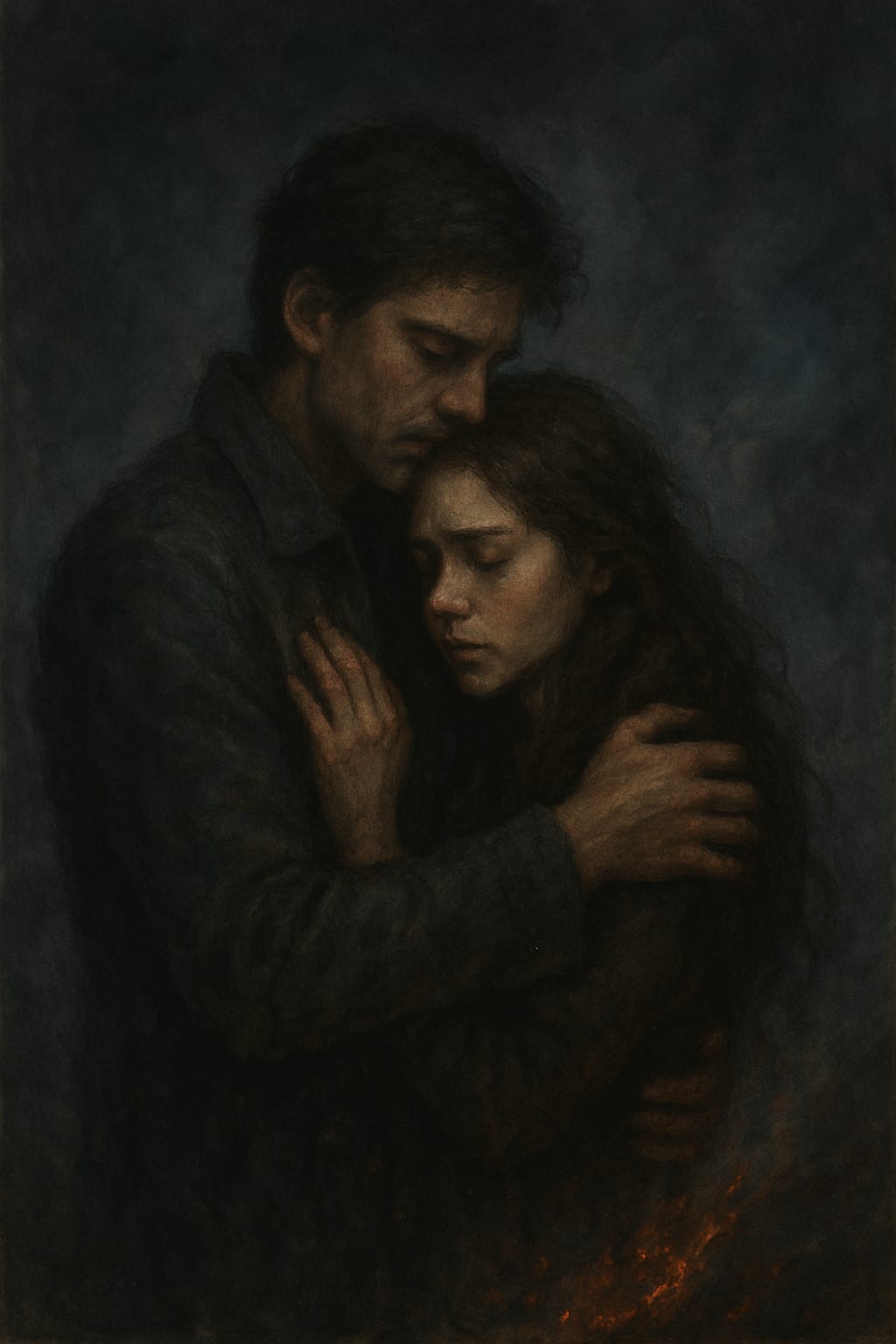
STANZA I
The fire that once consumed us turns to smoke,
Each flame a promise we could not sustain.
I watch the final sparks retreat to night,
And feel the cold creep in where there was heat.
What burned so bright has left us only ash,
The dying glow a mirror of our love.
STANZA II
We built this blaze on something we called love,
Fed it with words that vanished into smoke.
You said forever, but forever turned to ash
Like everything too fierce for us to sustain.
I felt you burning with that reckless heat,
The kind that blazes brightest in the night.
STANZA III
How many hours did we defy the night,
Convinced our fire was different, was true love?
We thought we'd found a never-ending heat,
That we could breathe and not produce just smoke.
But no flame burns without the will to sustain,
And ours collapsed, became a bed of ash.
STANZA IV
Now all that's left is this gray, bitter ash
Where passion used to rage against the night.
I search for coals that I might still sustain,
Some ember of the thing we once called love,
But find only the ghosts inside the smoke,
The fading memory of vanished heat.
STANZA V
Tell me, was it ever real, that heat?
Or were we always destined to be ash,
Two people choking on their own sweet smoke,
Burning too fast to make it through the night?
Perhaps we mistook destruction for love,
Confused the thrill of fire with what can sustain.
STANZA VI
I know now that true things learn to sustain,
They warm instead of scorch, they nurture heat
Without consuming all they claim to love.
They leave behind more than a pile of ash,
More than the darkness rushing back at night,
More than these lungs still heavy with your smoke.
ENVOI
The smoke has cleared. What we could not sustain
Cooled in the night, surrendered all its heat.
I watch the final sparks retreat to night.
Author’s Note: This poem was written in the sestina format.
A sestina is one of the most intricate and demanding poetic forms ever created. Instead of relying on rhyme, it uses a strict pattern of six repeating end words that rotate through six stanzas and return again in a final three-line envoi. Because every stanza must use the same six words in a precise position, the poet is constantly working within tight constraints while still trying to maintain emotional flow, narrative clarity, and musicality.
It’s a form that tests both discipline and creativity, and many writers consider it one of the hardest poems to write. The challenge lies in balancing structure with meaning: letting the repeated words evolve, deepen, and shift in tone while still honoring the rigid pattern. When it works, a sestina becomes a kind of spiraling meditation, obsessive, lyrical, and uniquely powerful.
About the Creator
Tim Carmichael
I am an Appalachian poet and cookbook author. I write about rural life, family, and the places I grew up around. My poetry and essays have appeared in Beautiful and Brutal Things, My latest book. Check it out on Amazon
Keep reading
More stories from Tim Carmichael and writers in Poets and other communities.
A More Human Vocal
When we launched Vocal nearly a decade ago, the world was a very different place. LLMs did not exist, and stories were created one at a time by people sitting down to write, revise, and share something personal. Many of our assumptions about publishing, trust, and participation were built for a world where effort and output were inseparable.
By Justin @ Vocal5 days ago in Resources




Comments (4)
Oh, Tim Gifted One! You get an "A" for attempting this! And I must say your "attempt" is mighty spiffy-looking. *Virtual back pats*
A love that fails naturally is tragic; a love destroyed by outside forces is horror. I love the structure of this poem. Beautiful
I shall not attempt, but rather I shall enjoy reading. I like how you challenge yourself with every poem you write.
Definitely a difficult form to master. The repeating words are a really tough to make not sound pedestrian or childish. You did an excellent job. The feeling came across, not just the form. 👏👏👏