

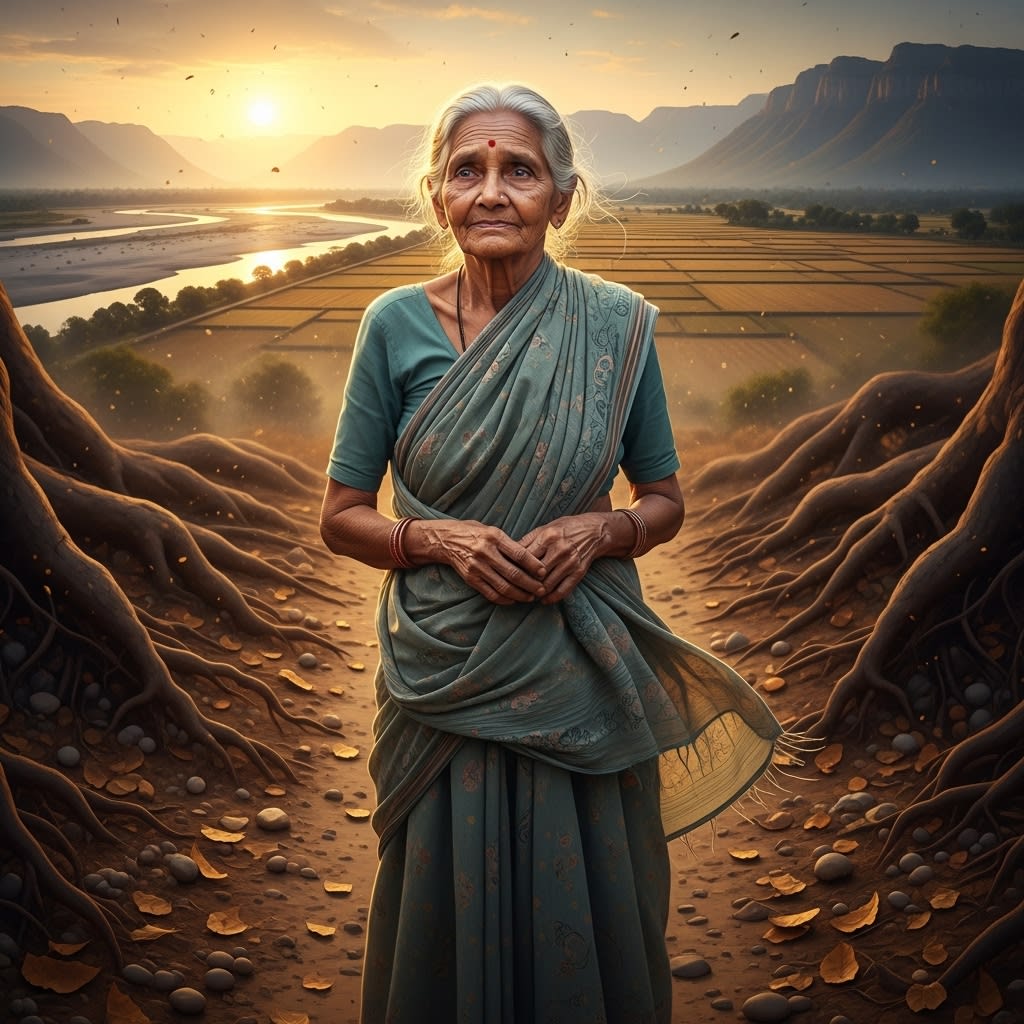
She was born in a village so small
that the wind knew everyone by name,
where morning sunlight entered through mud-hut cracks
as gently as a midwife’s hands,
and the smell of wet earth was the first language
children learned to speak.
My great-grandmother—
the woman whose shadow still stands
in the doorway of my memory—
was a wanderer not by choice
but by the quiet rebellion of the soul,
a root that refused to rot
in any one kind of soil.
They say she learned to walk
by following monsoon clouds,
her tiny footprints washed away
before anyone could trace them.
But she always remembered
the map her feet carried—
lines carved by dust,
rivers drawn by sweat,
forests whispered into her bones.
She married young,
like women of her time often did,
but she never let marriage
lock her spirit behind a courtyard wall.
While others learned embroidery,
she learned horizons—
counting not stitches but miles,
not threads but paths.
She learned early
that the world listens
more to silence than to voices.
So she practiced silence
as one practices prayer,
letting it stitch itself
into the hem of her sari.
And when she finally spoke,
the air leaned in
like a student eager for the first lesson.
Her hands were brown with sun,
hard with work,
soft with mercy.
The kind of hands
that could peel fruit for a hungry child,
or break open stubborn soil
for a season that had forgotten to rain.
“Work is worship,” she would say,
though she never stood inside a temple
without dust on her feet.
She carried stories
the way old trees carry rings—
layered, unhurried,
marking every drought, every bloom.
When she sat with me under the neem tree
and began a story with “Jab main choti thi…,”
time itself leaned back
and let her take the lead.
She told me of rivers she had seen,
wide like open arms,
narrow like regrets.
Of days she traveled on foot
with a pot balanced on her hip
and a baby tied to her back.
Of nights when the sky felt closer
than the roof over her head.
She taught me that wandering
is not walking away—
it is walking toward
something your blood remembers
even when your mind forgets.
She taught me
that roots do not mean stillness.
Some roots stretch—
under rivers, across continents,
beneath fences and borders—
seeking better water.
Seeking new possibilities.
And she,
my wander-root ancestor,
stretched so far
that her stories reached me
before her photograph ever did.
I remember her voice
like an old song hummed half-forgotten
but impossible to erase.
A rhythm of tin plates,
a melody of spinning wheels,
a chorus of women laughing
from one doorway to another.
Her strength was never loud.
It moved like evening light—
slow, golden, certain.
When life broke her in places
no one dared to touch,
she stitched herself back together
with thread pulled from faith.
On the day she died,
a crow sat on the roof
and did not fly for hours.
The wind was strangely polite,
and even the street dogs
didn’t bark.
It was as if the world paused
to hold its breath
for the woman who spent her whole life
breathing meaning into ordinary days.
I still feel her sometimes—
in the scent of wet soil,
in the hush of evening,
in the gentle ache of leaving home
and the soft relief of returning.
From her I inherited
the feet that cannot stay still,
and the heart that refuses to forget.
From her I inherited
a map of unseen places,
a courage older than my name,
and the quiet understanding
that the past is not behind us—
it is the root we wander with.
So here I stand,
generations later,
carrying her stories like lanterns
through the dark.
A wander-root,
just like her—
moving, learning, becoming—
growing toward the sun
while still anchored
to the woman
who taught me
how to bloom
everywhere.
About the Creator
Alexander Mind
Latest Stories
Keep reading
More stories from Alexander Mind and writers in Poets and other communities.
No Word Comes Near Enough
The English language has its limits. I learned this when I became a student of the Bible and looked up the Greek and Hebrew definitions behind the Scriptures I loved. Some languages have so much more depth and power than the one I use to convey my thoughts. But, even so, I don't think any word could ever come close to describing this void and pain I am journeying through. I don't know how to swim through its murky waters.
By Shirley Belk6 days ago in Poets




Comments
There are no comments for this story
Be the first to respond and start the conversation.