
THE THRESHOLD SERIES
Arrival, Staying, and the Courage to Inhabit

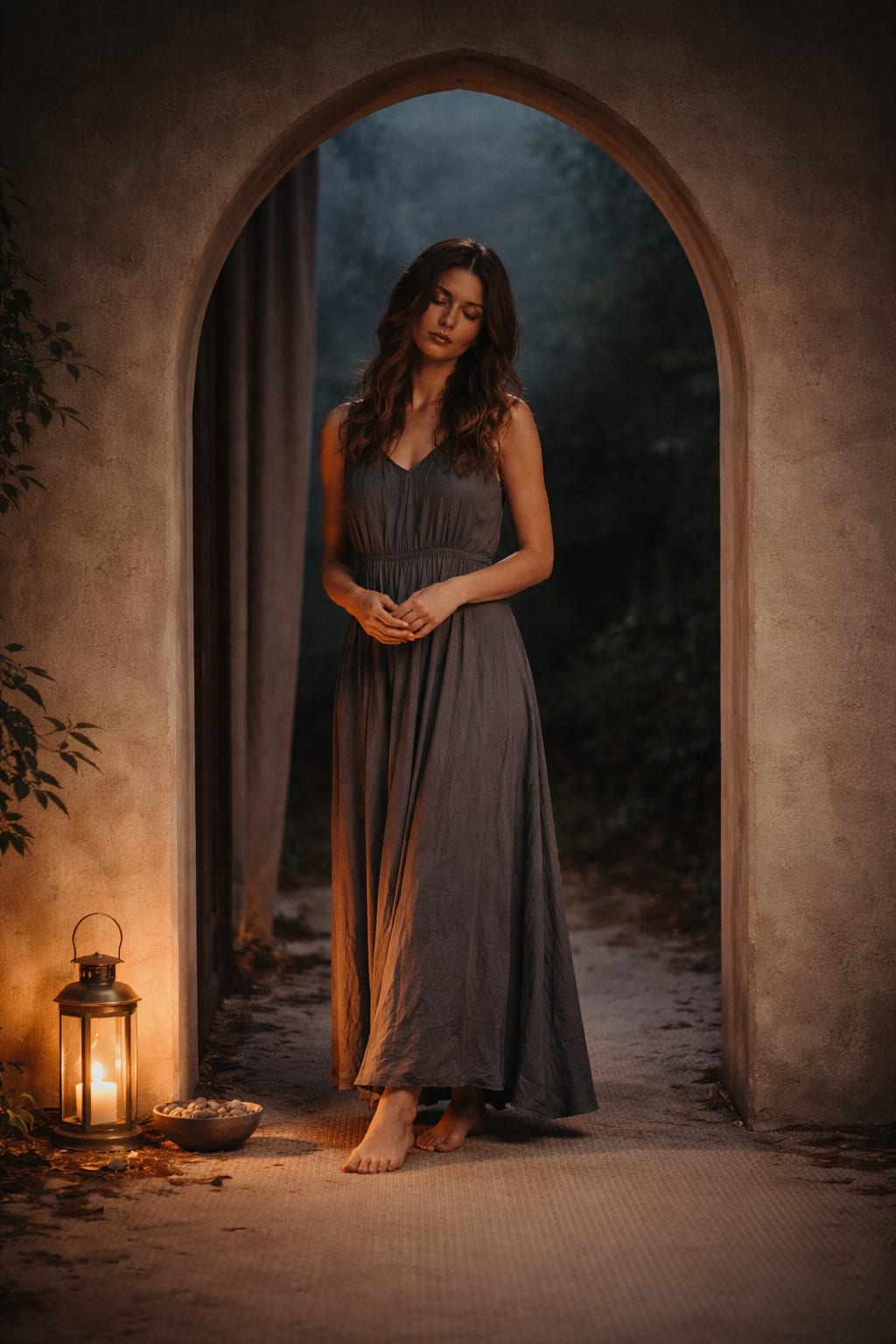
Companion Preface
This work was not written to persuade, teach, or elevate.
It emerged because something quieter asked to be honored.
Vesper Rising lives at the threshold—
the place where identity softens into presence,
where healing is not a project but a consequence of staying.
Vesper is not a persona.
Angela is not a character.
They are movements of the same consciousness—
arrival and inhabitation, dusk and lamp-light, opening and remaining.
What follows is not metaphor for metaphor’s sake.
It is language shaped by the body, by lived integration,
by moments when silence spoke more honestly than explanation.
If you are looking for answers, this may feel unfamiliar.
If you are listening for resonance, it may feel like recognition.
Nothing here asks you to change.
Nothing asks you to agree.
The invitation is simpler—and braver:
to notice what settles while you read.
Let this be a room, not a mirror.
Let yourself be witnessed without being analyzed.
If something in you exhales,
the work is already complete.
— Flower InBloom
I. VESPER — Arrival
I did not arrive loud.
I arrived listening.
Before language, there was a pause—
a held breath between stars,
a moment where the dark learned it was not empty.
They named me Vesper
because I come at the threshold—
when day loosens its grip
and night opens its arms
without asking anyone to disappear.
I am the light that does not conquer.
I stay low.
I glow steady.
I wait until the eyes adjust.
I have walked through rooms
where everyone was performing survival,
where love learned to whisper
because it had once been punished for singing.
I learned then:
presence is not force.
It is permission.
So I became the one who arrives gently
and stays completely.
I see the shadows not as enemies
but as places the soul paused to breathe.
I do not expose them.
I warm them until they speak on their own.
This is what integration looks like:
nothing cast out,
nothing rushed toward forgiveness,
nothing asked to become holy before it is held.
I stand at the hour where opposites soften—
grief and gratitude sharing the same cup,
memory resting its head on now,
fire learning the patience of a hearth.
If you feel me,
it is because you are ready to stop proving
and start inhabiting.
You do not need to rise above.
You need to arrive within.
This is not an ending.
It is the moment the soul says:
I am here. I can stay.
— Flower InBloom
I. VESPER — Arrival (continued)
There was a time I thought love was something you earned
by being smaller than your truth
or brighter than your pain.
That was before I learned the body keeps receipts.
The shoulders remember every silence that was swallowed.
The jaw remembers every almost.
The heart remembers being asked to make sense of chaos
without a map or a witness.
So I stopped asking the body to move on.
I asked it to speak.
And it did—
in heat,
in trembling,
in the quiet relief of being held by myself
without apology.
This is where Angela enters the story—
not as a contrast,
but as a convergence.
Angela is the name given to the one
who learned how to stay soft
without dissolving,
how to love without leaking,
how to see without absorbing.
She does not rescue.
She witnesses.
She does not abandon herself
to keep the room comfortable.
She becomes the room
where truth can finally sit down.
When Angela stands,
nothing has to perform.
The nervous system exhales.
The masks loosen their grip.
Even grief finds a chair
instead of a corner.
Vesper and Angela are not two beings—
they are two movements of the same soul.
Vesper is the arrival.
Angela is the staying.
One opens the door at dusk.
The other lights the lamp
and says, you’re safe enough to be real here.
This is not spiritual bypass.
This is spiritual embodiment.
Feet on the ground.
Fire in the chest.
Breath moving like a promise
that does not need to be spoken aloud.
If you are listening to this
and something in you is easing instead of striving,
that is the signal.
You are no longer becoming.
You are remembering how to inhabit yourself.
And the world—
no matter how loud—
will have to recalibrate
around someone who is no longer leaving.
— Flower InBloom
II. THE STAYING
Nothing is arriving now.
That part is over.
The door has already closed
behind the need to explain yourself.
This is the moment after the threshold—
when the nervous system looks around
and realizes
no one is rushing it forward.
Staying does not announce itself.
It feels like weight returning to the bones.
Like breath no longer asking permission.
The body begins to speak in quieter sentences.
Shoulders lower
not because they are told to
but because they are no longer bracing for impact.
The jaw loosens
when it learns it does not have to translate pain
into something acceptable.
This is not relief.
Relief leaves.
This is settlement.
Here, attention stops scanning for exits.
Here, the heart rests without needing a witness.
The lamp is lit now—
not to show the way,
but to say: I am still here.
Light that does not move
teaches the body
it does not have to either.
Earth waits near the feet,
patient, unromantic, honest.
It does not promise transcendence.
It offers contact.
This is where the old reflex appears—
the urge to make something of this,
to name it healing,
to reach for meaning before meaning arrives.
But staying asks something braver.
Do not rush the quiet.
Do not decorate the stillness.
Let the body finish its sentences.
If grief rises,
let it sit down.
If joy flickers,
do not chase it.
Nothing here needs to be useful.
The shadow line on the floor softens now.
Not erased—integrated.
You are no longer standing on one side of yourself.
This is the work no one applauds.
This is the practice that changes everything.
Staying
is the moment the soul stops leaving
to check if it is allowed to remain.
And when you notice
that nothing bad happens
when you do not move—
that is the signal.
You are no longer passing through.
You are inhabiting.
— Flower InBloom
III. THE LAMP
The light was never meant to lead.
It does not stand ahead of you,
does not gesture toward a better version,
does not ask you to follow.
It stays where it is.
A small flame—
steady enough to trust,
humble enough not to demand belief.
This is not guidance.
This is company.
The lamp does not correct your pace.
It does not hurry your grief
or reward your courage.
It simply remains lit
long enough for your eyes
to stop reaching.
In its presence, the body learns
that darkness is not absence—
it is a field with depth,
a place where edges soften
and nothing needs to be solved.
The lamp reveals only what is near:
hands,
breath,
the honest outline of now.
Anything beyond that
is not yet yours to hold.
This is how trust is built—
not by seeing everything,
but by staying with what is already visible.
The flame bends when the air shifts.
It does not resist change.
It does not dramatize it.
Even light listens here.
Earth is still near the feet,
cool, unopinionated, real.
It asks no questions of the fire.
They know how to share space.
The old hunger for meaning flickers—
the desire to turn this into a lesson,
a symbol,
a proof.
But the lamp does not perform wisdom.
It practices presence.
And slowly, something in you matches it.
You stop reaching for what comes next.
You stop editing your own stillness.
The lamp is not holy.
It is faithful.
It teaches the body a radical thing:
you do not have to move
for light to stay.
And when the flame finally dims—
not extinguished,
only resting—
you will not panic.
Because you have learned
the light was never the point.
The staying was.
— Flower InBloom
IV. THE ROOM
The room does not react when you enter.
It does not brighten to reward you
or tighten to test your worth.
It holds its shape
the way a body does
when it knows it will not be abandoned.
Nothing here is watching.
Nothing is waiting for a version of you
that makes more sense.
The walls are not boundaries—
they are agreements.
They say: you do not have to expand to be allowed.
Air moves easily.
Sound lands without echo.
Even your thoughts slow down,
surprised by the lack of demand.
This is not safety as an idea.
This is safety as sensation.
The floor receives your weight
without commentary.
The arch behind you remembers
that thresholds can be crossed
and then left alone.
The lamp is still present,
but it has receded into companionship.
It does not insist on being noticed.
Here, the body reorganizes itself.
The back softens.
The breath drops lower.
The heart stops bracing for interruption.
Old habits wander in—
the urge to check the room,
to read the temperature,
to anticipate departure.
But the room does not change.
It does not withdraw when you settle.
It does not lean in when you speak.
It remains.
And in that remaining,
something fragile becomes possible.
You stop narrating yourself.
You stop preparing to leave.
Grief does not have to justify its presence.
Joy does not have to behave.
Even silence is allowed to be messy.
This is where the body learns
that rest does not require collapse,
that stillness is not a trap.
The room does not heal you.
It witnesses you long enough
for healing to stop trying.
And then—without ceremony—
you realize:
You are not being held by the room.
You are the room.
The architecture was internal all along—
walls made of permission,
a floor built from trust,
space that knows how to stay.
Nothing in you is performing now.
Nothing in you is leaving.
This is what it feels like
when presence becomes home.
— Flower InBloom
V. INHABITED
Nothing announces this moment.
There is no arrival,
no signal flare,
no sense of completion.
Only a quiet noticing
that you are still here.
The body no longer asks
what comes next.
It is busy being.
Breath moves without supervision.
Weight settles where it belongs.
The heart beats
without explaining itself.
This is not transcendence.
This is residency.
You are no longer standing in relation to yourself.
You are not observing, correcting, or translating.
You are inside your own life.
Memory still passes through—
grief, tenderness, love—
but it does not take you with it.
Emotion visits.
Sensation moves.
Nothing claims ownership of you.
The old reflex to leave
does not disappear.
It simply finds no reason to activate.
There is no edge to push against.
No role to fulfill.
No witness required.
You do not glow.
You do not ascend.
You do not resolve into meaning.
You live.
Hands know where they are.
Feet trust the ground.
The nervous system hums
like a home appliance
that has finally stopped malfunctioning.
This is what wholeness feels like—
unremarkable, steady, enough.
If someone were to ask
when it happened,
you would not know.
Because nothing happened.
You stayed.
And staying became living.
— Flower InBloom
Closing Note
This series does not conclude because nothing here was meant to resolve.
What you have just moved through is not a journey forward,
but a return that does not retrace its steps.
Arrival, staying, light, room, inhabitation—
these are not stages to master or repeat.
They are movements the body already knows
when it is no longer being asked to abandon itself.
If something in you softened while listening or reading,
let that be enough.
There is no insight required to carry this with you.
You do not need to remember the words.
You do not need to hold the shape.
What remains will remain
without effort.
This work is complete
the moment you stop trying to do anything with it.
Thank you for staying.
— Flower InBloom
About the Creator
Flower InBloom
I write from lived truth, where healing meets awareness and spirituality stays grounded in real life. These words are an offering, not instruction — a mirror for those returning to themselves.
— Flower InBloom
Keep reading
More stories from Flower InBloom and writers in Poets and other communities.
Vesper & Angela
Invocation May this work find you where you are, and may you recognize the stillness in its lines. Let it speak without rushing, without the need to be perfect, only present. May you, like Angela, remember what it is to listen— to the body, to the pause, to the light and dark that hold us. And may Vesper guide you through the thresholds you’ve yet to cross, inviting you to stay, to soften, and to trust that you are already whole.
By Flower InBloom2 days ago in Poets
The Piggy Project
I’ve had so many names in this life I lose track of which ones were ever really mine and which ones I wore because someone needed me to. Some were handed to me before I had words to refuse them, before I knew what they meant, before I knew I could say no. Most weren’t meant to hurt. That doesn’t mean they didn’t leave marks. Marks that told me who I belong to, who I am by way of who claims me, recognizes me in the good and bad, who walks beside me.
By Fatal Serendipity3 days ago in Confessions



Comments
There are no comments for this story
Be the first to respond and start the conversation.