
The Library of Lost Pages
A journey through a hidden haven of stories and secrets

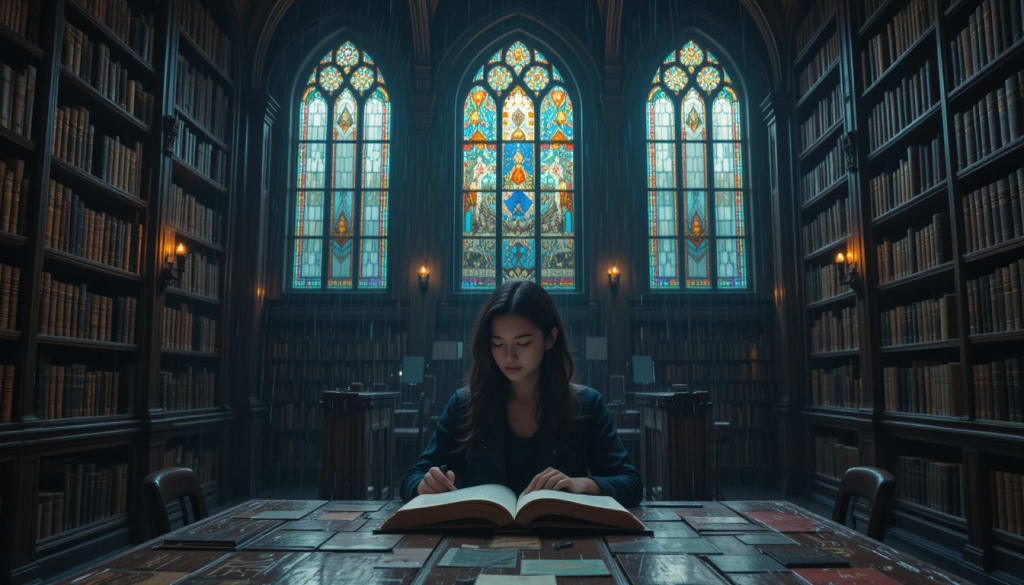
In the village of Chandpur, tucked between rice paddies and monsoon-soaked hills, books were a quiet rebellion. The villagers worked from dawn to dusk, their hands calloused from plows and nets, their lives bound by the rhythm of seasons. Reading was a luxury, frowned upon by elders who saw it as idleness, a distraction from the labor that kept Chandpur alive. But for Lila, books were air, and without them, she’d suffocate.
Lila was nineteen, with hair black as a crow’s wing and eyes that held the spark of a storm. She was the weaver’s daughter, expected to marry a farmer and spend her days threading looms. But her heart belonged to the stories she found in tattered books, smuggled from the city by her cousin Ratan, who drove a rickety van to the market every month. Dog-eared novels, poetry with broken spines, history texts with faded maps—these were her treasures, hidden under her cot in a tin box, read by candlelight when the village slept.
Chandpur had no library, no school beyond the eighth grade. The nearest bookshop was a day’s journey, too far for Lila’s means. But there was a rumor, whispered among the children, of a hidden library deep in the hills, a place where books grew like trees, their pages alive with voices. Lila dismissed it as a fairy tale, until the night she found the map.
It was tucked inside a crumbling copy of Tagore’s Gitanjali, a gift from Ratan. The map was hand-drawn, ink faded to the color of tea, showing a path through the hills to a place marked “The Library of Lost Pages.” Lila’s pulse quickened. She traced the lines with her finger, feeling the pull of something vast, like the river after rain.
The next evening, as the monsoon clouds gathered, Lila slipped out, a shawl over her shoulders, the map in her pocket. The village was quiet, the air heavy with the scent of wet earth. She followed the path, her sandals sinking into mud, the hills rising like sleeping giants. Lightning flickered, illuminating bamboo groves and jagged rocks. Fear gnawed at her, but the thought of books—endless, untouched books—pushed her forward.
The library appeared like a dream. It was a stone building, half-swallowed by vines, its windows glowing with candlelight. The door was unlocked, creaking as Lila pushed it open. Inside, the air was thick with the smell of paper and dust. Shelves stretched to the ceiling, crammed with books of every size—leather-bound tomes, pamphlets tied with string, manuscripts with curling edges. Some glowed faintly, their pages whispering as if alive.
A woman sat at a table, her silver hair braided, her eyes sharp as a hawk’s. She wore a sari the color of twilight, and before her was a book, its pages shimmering like water. “You found us,” she said, her voice low, like the hum of a sitar. “I’m Sarala, the Keeper.”
Lila’s throat was dry. “This is real?”
Sarala smiled, her fingers brushing the book. “As real as stories.”
The Library of Lost Pages, Sarala explained, was a sanctuary for books no one else wanted—orphaned stories, forgotten poems, diaries left in attics. They came from all over, carried by winds or wanderers, drawn to this place where time didn’t matter. “Every book has a soul,” Sarala said. “And every reader keeps them alive.”
Lila wandered the shelves, her hands trembling. She found a novel in Bengali, its cover faded, about a girl who sailed to the stars. A journal in Urdu, filled with sketches of flowers that didn’t exist. A poetry collection in English, its lines sharp as knives. Each book felt warm, like it knew her. She read until her eyes burned, the monsoon raging outside, the candles never dimming.
Sarala watched her, silent but kind. “Why do you love books?” she asked at last.
Lila hesitated. “They’re… freedom. In Chandpur, I’m just the weaver’s daughter. But in books, I’m anyone. I’m everywhere.”
Sarala nodded, as if she’d heard the answer before. She handed Lila a blank book, its pages crisp. “Write your own,” she said. “The library keeps those, too.”
Lila returned night after night, sneaking through the hills, her tin box now filled with new stories. She read voraciously, her mind alight with worlds—pirates on stormy seas, lovers in ancient cities, poets who spoke to gods. She began to write, too, her words hesitant at first, then bold, spilling onto the blank pages. Stories of Chandpur, of the river that sang, of a girl who refused to be bound.
But the village noticed her absence. Her father grew stern, her mother anxious. The elders whispered, their eyes narrowing at Lila’s distracted smiles, her ink-stained fingers. One night, her father followed her, his lantern bobbing in the dark. He found the library, its glow unmistakable, and stormed inside.
“What is this?” he demanded, his voice shaking. “You’re wasting your life on nonsense!”
Lila stood, clutching her book. “It’s not nonsense. It’s who I am.”
Sarala stepped forward, calm as stone. “She’s keeping stories alive. Isn’t that worth something?”
Her father’s face softened, but only for a moment. “You’re needed at home. This place… it’s not for us.”
Lila’s heart broke, but she didn’t move. “I’m not leaving,” she said. “Not yet.”
Her father left, his lantern fading into the rain. Lila stayed, reading, writing, her world growing with every page. Sarala taught her the library’s secrets—how to mend torn pages, how to hear a book’s voice, how to let a story change you. Lila learned that the library wasn’t just a place; it was a promise, a rebellion against a world that demanded silence.
Months passed, then years. Chandpur changed—slowly, grudgingly. Ratan brought more books, and Lila shared them, reading to children by the river, their eyes wide with wonder. The elders grumbled, but the stories spread, like seeds in the wind. Lila’s own book grew, a tapestry of her village, her dreams, her heart.
One night, Sarala handed her a key, small and silver, warm as a book’s glow. “The library’s yours now,” she said. “I’m old, Lila. It needs a new Keeper.”
Lila’s breath caught. “Me?”
“You love stories,” Sarala said. “That’s enough.”
Sarala vanished into the hills, her sari blending with the mist. Lila stayed, tending the library, welcoming wanderers who found its glow. She wrote, read, and lived, her days no longer bound by Chandpur’s rules. The village still worked, still prayed, but now it listened, too, to the stories Lila carried from the Library of Lost Pages.
And sometimes, on quiet nights, Lila opened her own book, its pages filled with her words, and read to the library itself, its shelves humming softly, as if the stories were singing back.
About the Creator
Shohel Rana
As a professional article writer for Vocal Media, I craft engaging, high-quality content tailored to diverse audiences. My expertise ensures well-researched, compelling articles that inform, inspire, and captivate readers effectively.
Keep reading
More stories from Shohel Rana and writers in Poets and other communities.
Eid Mubarak: A Tapestry of Joy
Eid Mubarak! The words alone carry a melody that resonates deep within, a call to celebration that transforms ordinary days into moments of profound connection. Eid-ul-Fitr, the festival marking the end of Ramadan, is a symphony of faith, family, and festivity. For me, this year’s Eid wove a tapestry of memories that I’ll carry in my heart forever, each thread vibrant with love, laughter, and the warmth of togetherness.
By Shohel Rana8 months ago in Poets
Smart phones, Humans and Aliens.
WARNING. I will be tapping into one of your favorite creative tensions: The absurdity of humans worshipping their glowing rectangles as if they were tiny oracles. There’s something deliciously poetic about that contradiction, and it lends itself beautifully to an instructive proviso.
By Novel Allen5 days ago in Poets
Miss Persephone's Manual to a Seemingly Ordinary Life
Miss Persephone was found at the dining table, her blue eyes swollen, her tears arriving and retreating like the tides of the ocean. Earlier that day, her family had visited her in the retirement home where she had lived for eight years. It was her eightieth birthday.
By Imola Tóth6 days ago in Fiction


Comments
There are no comments for this story
Be the first to respond and start the conversation.