
“The Library at the End of Time”
A mysterious library appears in the middle of a small town — every book predicts the future of the person who reads it.
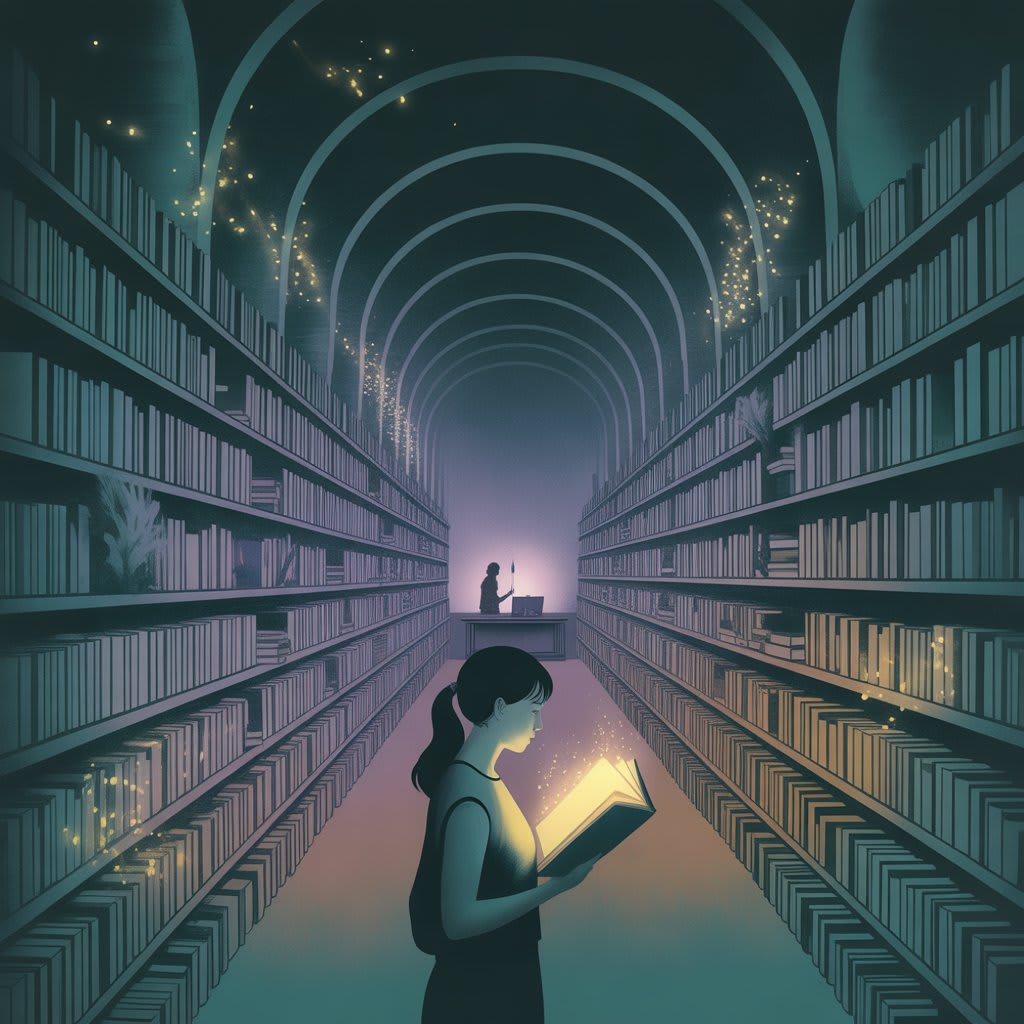
The Library at the End of Time
No one saw the library arrive.
On Tuesday morning, it simply stood where the old hardware store had been the night before — a long, low building of black stone and silver-framed windows, glittering faintly even under the grey Vermont sky. The sign above the door was etched with looping letters that shimmered as if underwater: The Library at the End of Time.
At first the townspeople assumed it was some kind of installation or publicity stunt. But the moment someone tried to peer through the windows, they noticed there were no reflections, only endless rows of books fading into darkness. No electricity lines connected to the building, yet soft light glowed from within.
Mara was the first person brave—or foolish—enough to enter. She was twenty-nine, a waitress at the diner across the street, and had been feeling the slow creep of desperation lately: student loans, a breakup, a sick father. The words “End of Time” lodged in her chest like a dare.
Inside, the air smelled of rain and old paper. The floor was smooth stone, cool beneath her boots. Thousands—maybe millions—of books lined shelves that reached higher than she could see, their spines bound in colors that shifted when she blinked: turquoise to silver, red to black, pale gold to deep green.
At the center of the main hall stood a marble desk. Behind it sat a man in a dark suit, pale as candle wax. His eyes were a grey so light they almost disappeared. A silver nameplate read simply: Librarian.
“You may read,” he said, his voice echoing as though from the bottom of a well. “But only once. Choose carefully.”
Mara’s hands trembled. “Read what?”
“The book that shows you your future,” he said. “Every patron’s book is here.”
She almost laughed. “My future? Like… predictions?”
The Librarian inclined his head. “More than predictions. Certainties.”
He gestured toward the nearest aisle, where a single book had appeared at the edge of a shelf, glowing faintly. Its cover was blank except for her name stamped in silver.
Mara hesitated. She thought of her father’s labored breathing. She thought of her bank balance. She thought of the dead look in her ex-boyfriend’s eyes when he said goodbye. She pulled the book free and opened it.
The first page showed a date five years in the future, written in a neat serif font. Under it was a paragraph describing her waking up in an apartment in Chicago with a stranger’s arm draped across her waist. The next page, another date, another scene. Some entries were mundane — serving coffee at a café in another city, feeding a tabby cat she didn’t yet own — others were monumental: the death of someone she hadn’t even met yet, the award she’d win for a book she hadn’t written, the birth of a niece she didn’t know she’d have.
Each page flipped itself when she finished reading, like a restless breeze urging her on. The words tightened into a rhythm she couldn’t break. Her eyes devoured years, then decades. A slow panic spread through her ribs as she read her own final paragraph: lying in a hospice bed at ninety-two, whispering an unfamiliar name.
She slammed the book shut.
When she looked up, the Librarian was watching her with mild interest. “Did you find what you were looking for?” he asked.
Her mouth was dry. “I don’t know.”
News of the library spread fast. Within a week, lines stretched down Main Street: high school students, factory workers, retirees, even the mayor. Some emerged from the library weeping, others euphoric. A few went in and never came out at all. No one explained what they’d read; the details were too intimate, too inevitable.
Soon the town itself began to change. People quit their jobs or clung to them fiercely. Couples who learned they’d break apart stayed together stubbornly or split preemptively. A man bought a gun because his book mentioned it; another refused to leave his house because of a single sentence on page 47.
The future stopped being a vague horizon and became a list of appointments written in permanent ink.
Mara tried to go back to normal. But every moment now felt preordained. When she spilled coffee at the diner, she thought, ah, there it is, page twelve. When she met a new coworker, she searched his name in her memory, trying to place where in the book he might appear.
One night, unable to sleep, she returned to the library. The Librarian sat as before, hands folded.
“Can I read it again?” she asked.
“You may only read once,” he said. His grey eyes flicked to the shelves. “Unless…” He let the word hang like a thread of smoke.
“Unless what?”
“Unless you write.” He reached under the desk and produced a blank book. “Most people never consider this option. But there are always blank shelves at the edge of time. You may write your own book there. But doing so erases the certainty. You will never know if what you write becomes true.”
Mara held the blank book. Its pages were soft, like pressed petals. Her hands shook.
She left the library before dawn and went home to her small apartment. She opened the blank book on the kitchen table and stared at the first page until the sun rose, orange and slow. Then she picked up a pen.
She didn’t start with predictions. She started with possibilities: the café she might open by the lake, the stray dog she might adopt, the love she might find and lose and find again. Her handwriting looked like a stranger’s, but the act of writing loosened the tight knot in her chest. She wrote for hours, days, weeks, until the pages began to fill with ink and fingerprints and hope.
And somewhere in the middle of it, she realized the library had given her not a curse but a choice.
Because at the end of time — just like at the end of a story — what matters isn’t the ending carved in stone but the courage to imagine another one.
About the Creator
The Forsyth House Fire
Since 1851, Forsyth House has stood on the corner of Union Street and Gordon Street in the heart of Glasgow. Its iconic, or was... because on Sunday 8th of March, 2026, a fire broke out in a small, seemingly un-named shop in the building and tore all that history down. As I write, the rubble is still unsettled and the street is still blocked off. Central Station is quiet on the upper level, and around 30 small businesses have quite literally gone up in smoke.
By S. A. Crawford3 days ago in The Swamp


Comments