
The Ink-Bound Brotherhood
A circle of young men who found strength, friendship, and hope through their words.
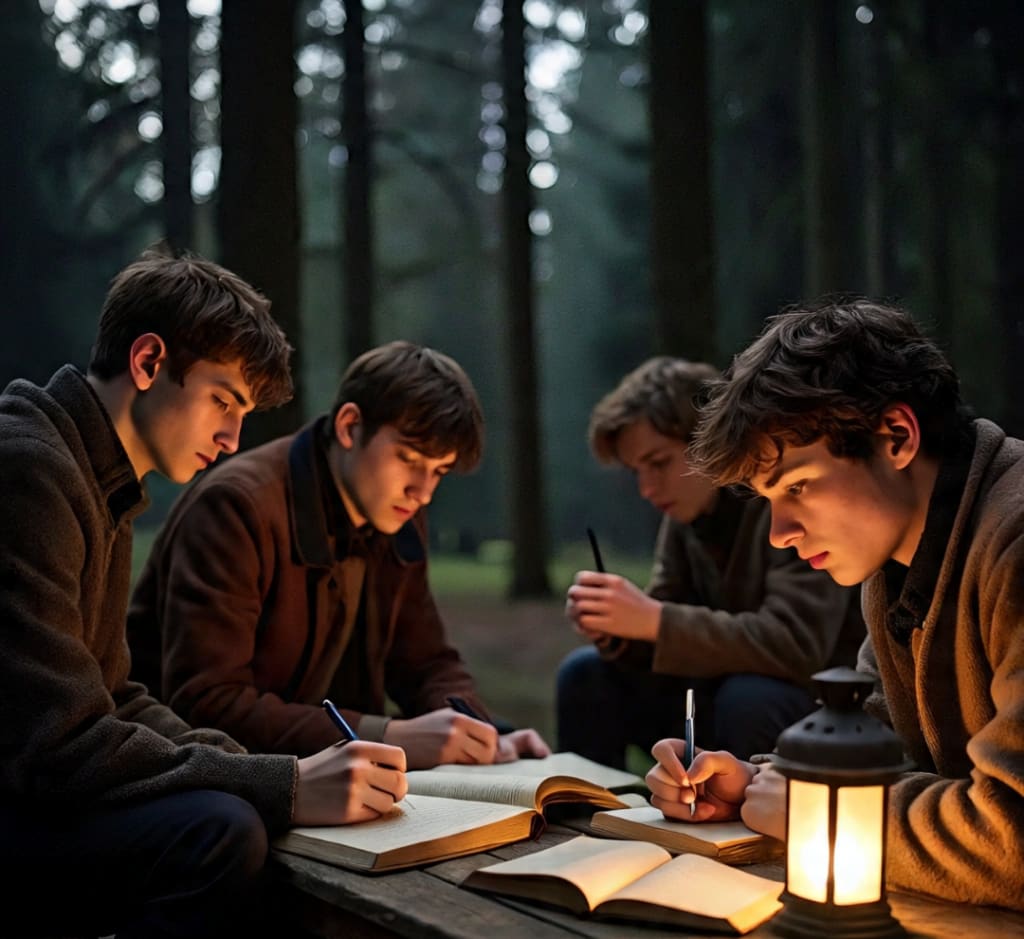
In the heart of the old city of Hilstone, there was a forgotten garden behind a dusty public library. Most people passed by it without paying attention—except a group of boys who believed that words had the power to change the world. They called themselves The Ink-Bound Brotherhood.
The members were not famous, rich, or well-dressed. They were ordinary young men from different backgrounds. Still, every evening, after school, work, or part-time jobs, they gathered to turn their feelings into verses. To them, poetry was not a hobby—it was a lifeline.
The group was led by Rohan, a calm boy with spectacles and a voice that always sounded thoughtful. Rohan never considered himself talented, but everyone knew his words carried depth as if each poem came from a hidden ocean inside him.
Then there was Sameer, the loud one, whose poems were like fire—angry, passionate, filled with emotion too big to stay silent. Bilal, the shy sketch artist, only spoke through his drawings, adding illustrations to everyone’s poetry. Zain, the storyteller, could turn a simple walk to school into an epic adventure. And Arif, the youngest, always questioned everything through short poetic lines that surprised the older members.
Every Friday evening, they held small poetry readings in the garden. They took turns reciting, while the others clicked fingers as applause. They didn’t care about likes, applause, or fame. They wrote for healing, for peace, for hope—and sometimes, just to feel understood.
One day, the garden was suddenly sealed off by construction workers. The library was being renovated, and the garden was to be demolished to build a storage room. The news shattered the group. The place where they had grown as friends, as poets, as people, was about to disappear.
Sameer wanted to protest loudly. Rohan suggested diplomacy. Zain wanted to write a story. But it was Arif who said something simple:
> “If we believe poetry can change hearts, then let us try to change theirs.”
Inspired, they came up with an idea. They wrote a long poem together—each verse by a different member. It spoke about brotherhood, their city, dreams hidden in silence, and a small garden that gave life to their voices. Bilal created drawings around the poem: lanterns, benches, falling leaves, notebooks.
They printed copies and gave them to the library staff and construction manager. At first, the workers smiled but didn’t take them seriously. Yet, something unexpected happened: the library’s head librarian read their combined poem that night. He was moved by the sincerity and unity of their voice.
The next day, the librarian visited the group.
“I didn’t know this garden had a story,” he said.
Rohan replied softly, “Every place that carries feelings becomes a story.”
The librarian convinced the city committee to keep part of the garden intact—not as a storage site, but as a Public Poetry Corner. Instead of destruction, the space was given life, benches, and even a small notice board where anyone could post poems.
The Ink-Bound Brotherhood celebrated that evening, reciting their shared poem in the garden they saved. Their words were no longer just ink on paper; they had changed something real.
And from that day on, the garden was no longer forgotten. It became a home where strangers became poets, and poets became friends.
About the Creator
Keep reading
More stories from Muhammad Saad and writers in Poets and other communities.
The River of Shared Voices
There were many things that made the small town of Riverseed ordinary—its quiet streets, its local shops, and the slow river that hugged its edge like a peaceful old friend. Yet, there was one thing that made the town extraordinary, although most people only realized it much later. The secret began with a single voice.
By Muhammad Saad 3 months ago in Poets
Tatt~Master
— Assembly Line Tatt Machine ~ Impressions to Impress — As I begin to understand more about the Tattoo Phenomenon. I've written silly, yet verbatim, dating site anecdotes in 'Frazzled.' So let me ask you: Would you be More attracted to someone slathered with tattoos, or Less?
By Jay Kantor5 days ago in Humor


Comments (2)
poet community.
Story.