
The Hidden Language Of Crystals: How To Understand Gem Energy
Understanding Gems and Crystals
This document aims to clarify the distinctions between gems and crystals, providing definitions, classifications, and answers to frequently asked questions. By understanding these differences, readers can appreciate the unique qualities of each and their significance in various contexts, particularly in jewelry and mineralogy.
I. Introduction
Crystals and gemstones are often confused, yet they represent distinct categories within the realm of natural materials. Understanding their differences is crucial for anyone interested in geology, jewelry making, or simply appreciating the beauty of these natural wonders.
II. Definitions
Gems
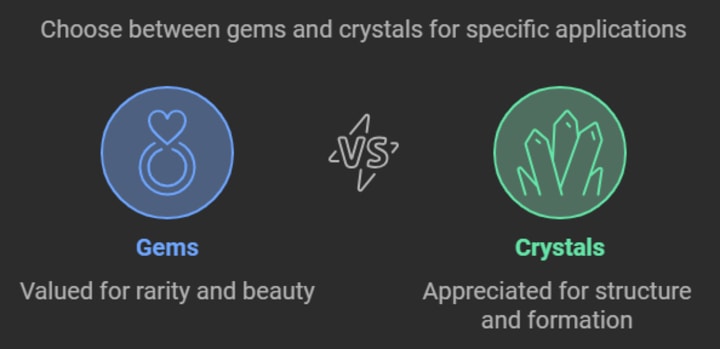
Gems, or gemstones, are rare minerals, rocks, or organic materials valued for their beauty and rarity. They are often cut and polished for use in jewelry, enhancing their aesthetic appeal.
Precious Gemstones
Traditionally, four gemstones are classified as precious: diamond, emerald, ruby, and sapphire. These stones are highly sought after for their rarity and brilliance.
Semi-Precious Gemstones
In contrast, there are many semi-precious stones, which include amethyst, moonstone, quartz, and topaz. While they may not be as rare as precious gemstones, they are still valued for their beauty and unique characteristics.
Crystals
Crystals are defined as pure substances with a regular, repeating, three-dimensional molecular structure. This orderly arrangement gives crystals their unique shapes and properties.
Crystal Categories
Crystals can be classified based on their shape, with common categories including cubic, hexagonal, and others. Each shape reflects the internal structure of the crystal.
Minerals
Minerals are naturally occurring inorganic substances that can be elements or chemical compounds. They often possess a crystalline structure, which is a key characteristic of many minerals.
Stones
The term "stones" is a broad category that encompasses gemstones, crystals, minerals, and rocks. It serves as an umbrella term for various natural materials.
Rocks
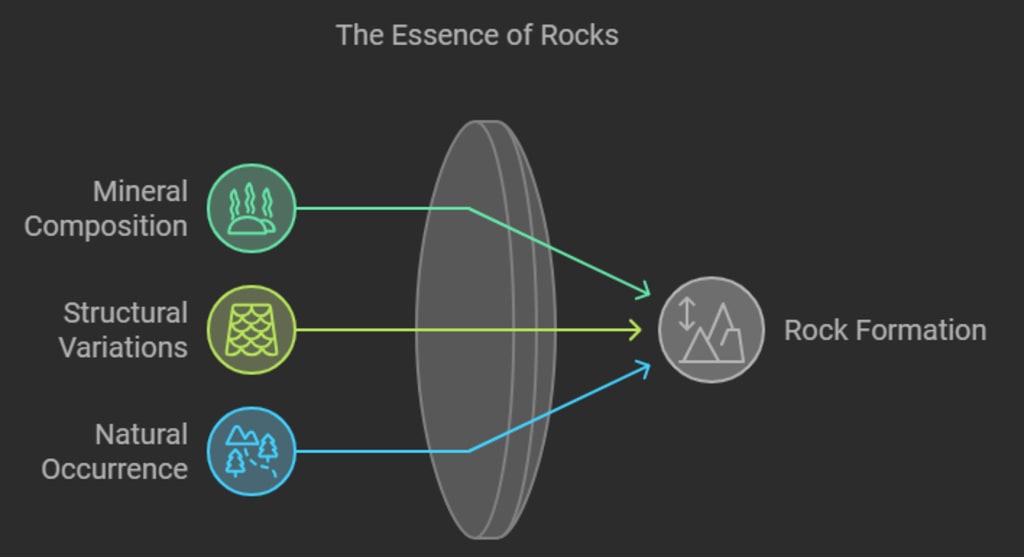
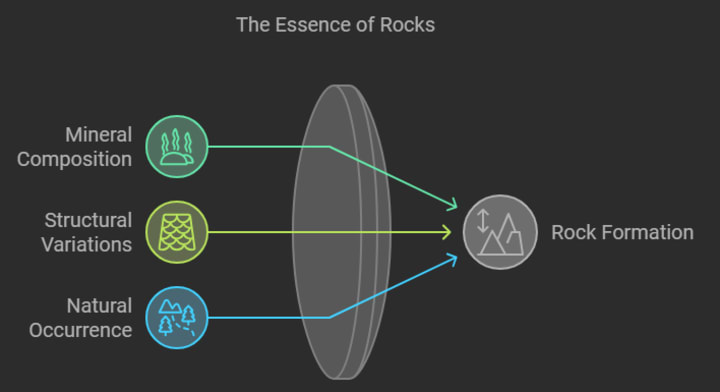
Rocks are defined as naturally occurring solid materials typically composed of multiple minerals. They can vary widely in composition and structure.
III. Frequently Asked Questions
Are Crystals and Gemstones the Same Thing?
Crystals and gemstones are distinct terms. Crystals have a regular geometric pattern, while gemstones are limited to precious and semi-precious stones that are often cut and polished for jewelry.
Are Gemstones Made from Crystals?
Some gemstones are derived from crystals, such as amethyst, quartz varieties, and topaz. These stones originate from crystalline structures.
Is a Crystal a Gem or a Mineral?
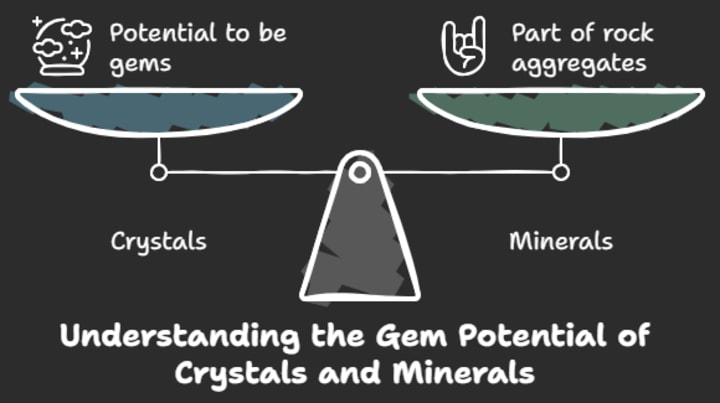
Crystals are not inherently gems but can become gems if cut and polished for jewelry. Minerals often form in crystal structures, but if a mineral is part of an aggregate solid, it is usually considered part of a rock, not a crystal.
What's the Difference Between Minerals and Crystals?
Minerals are naturally occurring inorganic solids with specific chemical compositions, while crystals refer to a material's structure. Many minerals possess the necessary structure to be classified as crystals.
How Do You Identify Crystals and Gemstones?
Crystals are identified by their organized three-dimensional molecular structure, shape, and properties like luster, color, and transparency. Gemstones are typically identified as precious or semi-precious stones used ornamentally.
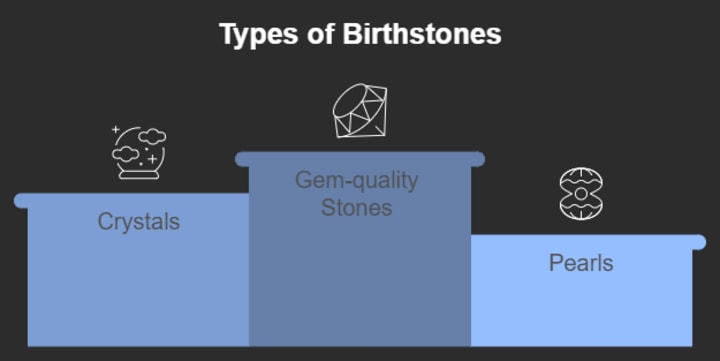
Are Birthstones Crystals or Gems?
Birthstones are typically gem-quality precious or semi-precious stones, making them gems. However, some birthstones, like amethyst, can also be considered crystals. Notably, pearls are examples of birthstones that are not crystals.
By understanding these definitions and distinctions, individuals can deepen their appreciation for the beauty and complexity of gems and crystals, enhancing their knowledge in both jewelry and geology.
About the Creator
Keep reading
More stories from SUNMOONBAY LLC and writers in Poets and other communities.
Gem Business Tips: How to profit from finding and selling gems
Making Money Investing in Gems: A Detailed Guide Making Money Investing in Gems: A Detailed Guide This document serves as a comprehensive guide for individuals interested in investing in gems, providing essential rules and insights to navigate the gem market effectively. It dispels common myths, emphasizes the importance of knowledge and strategy, and offers real-life case studies to illustrate key concepts. By following the outlined rules and continuously learning, investors can enhance their chances of profitability in this unique investment arena.
By SUNMOONBAY LLCabout a year ago in Poets



Comments
There are no comments for this story
Be the first to respond and start the conversation.