
The Hall of Echoed Voices
Where Poets Gather to Build Dreams from Words
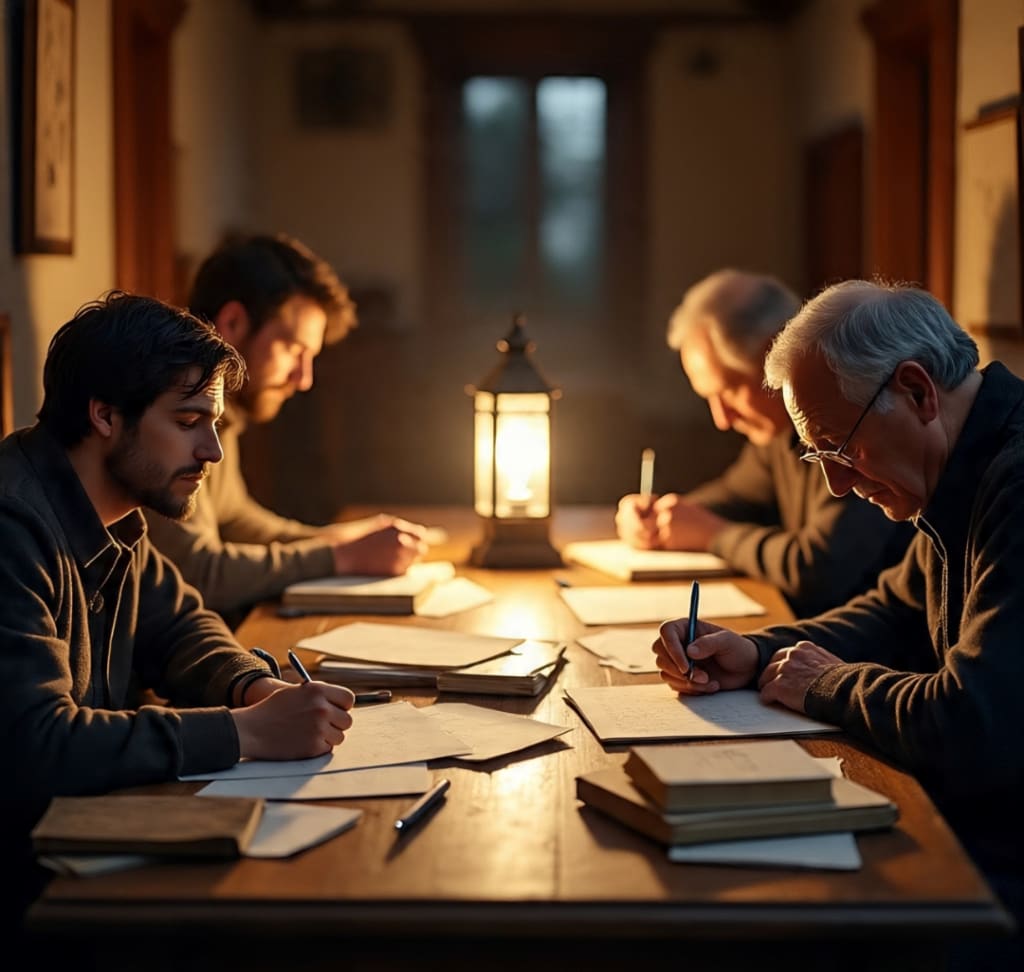
In a quiet corner of the town, beyond the marketplace of noise and beyond the restless rush of streets, stood a hall as modest as a whisper and as wise as a century. The people called it The Hall of Echoed Voices, but poets called it home.
Every night, when the lantern was lit and shadows began to speak on the walls, the poets arrived carrying paper, stories, silence, and dreams still unformed. It did not matter who they were outside—some were tailors, some were teachers, one even sold tea in a wooden cart—but once they stepped into the hall, they became keepers of words.
The youngest among them was Azeem, a boy of seventeen with questions more than answers and verses more than rules. He wrote with excitement, messy and sincere, like a river discovering its own path.
The oldest was Baqir, his beard white as a forgotten winter, his voice soft like an old book. He wrote slowly, carefully, as though every word had to be respected before it was allowed to exist.
There was Rafi, who spoke less and listened more. He believed silence had rhythm and believed deeply that poems were simply silent songs given names. He wrote poetry on the backs of receipts, sometimes on walls, sometimes on his own palms, because inspiration never waited for paper.
Lastly, there was Sultan, a man of strong build and quiet observation. While others wrote, he would sit, watch, and sketch lines of poetry with the calm of a craftsman shaping wood. He said poems were carved, not written.
Each night, they gathered around the lantern, and the hall became a living heartbeat of ink. They read aloud their verses—some trembling, some bold, some broken, some whole. No one mocked, no one competed. They listened with reverence, because here, poetry was not a show; it was truth being uncovered.
Azeem once asked,
“Master Baqir, how does a poet know if his poem is good?”
Baqir smiled the slow smile of someone who had watched many words grow wings.
“A poem is not good because others clap,” he replied.
“It is good when it refuses to leave your heart after you write it.”
The hall echoed with understanding, with nods, with shared silence.
Some nights, they wrote about the moon that kept them company. Some nights about unseen pain. Some nights about hope that stubbornly refused to die. They wrote for the farmer who could not sleep, for the laborer who hummed songs of hunger, for the children chasing kites of forgotten dreams, and for themselves—broken, healing, learning.
The Hall of Echoed Voices became more than a place; it became a bridge of souls, built by lines of poetry. The community that gathered there did not write to become famous; they wrote because they felt alive only when words breathed through them.
And one night, after years of meeting, Baqir said, “One day, my friends, this building may fall, but our echoes will not. Poets do not live in halls. They live in hearts that feel.”
The lantern flickered as if agreeing.
So the poets continued, night after night, carrying not just ink and paper, but the power to turn silence into gold, and ordinary life into endless poetry.
About the Creator
Keep reading
More stories from Muhammad Saad and writers in Poets and other communities.
Center Stage with Paul Stewart
*** I'm keen to republish the interviews I did for my series with Vocal creators. It's been a few years and I thought it might be nice to revisit these wonderful conversations. I'll be releasing them one at a time for a few weeks/months.
By Heather Hublera day ago in Interview




Comments
There are no comments for this story
Be the first to respond and start the conversation.