
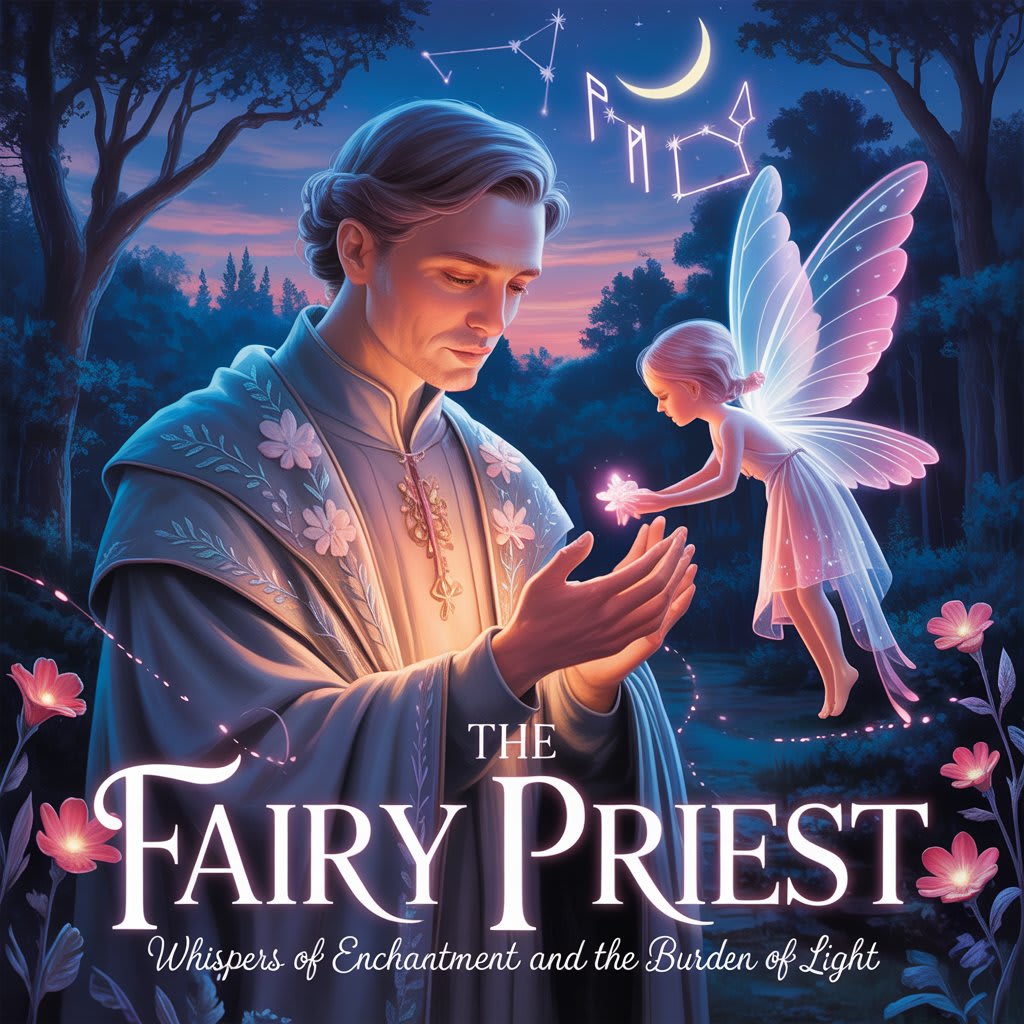
The Fairy Priest
Whispers of Enchantment and the Burden of Light"

The Eternal Flame: Celebrating the Greatest Romantic Poets
In the garden of human expression, the Romantic poets are the roses—fragile yet fierce, delicate yet daring, and always blooming in defiance of reason. The Romantic era, spanning the late 18th to mid-19th century, brought forth voices that sought the sublime in emotion, nature, imagination, and rebellion. Their words became oaths of the heart, whispered to time.
Let us walk through the ethereal gallery of the greatest Romantic poets—those who lit candles of longing and love in the shadows of reason and rule.
1. William Wordsworth: The Priest of Nature
William Wordsworth (1770–1850) was the soul who listened to the wind as though it were the voice of God. His poetry reflects a sacred reverence for nature, believing it to be a reflection of the divine and a balm for the wounded heart.
In his prelude to Romanticism, Wordsworth declared:
"Poetry is the spontaneous overflow of powerful feelings: it takes its origin from emotion recollected in tranquility."
From “Lines Composed a Few Miles Above Tintern Abbey”, he writes:
“These beauteous forms,
Through a long absence, have not been to me
As is a landscape to a blind man's eye:
But oft, in lonely rooms, and 'mid the din
Of towns and cities, I have owed to them
Sensations sweet, felt in the blood, and felt
Along the heart.”
Wordsworth believed that true joy and wisdom came not from society but from nature’s embrace. His was a romanticism of serenity, where hills spoke truth and rivers washed away pain.
2. Lord Byron: The Rebel Lover
George Gordon Byron, 6th Baron Byron (1788–1824), was poetry’s dark flame—a scandalous, brilliant, irresistible soul whose life mirrored the passion of his verses. Byron was the embodiment of the "Byronic Hero": proud, brooding, charismatic, and doomed.
He said of himself:
“I am such a strange mélange of good and evil that it would be difficult to describe me.”
From “She Walks in Beauty”:
“She walks in beauty, like the night
Of cloudless climes and starry skies;
And all that's best of dark and bright
Meet in her aspect and her eyes…”
Byron romanticized sorrow and made melancholy a crown. He loved deeply, rebelliously, and often self-destructively. But in all his loves—be they people or ideals—he never flinched from passion’s edge.
3. Percy Bysshe Shelley: The Dreamer of Hope
If Byron was fire, Shelley was air—unbound, idealistic, and eternally in pursuit of a better world. Percy Bysshe Shelley (1792–1822) sought not only beauty but also transformation. His poetry was as much a cry for justice as it was a kiss from the stars.
In “Love’s Philosophy”, he muses:
“The fountains mingle with the river
And the rivers with the ocean,
The winds of heaven mix forever
With a sweet emotion…”
And yet, in “Ozymandias”, he reminds us of time’s cruel erosion:
“Look on my Works, ye Mighty, and despair!
Nothing beside remains. Round the decay
Of that colossal Wreck…”
Shelley was a poet who dared to love the world not as it was, but as it should be. In his vision, even revolution could be romantic, and despair could bloom into renewal.
4. John Keats: The Fragile Flame
John Keats (1795–1821) lived but twenty-five years, yet his work possesses the timeless ache of eternity. More than any other Romantic, Keats was obsessed with beauty—not merely physical, but spiritual and tragic. He believed that beauty was truth, and that truth was all we ever needed to know.
From “Ode to a Nightingale”:
“Fade far away, dissolve, and quite forget
What thou among the leaves hast never known,
The weariness, the fever, and the fret
Here, where men sit and hear each other groan…”
And the immortal lines from “Ode on a Grecian Urn”:
“‘Beauty is truth, truth beauty,—that is all
Ye know on earth, and all ye need to know.’”
Keats loved with a yearning that bled into every syllable. His tragic romance with Fanny Brawne, cut short by his illness, adds a haunting gravity to his lines. He died whispering his own epitaph: “Here lies one whose name was writ in water.”
5. Elizabeth Barrett Browning: The Voice of Sacred Love
One of the few female giants in the Romantic tradition, Elizabeth Barrett Browning (1806–1861) brought intellect, faith, and deep emotional nuance to her poetry. Her famous “Sonnets from the Portuguese” is among the most tender and exalted expressions of romantic love ever written.
From Sonnet 43:
“How do I love thee? Let me count the ways.
I love thee to the depth and breadth and height
My soul can reach…”
Her love for Robert Browning was not only poetic—it was defiant, enduring, and transformative. Her poetry radiates with a purity that seems to reach beyond mere human affection toward something divine.
Why Romantic Poets Still Matter
In a world driven by logic and speed, the Romantic poets remind us to pause—to feel. They teach us to find the infinite in a single tear, a dying rose, or a line of verse that shivers through the ages.
Their poetry was not written from ivory towers but from forests, windswept cliffs, candlelit rooms, and broken hearts. They remind us that it is not weakness to weep, nor foolishness to dream. They gave language to longing and clothed the soul in metaphor.
Conclusion: The Fire Still Burns
To read the Romantic poets is to kneel at the altar of human emotion. It is to believe, even for a moment, that love is holy, that nature speaks, and that words can resurrect what time tries to kill.
They may have passed, their bodies turned to dust, but their verses are immortal flames. And so, when we whisper “She walks in beauty,” or “I love thee to the depth and breadth and height,” we are not merely quoting lines—we are lighting candles in the cathedral of love.
About the Creator
Nomi
Storyteller exploring hope, resilience, and the strength of the human spirit. Writing to inspire light in dark places, one word at a time.
A Historic Declaration
We the People of the Husbands of the United States of America, in Order to form a more perfect Union, and I mean you...with me...establish Justice, insure domestic Tranquility, provide for the common defence, promote the general Welfare, and secure the Blessings of Liberty to ourselves, after Puberty, do ordain and establish this Declaration of Co-Dependence.
By Gerard DiLeo5 days ago in Humans



Comments
There are no comments for this story
Be the first to respond and start the conversation.