
The City Where Sleep Was Outlawed
When Night Was Erased

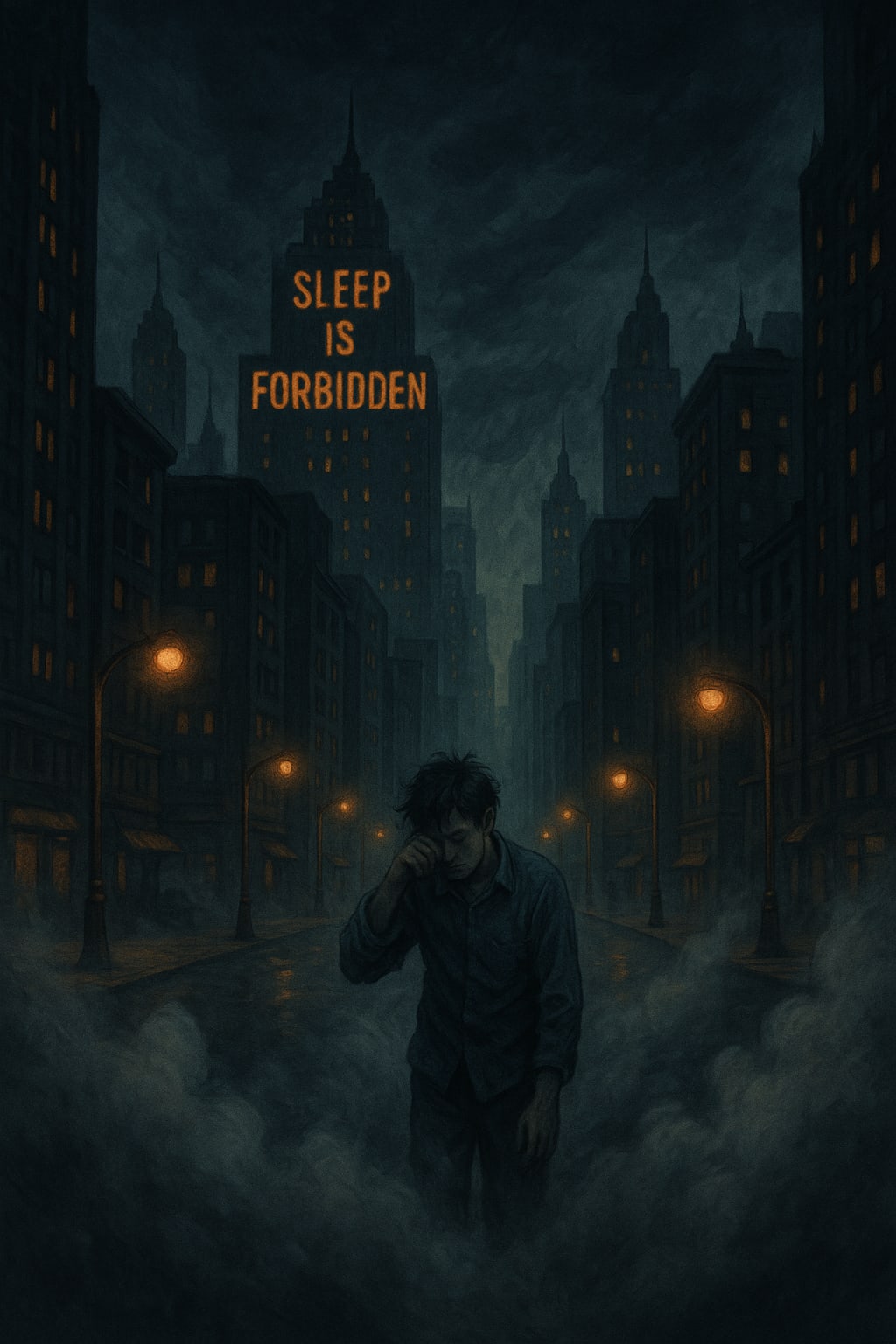
They called it progress.
They always do.
I. The Law of Wakefulness
The decree was passed one hundred and three years ago, carved into steel tablets and broadcast across the endless avenues of Noctis: to sleep is to vanish.
The Council framed it as survival. Sleep, they said, was inefficient. Dreams were wasteful, ungovernable, a threat to order. Why surrender half a life to unconsciousness when every hour could be measured, taxed, and put to work?
It began with curfews reversed—lights that never dimmed, factories that never stopped, schools that rotated in shifts so children learned the alphabet at dawn or midnight without distinction. Then came the “Seven-Minute Rule”: eyes could close, but not long enough for dreaming. Rest was a blink stretched, no more.
At first, people laughed. They thought the law impossible. But then came the vanishings.
A handful of rebels, eyes swollen shut, who dared defy the decree were found gone by morning. Their beds empty, their bodies erased. The Council called it “dream-disappearance.” The citizens called it fear.
And soon, no one dared to close their eyes.
II. The Machinery of Wakefulness
The city adapted. It always does.
Caffeine became currency. Pills were rationed by the state, stimulants subsidized for the poor. Coffee houses replaced churches, buzzing with the faithful at all hours. To drink was not pleasure, but duty.
Neon became sun. Towers blazed day and night, humming with false light until even shadows forgot how to stretch. Billboards scrolled propaganda in glowing fonts: Stay Awake. Stay Alive.
Parents sang children to wakefulness, lullabies inverted into jingles about vigilance. “Sleep is the thief,” they told them. “Sleep steals you.”
And work never ended. Time ceased to divide into day or night; there was only the endless now, punctuated by alarms and deadlines.
The body learned to endure. But the soul? It frayed.
III. The Tiredness That Spread
It is difficult to describe the exhaustion of Noctis. Not tiredness as you know it, but something deeper, marrow-deep.
Eyes burned without tears. Hands twitched endlessly, unable to unclench. Thought slowed, but never enough to stop. Children grew tall without ever knowing what it meant to dream of flying. Lovers kissed under fluorescent skies, their passion dulled by the constant hum of lights.
The people forgot lullabies. They forgot silence. They forgot themselves.
Some died standing upright, their hearts failing before their eyes ever dared to close. These were called “honorable vanishings”—proof that the body could obey even to the end.
IV. Whispers Underground
But every city breeds whispers.
They said there were rebels who still dreamed. That deep underground, beneath the endless neon, hidden beds lay warm with sleepers. That these sleepers dreamed for everyone, bearing the collective unconsciousness like Atlas carrying the sky.
The Council denied it, of course. They called it subversion. But denial only fuels belief. And the people longed to believe.
Some claimed they’d seen the dreamers’ faces in flashes—reflected in puddles, mirrored in glass, serene and whole, their breathing slow and sure. Some said the dreamers shaped the vanishings themselves: calling rebels into the hidden depths, gathering them into a secret kingdom of night.
The rumor spread: the dreamers wait. And when enough awaken to the need for sleep, they will rise.
V. My Confession
I did not intend rebellion. I only intended rest.
One night, beneath the unblinking glow of the city, I closed my eyes longer than permitted. At first there was panic, a rush of guilt. But then—a hush, softer than law, softer than neon.
I thought I heard singing. I thought I heard my own name. Not from the living, but from the quiet itself.
When I opened my eyes, I was still here. But something had shifted. A crack opened in me, a fissure of longing.
Since then, I carry the rumor like a heartbeat. I write these words in secret, between alarms, knowing that if they are found, I too may vanish.
But I believe the truth:
The dreamers exist.
The dreamers wait.
And I believe the greatest crime is not in sleeping—
but in forgetting how.
About the Creator
Alain SUPPINI
I’m Alain — a French critical care anesthesiologist who writes to keep memory alive. Between past and present, medicine and words, I search for what endures.
Keep reading
More stories from Alain SUPPINI and writers in Poets and other communities.
Mastering French Without Losing Your Sanity: A Realistic Guide for Beginners
Learning French can feel like solving a Rubik’s Cube blindfolded. The tricky pronunciation, the never-ending grammar rules, and the surprising exceptions make it seem impossible. But don’t worry—equipping yourself with key expressions and effective strategies can turn frustration into fluency. Let’s simplify French and make learning enjoyable.
By Alain SUPPINIExclusive • 11 months ago



Comments (1)
What a crazy reality that would be. I would most certainly be one of the ones who vanish.