

Intelligent people care more about their mistakes.
It’s a well-known maxim in leadership circles and management.
They act that way because they know that the future
unfolds more smoothly when you try to avoid
compounding mistakes with more stupid mistakes.
____________________________________________________
“Fear never built a boardwalk.”
____________________________________________________
Sunshine
The mayor’s face glistened under the television lights as if someone had rubbed it with bacon grease. He sat low in the chair, spreading himself like a man who owned whatever he touched — the chair, the town, and, if necessary, the weather itself. The young reporter, who sounded like someone who believed in science, asked him about the upcoming forecast: a line of severe storms was expected to hit the coast hard just in time for the annual boardwalk festival.
The mayor chuckled the way a deacon chuckles when a child recites Scripture badly. “In fifty years,” he said, wagging his finger at the camera, “we’ve had maybe two storms worth remembering. Two! Folks come here because we’ve got reliable skies. Sunshine’s our industry. You don’t bankrupt a town with worry over shadows in the clouds.”
The reporter tried again, her eyes on the notes in her lap. “But the long-range models say—”
“Models, my butt,” he interrupted, tugging at his collar. “That’s ivory-tower guesswork. Conservative common sense tells me the Lord runs a balanced universe. He doesn’t drop a flood on the righteous every time some graduate student fiddles with a chart. Fearmongering is what it is. And let me tell you, fear never built a boardwalk.”
That clip was in every corner of the county by sundown. The believers printed it out as proof they’d chosen a man of backbone. The unbelievers played it on loop, calling him a weather-denying ignoramus. But he read only the clippings that pleased him, the ones that praised him for calm leadership. He taped one above his desk: Mayor Defends Tradition Against Alarmists.
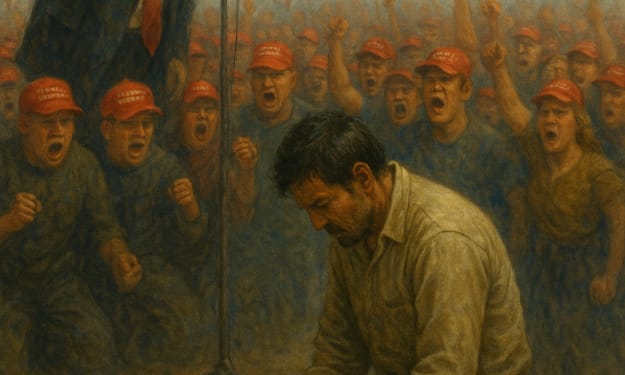
By the week’s end, the sky was the color of dishwater and the air squeezed down like a mash press. Emergency services planned for evacuations, but the mayor brushed them aside. “We don’t bow to hysteria,” he told the council. “We’ve got a festival, and we will have it, rain or shine.” The mayor was a well-known bully with a vindictive streak painted down the front of every outfit he owned. Nobody wanted to get in his cross-hairs by thwarting his demands.
The festival began with its usual brass music and fried foods, but the sky suddenly darkened. A banner whipped into an old man’s face, the mayor spread his arms and called it a “refreshing breeze,” and then the breeze became a gale. Cotton candy dissolved into pink froth, a tuba gurgled like a drowning man, the ferris wheel teetered sideways, children shrieked as cars jammed the only road out—while the mayor, hair plastered down and tie hanging like a wet rag, clung to the podium and shouted there was no cause for panic as everyone around him panicked.
The cameras loved it. On the evening news, every TV station spliced his festival fiasco against his calm smile from the studio. “In fifty years, maybe two storms worth remembering”—cut to him clinging to the podium while tents cartwheeled past. In the morning, the state's largest newspaper ran his image on the front page with a picture of him, sopping wet, under the headline: MAYOR WHO PROMISED SUNSHINE.
He crumpled the paper and closed his office blinds against the still-storming morning. On the television he saw his face, gleaming and smug from before the storm. Now it made him look stupid. Just for an instant, a silent sensation flickered in his mind that his stupidity had endangered them all—his neighbors, their children, the whole town. For less than a second, his gut felt like someone had driven him over a big bump at high speed. Then it passed.
He pulled out a yellow pad, licked the tip of his pencil, and began to write a statement. He blamed the panic on media sensationalism. He accused “so-called experts” of undermining prosperity. He praised the townspeople for “standing firm against alarmists, defeatists, and enemies of freedom.” When he finished, he leaned back, pleased, having smothered the pathetic flicker of self-awareness.
Outside, the streets ran with floodwater, carrying away the festival’s bright-colored debris like blasphemous offerings to a false god.
About the Creator
William Alfred
A retired college teacher who has turned to poetry in his old age.
Keep reading
More stories from William Alfred and writers in Poets and other communities.


Comments
There are no comments for this story
Be the first to respond and start the conversation.