
Shall I compare thee to a summer’s day? By William Shakespeare
William Shakespeare’s is one of his most iconic poems, exploring the themes of beauty, time, and immortality. By comparing his beloved to a summer’s day, Shakespeare highlights their superior and enduring qualities. The poem immortalizes this beauty through the timeless power of poetry.

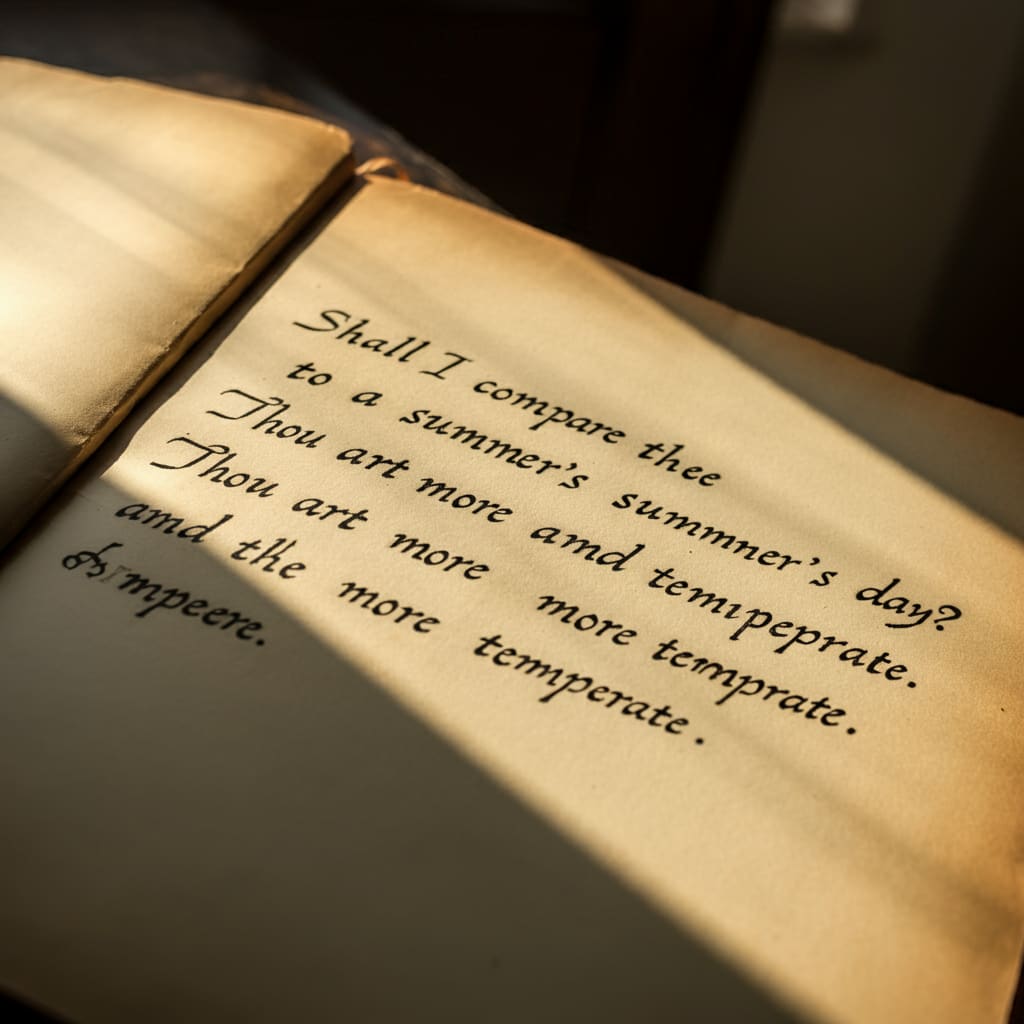
William Shakespeare’s often titled “Shall I compare thee to a summer’s day?”, is one of the most celebrated and analyzed poems in English literature. It serves as a timeless exploration of beauty, immortality, and the power of poetry. This article unpacks the poem stanza by stanza, revealing the nuanced meanings and artistic brilliance that have captivated readers for centuries.
"Shall I compare thee to a summer’s day?
Thou art more lovely and more temperate:"
The poem begins with a rhetorical question that sets its central theme: comparing the beloved to a summer’s day. Shakespeare, however, immediately answers his query by stating that the beloved surpasses summer in beauty and consistency. The use of "lovely" and "temperate" suggests both physical beauty and inner harmony. Unlike summer, which can be erratic and fleeting, the beloved’s qualities are enduring and balanced.
Here, the poet establishes a contrast between the impermanence of nature and the lasting nature of the subject's beauty. This comparison also introduces a broader theme—how art and poetry can preserve and elevate beauty beyond the limitations of time.
"Rough winds do shake the darling buds of May,
And summer’s lease hath all too short a date:"
Shakespeare emphasizes the imperfections of summer, highlighting its transience and susceptibility to external forces. "Rough winds" symbolize the disruptions that can mar natural beauty, while "darling buds of May" evoke the fragile and fleeting nature of spring’s early blooms. The word "lease" metaphorically underscores summer’s temporary tenure, implying that even the most glorious seasons are bound by time.
This imagery reinforces the idea that nature’s beauty is short-lived, contrasting with the timeless essence of the beloved. Shakespeare subtly introduces the notion that poetry can transcend these natural limitations.
"Sometime too hot the eye of heaven shines,
And often is his gold complexion dimm'd;"
Here, Shakespeare personifies the sun as the "eye of heaven" and acknowledges its duality. While the sun symbolizes vitality and brilliance, it can also be overpowering ("too hot") or obscured by clouds ("dimmed"). This reinforces the poem’s theme of inconsistency in nature, where even the celestial sun is subject to imperfections.
By contrast, the poet implies that the beloved’s beauty is neither overwhelming nor diminished—it is steady and unblemished. This section subtly underscores the idea that human attributes, when idealized in poetry, can surpass the physical world.
"And every fair from fair sometime declines,
By chance or nature’s changing course untrimm'd;"
In this couplet, Shakespeare acknowledges the inevitability of decay. "Every fair from fair" refers to all forms of beauty eventually fading, whether due to external accidents ("chance") or the natural passage of time ("nature’s changing course"). The word "untrimm'd" evokes the image of a once-pristine object losing its shape or luster.
This acknowledgment of transience serves as a prelude to the poem’s turn (volta). While natural beauty is subject to decline, the poet suggests that artistic preservation offers an alternative to this decay.
"But thy eternal summer shall not fade,
Nor lose possession of that fair thou ow’st;"
With the word "but," the poem pivots to its central claim: the beloved’s beauty defies the ravages of time. Shakespeare introduces the concept of an "eternal summer," a metaphor for everlasting vitality and charm. Unlike the natural summer, which is fleeting, this "eternal summer" will endure indefinitely.
The phrase "that fair thou ow’st" can be interpreted as the beloved’s innate beauty, which is portrayed as a possession. This beauty becomes immortal through poetry, immune to the decay that affects all earthly things.
"Nor shall death brag thou wander’st in his shade,
When in eternal lines to time thou grow’st:"
Shakespeare personifies death, portraying it as a boastful figure who cannot claim the beloved. The metaphor of "wander’st in his shade" suggests succumbing to mortality, yet the poet asserts that the beloved will not be relegated to oblivion.
The "eternal lines" refer to the poem itself, which acts as a vessel for preserving the beloved’s essence. By inscribing the beloved in verse, Shakespeare ensures that their beauty and spirit will "grow" through time, reaching future generations.
"So long as men can breathe or eyes can see,
So long lives this, and this gives life to thee."
The concluding couplet delivers a resounding statement on the power of art. As long as humanity exists, the poem will endure, granting immortality to the beloved. The repetition of "so long" emphasizes the perpetual nature of this preservation.
Shakespeare’s assertion underscores his confidence in the durability of his work. He defies time and mortality by immortalizing the beloved in verse, ensuring their legacy remains undiminished.
1. The Transience of Nature vs. The Permanence of Art
The sonnet juxtaposes the fleeting beauty of nature with the eternal nature of poetry. While summer fades and beauty declines, the beloved’s essence is immortalized through Shakespeare’s art.
2. Immortality Through Poetry
Shakespeare champions the idea that poetry can grant eternal life. The "eternal lines" of the poem serve as a metaphor for this transformative power, allowing the subject to live on beyond their physical existence.
3. Personification
Throughout the poem, Shakespeare uses personification to animate natural elements (e.g., "rough winds," "the eye of heaven") and abstract concepts (e.g., "death brag"). This technique deepens the emotional resonance of the poem and emphasizes its themes.
4. Metaphor and Imagery
The "summer’s day" serves as an extended metaphor for beauty and perfection, while imagery like "rough winds" and "gold complexion dimm'd" vividly conveys nature’s imperfections.
5. Structure and Rhyme Scheme
Written in the traditional Shakespearean sonnet form, the poem consists of 14 lines with an ABABCDCDEFEFGG rhyme scheme. The final rhyming couplet delivers a powerful resolution, encapsulating the poem’s message.
Conclusion
Masterful exploration of beauty, time, and the enduring power of art. Through its intricate metaphors, vivid imagery, and confident assertions, the poem transcends its era to remain a cornerstone of literary achievement. By immortalizing the beloved in his verse, Shakespeare not only celebrates their beauty but also affirms the transformative capacity of poetry to defy time and mortality.
Even centuries later, the poem’s resonance remains undiminished. It is a testament to Shakespeare’s unparalleled ability to capture universal truths and elevate the human experience into the realm of the eternal.
About the Creator
Muhammah Hanzalah
Passionate about history and culture. Join me on Vocal Media for captivating insights into hidden historical gems and diverse cultural traditions. Let's explore the rich tapestry of our shared heritage and artistic expressions.
Keep reading
More stories from Muhammah Hanzalah and writers in Poets and other communities.
From you have I been absent in the spring by William Shakespeare
"From you have I been absent in the spring, When proud-pied April, dressed in all his trim," The speaker begins by lamenting their separation from the beloved during spring, a time traditionally associated with renewal and joy. The phrase "proud-pied April" refers to April’s multicolored vibrancy, highlighting the rich and varied beauty of the season. The imagery of April "dressed in all his trim" suggests nature adorned in its finest attire, signaling abundance and life. However, despite this lively scene, the speaker feels disconnected because of the beloved’s absence.
By Muhammah Hanzalahabout a year ago in Poets
Top tipple tricks
Been thinking a lot about drinking, lately. Not least because of a recent episode of over-indulgence and the inevitable after effects. Some readers may recall the earlier articles I wrote about beating the booze. Here I set out an experiment in techniques for cutting down on my alcohol intake. The experiment was successful, the techniques worked, and I have armed myself with an arsenal of weapons in the war against the demon drink. I have yet to fire the first round however. It's all a question of timing (perhaps procrastination).
By Raymond G. Taylor5 days ago in Psyche



Comments (1)
Beautiful ✍️🏆♦️♦️♦️♦️♦️