
Not a Rulebook, but a School of Love
When Stone Learns to Breathe

Beloved,
You have heard it said: The Law is a wall, a book of rules, a list of what not to do.
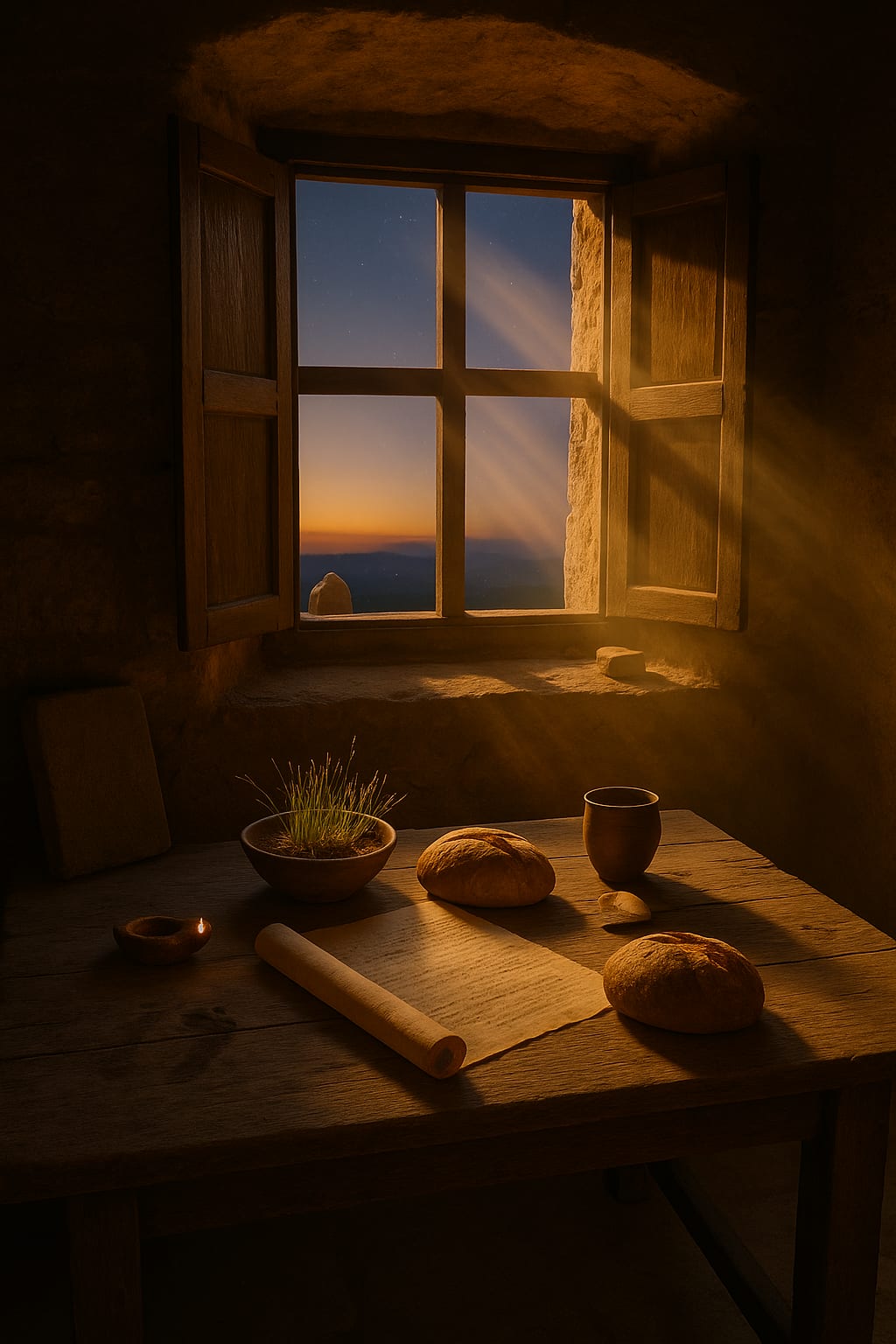
But I tell you, the Law is a window.
Christ does not shatter it.
He leans upon its frame,
opens the shutters,
and lets the light pour through.
Fulfillment does not tear the page.
It changes how the page is read.
Stone becomes flesh.
Code becomes covenant.
What once was letter becomes Spirit.
The commandments are not chains.
They are the shape love takes when it learns to walk in the dust of the earth.
“Do not steal” becomes love refusing to trample another’s bread.
“Do not bear false witness” becomes love guarding the fragile trust of a village.
“Do not covet” becomes love refusing to measure itself against another’s gifts,
choosing instead to be grateful, to be free.
The Sabbath?
It is not a prohibition.
It is love daring to rest,
to lay tools down in the field and whisper,
“The world does not turn because I push it.
It turns because God holds it.”
These are not hoops.
They are the grammar of fidelity.
The music of covenant.
But hear this, too:
Rules are good servants but terrible masters.
Left on their own, they grow brittle.
They turn a feast into a ration book,
a covenant into a contract.
The Pharisee counts coins of obedience.
The lover brings flowers.
Both may spend,
but only one has understood the heart of the Bridegroom.
The Law, when lived without love,
becomes a cage.
The Law, when fulfilled in Christ,
becomes a school where the Spirit is the Teacher.
Do not mistake shadow for substance.
The old words served as scaffolding for a house that is not yet complete.
Christ is the cornerstone, the dwelling itself.
Some still cling to the scaffolding as if it were permanent,
forgetting it was built only to hold the beams until the house stood strong.
Animal sacrifice, temple rites, ritual purity
all were signs pointing forward.
The Lamb became the Lamb of God.
The temple became His Body.
Purity became the posture of the heart.
To cling to the husk once the grain has ripened
is to chew shells when the feast has already been set.
Some treat the commandments like court decrees,
as though the Torah were a judge’s gavel.
But Torah means “teaching,” not “penal code.”
It is not the bark of orders,
but the song of covenant.
“Do not” is not a prohibition;
it is a promise:
“This is what love looks like when it breathes.”
So Christ does not discard.
He deepens.
“You shall not murder” becomes “Do not hate.”
“You shall not commit adultery” becomes “Honor the heart, even in desire.”
The old Law guarded the edges of the field.
The new Law plants the seed in the center of the heart.
But many misuse it.
Some wield the old words like weapons,
quoting punishments as though the Cross had never been lifted.
Others cast the words aside altogether,
as though the prophets were silenced when the veil tore.
Both are blind.
The Old is not trash.
It is the seed.
Christ is the flower.
The old is the night sky, stars scattered bright.
The New is dawn.
The stars are not despised;
they are fulfilled in the Sun.
The old is a sketch of a face.
The New is the Person arriving in the room.
You do not erase the sketch
you behold what it pointed to.
Commandments are not laws.
Laws are external weights.
Commandments are vows within a covenant.
They belong to a table, not a courtroom.
In Christ, they are inscribed within the soul itself,
not pressed from outside like shackles.
This is why the Spirit is called Paraclete
not a warden, but a Friend at your side,
writing love within you as naturally as breathing.
We call it freedom
not the freedom from obligation,
but the freedom for love.
Not a shrinking of the Law,
but its transfiguration.
I once read about an “eleventh commandment”:
Create, invent, take initiative, and change the world.
Not rebellion,
but fidelity so alive it must overflow.
Think of a child first tracing letters with a trembling hand.
The lines are stiff.
The ink smudges.
But the day comes when the letters dance into poetry.
So, too, with the commandments:
from stiff obedience
to living creativity.
From stone tablets
to a burning heart.
A map is good until the Guide arrives.
Then the lines give way to a voice:
“Follow Me.”
The map is not discarded
it is transfigured by the living Presence.
The paths are no longer abstractions;
They are footsteps in the sand beside yours.
You see, my friend,
the Gospel does not ask less than the Law.
It asks for more.
But it gives more.
For the Author Himself steps into you,
so that His commands are no longer heard as foreign orders
but as the pulse of your own reborn heart.
So do not read the Bible as a ticket book of infractions.
Read it as a covenant song.
Not “don’t, don’t, don’t,”
but “this is what love looks like when it speaks,
when it works,
when it rests,
when it touches another’s life.”
You are not escaping the Law.
You are inhabiting it
because its Giver lives in you.
The Spirit inscribes the letters again,
this time not on Sinai’s stone,
but upon your very breath.
And so the invitation stands:
Walk in freedom.
Not freedom without form,
but freedom shaped by love.
A love that protects,
a love that creates,
a love that fulfills.
About the Creator
Joe Sebeh
Friend, Brother, and Son to all. I invite you without fear to a sacred world of wonder, to stories and poems that transport you to new worlds, and above all, to encounter God's presence in the broken, the holy, and all that lies in between.


Comments (1)
So beautiful and full of life wisdom 💥🌸🩷🌝🔥