
"Nor the Demons Down Under the Sea"
An Essay on "Annabel Lee" by Edgar Allan Poe

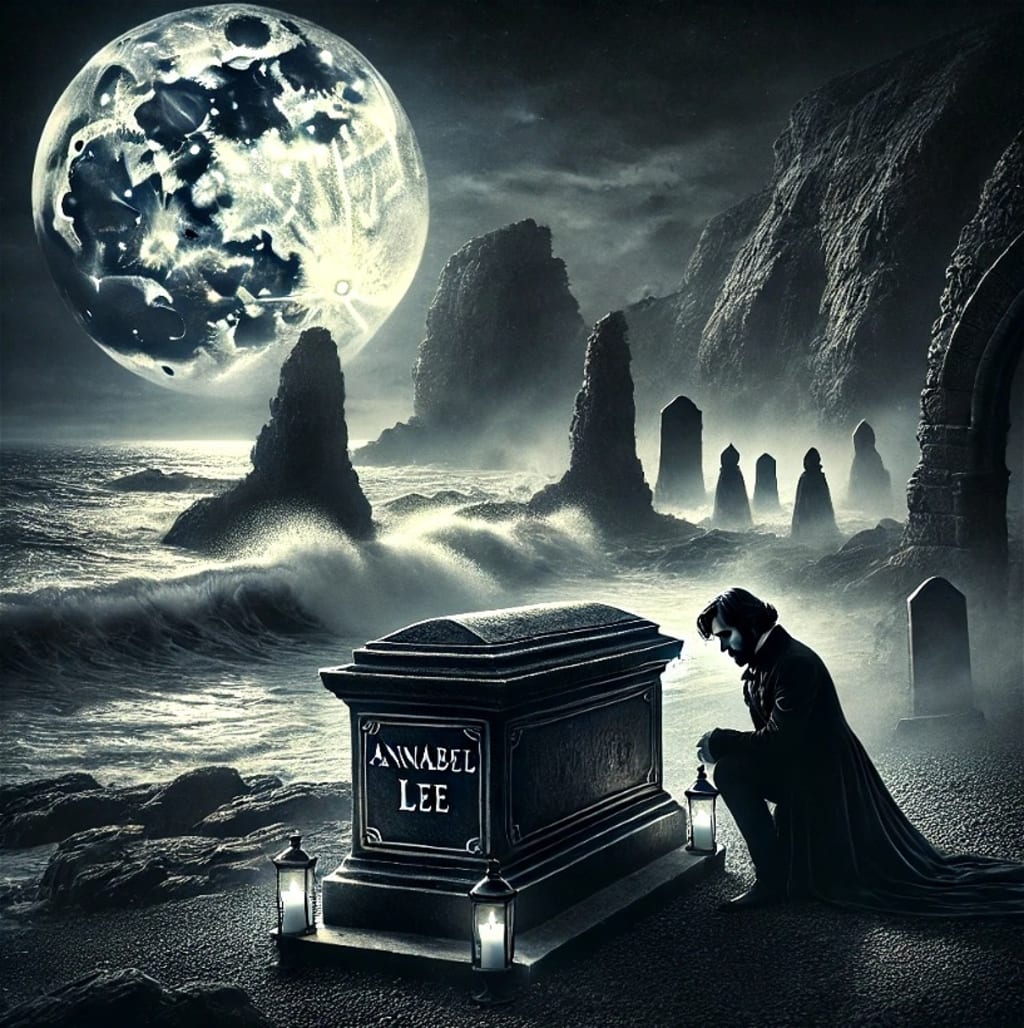
"Annabel Lee" is Poe's low, mournful, mystical Medieval ballad written to memorialize his beloved Virginia Clemm.
The virginal child-bride of Edgar Allan Poe died of consumption, a common enough disease, but her death rocked the already unstable and doomed versificator to his very core, so much so that he spent the rest of his life resurrecting and destroying her image, assuaging his guilt—or attempting to. She is Ligeia, Lenore, and Madeline Usher (or perhaps none of them).
Annabel Lee is also, who "many and many a moon ago, in a kingdom by the sea," lay down in the frigid grip of unstoppable Time, frozen stiff and stark in her shroud by the blowing, icy gale. This maiden had lived with "no other thought than to love and be loved by me."
"I was a child and she was a child," exclaims the balladeer, the man of insurmountable sorrows and woe, in "this kingdom by the sea." Indeed, Annabel, or rather Virginia, was a literal child, a waif tempest tossed upon the shores of sorry fate, Poe’s hostage to fortune, along with her mother. Alas, Mr. Poe knew inside himself of his fatal flaws—his vast will toward self-destructiveness, his ne'er-do-well incarnation upon this Earth, wherein sensitive and visionary souls are crushed under the boot of a world that doesn’t want them.
"We loved with a love that was more than love, I and my Annabel Lee, with a love that the winged seraphs of Heaven coveted her and me..." Poe’s relationship with the young consumptive defined his earthly existence; or he was dishonest with himself, maybe. This may have been where the single drop of blood, that single spot of stain—that spiritual cancer that ate up everything in its path in Poe’s life—dripped from. Virginia Clemm first presented with symptoms of tuberculosis by exuding a single drop of blood; it might have evolved, in Poe’s mind, into a "demon." But at any rate, he claims winged "Seraphs" wanted her—perhaps to elevate her out of the pit of contumely that Poe had dug, the sin-besotted grave of his incest.
"A wind came out of a cloud," wails the balladeer, "chilling and killing my Annabel Lee." Alas, "...her highborn kinsmen came and bore her away from me."
"To shut her up in a sepulcher, in this kingdom by the sea." Her "highborn kinsmen" deliver the stiff, cold body of the beautiful child bride to its accursed, rocky, impregnable tomb. Her virgin womb, never having issue, encompasses her earthly form, while the sea, the sand, and the wailing of the wind call out to our stricken balladeer to come—like a siren song—to the rocky coast. "Lay down with me," it seems to beckon him.
Moon and sun bring him dreams and visions of her, still resplendent in her glory as the one perfect, beautiful, inviolable angel in the otherwise bespattered and turgid existence of our balladeer, who recreates her in the misty fabric of his dreaming brain. Below, in that buried murk of his subconscious self, where guilt holds back the gates of the lurking, submerged Thing—the primitive, atavistic self—something fights, struggles to be born. These are the "demons down under the sea."
The sea is redemption, baptism, rebirth—the vehicle upon which Christ rode and even walked to deliver the sermon of Salvation and the Resurrection of the Bodily Dead to the multitudes.
But its vast, churning waters hide a more hideous self—at any rate, no messiah or holy man.
"And now all the night tide, I lie down by the side, by my darling, my darling, my life and my bride—"
Where does he lie down beside her?
"In her sepulcher there by the sea, in her tomb by the sounding sea."
The reader is invited to draw whatever conclusions they may.
Post-Script:
At the ending of "Annabel Lee," one is reminded of the story of the ancient Greek Dimoetes, who, upon finding a body washed up on the beach, fell in love with it, as it bore a close resemblance to his suicided daughter. He builds for it a seaside tomb, and there, according to the tale, ravishes it. At least, we suppose that is what he does.
Annabel Lee I Edgar Allen Poe I Poetry Reading I 1849
About the Creator
Tom Baker
Author of Haunted Indianapolis, Indiana Ghost Folklore, Midwest Maniacs, Midwest UFOs and Beyond, Scary Urban Legends, 50 Famous Fables and Folk Tales, and Notorious Crimes of the Upper Midwest.: http://tombakerbooks.weebly.com




Comments (1)
Marvelous, thought-provoking essay, granting us a greater peak into the life of this master of the written word. And your reading is greatly appreciated. I imagine you as a man of letters engaged in a reading in a dusty bookseller near the shore before a crowd of enthusiasts who long to be anointed by your words but shall never rise to them, save one who will become more than they ever dreamt they might be.