
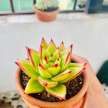
The Emperor's Stone Lotus has a unique shape and strong beauty, not only is it a decorative plant but also has a special feng shui meaning. This type of stone lotus is considered a symbol of authority, stability and success in life. Whether you are a lover of ornamental plants or are looking for a meaningful gift, the Emperor's Stone Lotus is the perfect choice.

Name, origin, characteristics of the Emperor's Stone Lotus
The Emperor's Stone Lotus has the scientific name Echeveria ebony agavoid. They belong to the Crassulaceae family and are native to Mexico, Central America and some regions in South America. This plant has the following outstanding characteristics:
The size of this stone lotus is about 15cm high and about 30cm wide. They have the shape of an agave, thick leaves, thorns and pointed tips.
There are many different types of plants: from red, green, pink to yellow.
The plant has red flowers, yellow tips. When mature, this succulent can bloom all year round without needing to be fertilized too often.
How to grow the emperor succulent?
For the plant to grow well, when buying seedlings, you need to choose healthy plants, without signs of pests, disease, or wilting. After buying the plant, you should leave it in a cool place to help it adapt to the environment before planting.
Preparation before planting
Choose a pot: Choose a pot that fits the size of the plant, not too small or too large. Prioritize pots with drainage holes at the bottom to avoid waterlogging, which is a common cause of succulent root rot. Ceramic, porcelain or cement pots are good choices because they retain heat and drain water effectively.
Suitable soil: The emperor succulent needs well-drained and nutrient-rich soil. You can mix the soil with ingredients such as rice husk ash, coconut fiber, sand or perlite in a ratio of 2:1:1. You can add a little organic fertilizer or slow-release fertilizer to increase the nutrients of the soil.
Planting tools: Sharp knife or pruning shears to trim the roots (if needed). Spray bottle or watering can to water gently after planting.
Steps to grow the king lotus stone
Step 1: Put a layer of small stones or pebbles at the bottom of the pot to increase drainage, then place a thin layer of soil on top.
Step 2: Remove the seedling from the pot and remove the old soil, then gently place the plant in the middle of the pot.
Step 3: Add soil around the base of the plant and press lightly to secure the plant, making sure the soil does not press too tightly on the roots so that the plant can breathe and grow easily.
Step 4: After planting, water with enough water to moisten the soil, avoid watering too much causing waterlogging.
Place the pot in a cool and lightly lit place, avoiding direct sunlight so that the plant can adapt to the new environment.
How to propagate the king lotus stone effectively
This is an easy-to-propagate plant and can be done by two main methods: propagation by leaves and propagation by seedlings. Here are detailed instructions:
Propagation by leaves
Step 1: Choose large, thick, pest-free, and succulent leaves from the mother plant. Healthy leaves will increase the ability to grow roots and new shoots.
Step 2: Use your hand to gently rotate or pull the leaf downwards, avoiding tearing or damaging the leaf. Make sure the leaf stem is not broken so that the rooting process can proceed smoothly.
Step 3: Place the separated leaf in a cool place, away from direct sunlight for 3-5 days to dry the leaf and the cut part will shrink. This helps to prevent the leaf from rotting when in contact with the soil.
Step 4: Prepare loose soil and a well-drained nursery tray. Then, gently place the leaf on the soil surface, with the leaf stem in contact with the soil.
Use a spray bottle to moisten the soil, place the pot in a cool place, away from direct sunlight. After 2-4 weeks, you will see roots and new shoots growing from the mother leaf. When the shoots develop into small plants with about 2-3 leaves, you can transfer the plant to a separate pot to care for it like an adult plant.
Propagation by seedlings
Step 1: Seedlings usually grow around the base of the mother plant, are small in size but have developed roots. Observe carefully to choose healthy seedlings that are free of pests and diseases.
Step 2: Use a sharp knife or scissors to cut close to the base of the mother plant, making sure to get the roots of the seedling. If the roots of the seedling are too long, you can trim them.
Step 3: Leave the seedling in a cool place for 3-5 days to let the roots and cuts dry, avoiding root rot when planting in the soil.
Step 4: Prepare a small pot with well-drained soil (similar to the soil for adult plants). Place the seedling in the middle of the pot, gently fill the soil around the base, and fix the plant upright.
Water the first time just enough to keep the soil moist, then place the plant in a cool, lightly lit place for the plant to grow new roots and develop.
About the Creator
HieuDinh
- Loves nature, likes to grow ornamental plants such as succulents, lotus (participates in volunteer activities to plant forests, protect forests in the locality)
- Loves dogs and cats (participates in local wildlife rescue activities)


Comments
There are no comments for this story
Be the first to respond and start the conversation.