
Free speech, blah, blah, blah.
It’s become a tedious slogan.
It usually only means,
“I don’t want to listen
to anything I don’t want
to hear, but I want you
to give me what I want.”
If you really believed in
free speech you’d have to
accept the responsibility
that comes along with it,
which is—to try to grasp
what those who oppose you object to,
and change your mind if you
can’t find a better argument.
But just to bray and strut
and rant and bully and threaten
and act like a boor and a thug
because your own speech
is mere assertion without
cogent, persuasive force,
is not free speech at all.
Its adolescent “freedom”—
irresponsible,
selfish, tyrannical,
and slices off your own ears.
____________________________________________________
If you can’t get a grip on your irrational impulses, you are more—not less—responsible for the harm you cause.
____________________________________________________
Keys
The diner lights hummed overhead, pale against the black windows. Trucks idled in the lot. Their headlights were aimed mostly toward the highway. Inside, the last clean plates were stacked and, even though the cleanup was done, the fishy smell of old fry oil hung in the air. The waitress was wiping the counter when the bell rang.
He entered swaying, shoulders wide, feet dragging. His tie dangled loose, his coat hung crooked. A set of keys clattered onto the counter, thrown down like a gauntlet.
“Coffee,” he said, slurring the single word. “Then I’ll head out”
She looked at the keys, then at him. His eyes twitched like tadpoles in a stagnant pool. Whiskey fumes hovered around him.
“You’ve had enough driving for tonight,” she said.
He smirked menacingly. “Don’t tell me what I’ve had enough of. My car’s right there.” He pointed toward the window where a sedan crouched under the lamplight. Its front right fender was split, the headlight taped with yellowing strips of package-sealing tape.
The bell jangled again. Two locals with damp coats entered. They nodded at her, then measured him. He mumbled something indistinct but somehow threatening.
“You ought to let someone else take you home,” one of the locals said. “Give me the keys.”
The drunk laughed, scooping the ring and dangling it. “These? My freedom. Nobody takes them. Not from me.” The keys stood out against the dark windows.
Freedom without responsibility, she thought—an axe in a spoiled child’s hands. She set down the counter rag, breathed deep, and stepped out from behind the counter and stared the drunk straight in face. “You’ll kill someone,” she said.
He puffed his rancid breath in her face. “And what are you going to do about it?” He shoved the keys into his pocket and staggered to the door.
He shouldered it open. Rain hissed on the blacktop, lot lights buzzing overhead. She followed, the two locals close behind. The sedan crouched near the lane, dark and waiting.
The men flanked her.
“Lot lane’s blocked. You’re not getting far.”
He yanked the car door open, dropped inside, and jammed the key into the ignition. The engine roared. He pressed the pedal hard. His eyes had gone wild.
The sedan lurched forward, fishtailing toward the narrow lane. Parked trucks crowded either side. Their side mirrors jutted out in the car’s headlights like shark’s teeth.
“Stop him!”
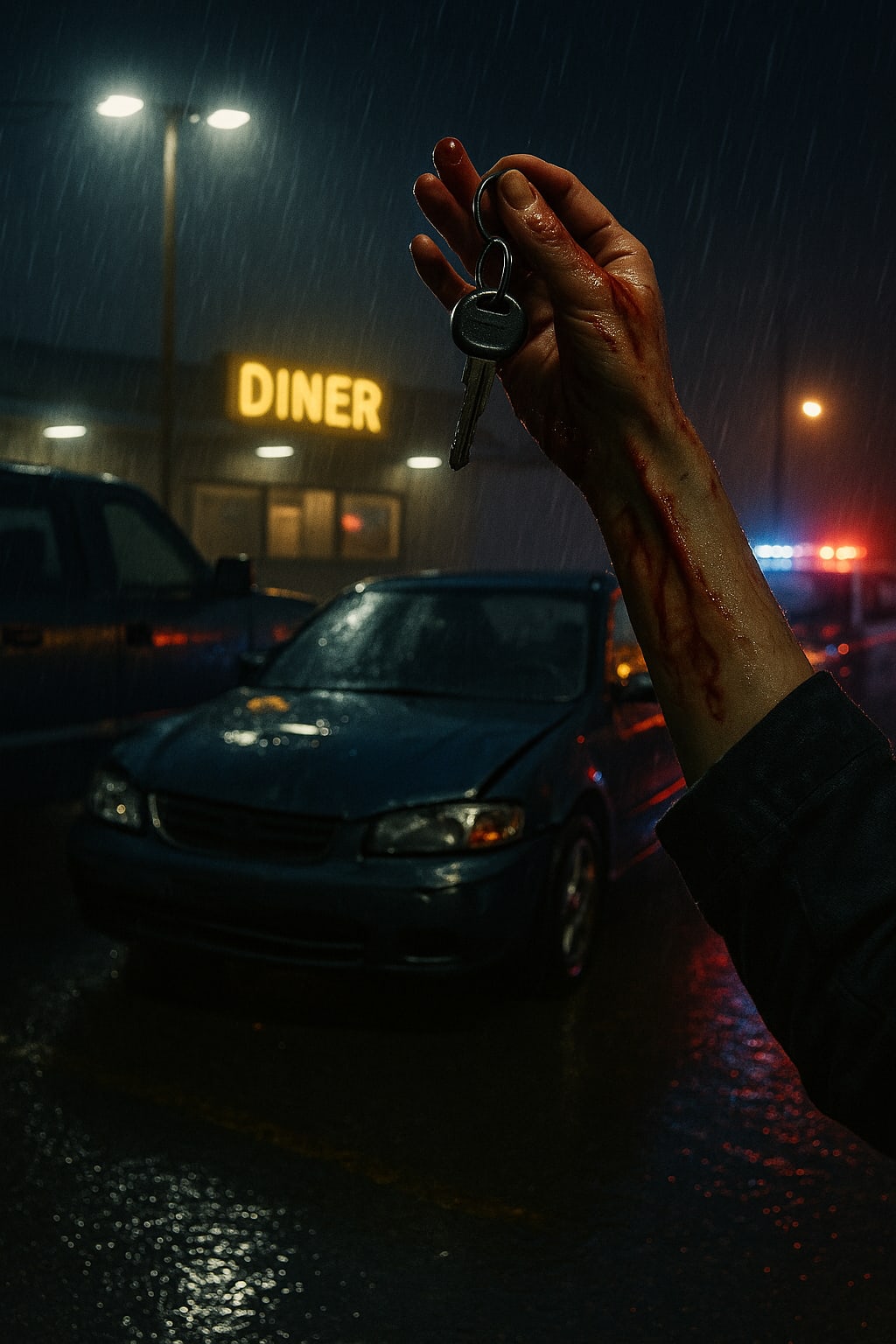
She lunged to the window. Her hand shot in and she grabbed for the keys. His fist smashed her hand against the key ring, gouging it. Her blood dripped on the keys. She pulled away. He laughed, revved harder, put the car in drive—and lurched into a parked truck, smashing the other fender.
His head snapped against the steering wheel, and his teeth split his lip, leaving a smear of blood. The waitress ran forward again, ripped the keys free, and stumbled back. Blood from her palm was flowing down her wrist.
The locals dragged him out, slammed him across the hood. His cheek flattened on wet steel. Spit and blood streaked the rain. He heaved once, then sagged.
A circle closed in. “Keys?” they asked.
She lifted them high. Her hand was shaking and covered in blood, but she held them up so everyone could see.
Within minutes the sirens approached. Red and blue lights strobed across the lot as a cruiser edged through the same lane the drunk had tried to force. The officers leapt out.
Handcuffs snapped shut. The emergency lights pulsed on the punched-in fenders. He raved about rights, about freedom, but no one was paying any attention.
The waitress handed the keys to one of the officers.
Engines turned over, boots scuffed, the circle thinned. The trucker whose vehicle had been hit bent down to look at the damage. Hardly a scratch. “Could’ve been worse,” he said.
Back inside, she bound her hand in a napkin. The cloth quickly became red. The diner lights hummed until she flicked them off. She gathered her things, locked the door, and slipped the spare key into her pocket.
Then she walked home through the rain, her wound stinging with each step.
The cruiser rolled slowly toward the highway. For an instant, the handcuffs glinted under an overhead lamp. Then the cruiser’s tail lights sped off into the rainy darkness.
About the Creator
William Alfred
A retired college teacher who has turned to poetry in his old age.
Keep reading
More stories from William Alfred and writers in Poets and other communities.
The steps to losing a child
Step One: Lose a child. Not what anyone wants to happen and nothing you can do to change it, but you can go through steps to becoming happy again. You can go through steps to loving again. You can go through steps to become a new you because after losing a child you will never be the same person you once were.
By Tabitha Hinkley2 days ago in Fiction


Comments
There are no comments for this story
Be the first to respond and start the conversation.