
How I Wrote "Riverboat Resistance"
From Thought to Text

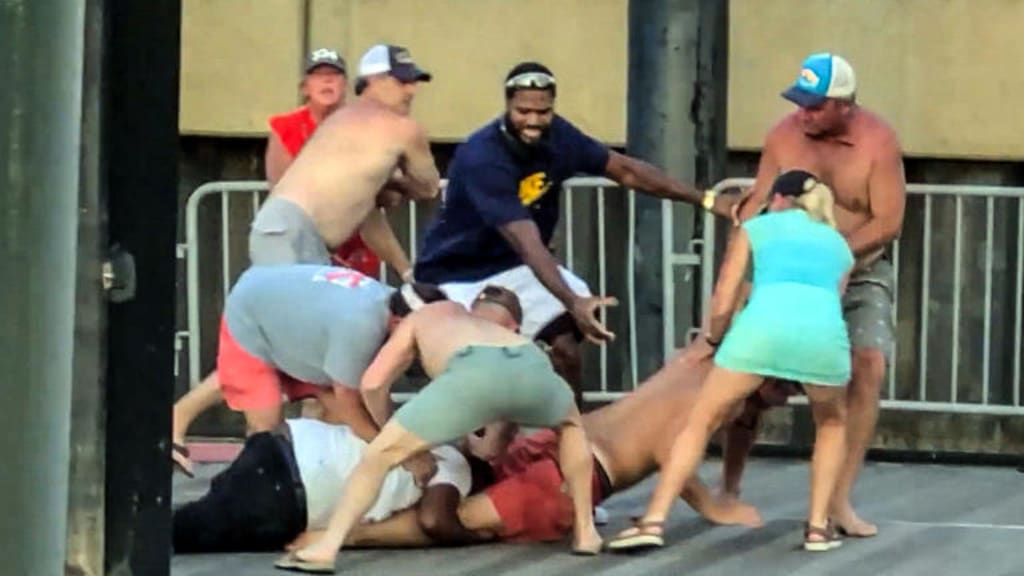
I first saw an X clip of the “Riverboat Brawl” on Thursday morning, August 10, in Turkey. I had stopped watching in the first two seconds because I thought I knew how it would end: another black man killed at the hands of a white mob. And although I hadn't seen much apparent violence like that in Turkey, just the usual symbols of force and power in the guns and assault rifles, I didn't want to see any more.
It wasn't until I returned to Florida on Friday morning that I heard about the incident again. My daughter, Anna, was driving us home, and she mentioned the number of views the incident had garnered. When we got to our apartment, she showed us the entire clip. I was intrigued because the incident occurred in Alabama, a state I’d visited last year to screen the film “African Redemption: The Life and Legacy of Marcus Garvey." During my stay in Birmingham, my hosts, Central Alabama Caribbean American Organization, took me to many places that played a pivotal role in the Civil Rights Movement, so I was all too aware of the role that Alabama played in this nation's racist history.
After our 24-hour+ ordeal, including three layovers to get home, we went to bed immediately. We rested for most of Friday, intending to get up early on Saturday morning, around 6 a.m., to begin our first round of preparing my wife's classroom for the new school year.
The poem had a different idea. Somewhere between my fifth and sixth turn in bed, a line for the poem—now deleted—popped into my head. I am too old to believe I will remember a line when I wake up—as if that ever happened!—so I began writing at about 2 a.m. until six, when the rest of the family was ready to go to school.
By then, I'd constructed my own timeline from the news reports and figured out the key elements: who, what, why, where, when, and how. I wrote at least ten drafts of the poem to show how the incident was a struggle over physical and cultural space in American history.
As I wrote the poem, I worked in lines from Claude McKay's poem of black unity, "If We Must Die," for I saw what was described as a “brawl” as an act of resistance, a moment to change the narrative about how black folk would come to the assistance of each other, and that it had the potential to “set a new standard for how we treat each other.”
I also included historical allusions to Rosa Parks, Dr. Martin Luther King Jr., George Wallace, and Malcolm X, and the march from Selma to Montgomery (also deleted) as an attempt to show how the incident echoed the long struggle of our ancestors for freedom, which many states, including my home state of Florida, are actively trying to erase, and which we must resist.
But how would all this work in a poem? One of my core beliefs about poetry is that it shouldn’t be chopped up prose—that a poem should have music, as my friend Mervyn Taylor wrote in "Country of Warm Snow” about Derek Walcott’s question to him, "Donde esta, la musica?"
Then, I remembered Walcott's description of “Omeros” and why he used the terza rima form: "The interlocking rhyme scheme of terza rima creates a sense of momentum and flow in a poem."(1) I accepted the challenge but now what?
I worked through another five drafts and thought that I was finished before I left the poem on my desk and went to work with my wife. We worked in the classroom until about 3 a.m. on Saturday, and after an 18-hour day, we slept until Sunday morning when we went out for breakfast. Nobody wanted to cook anything.
My daughter and my wife spent the rest of the Sunday afternoon watching horror movies, and I continued fidgeting with the poem by putting in and taking out allusions to “If We Must Die." I thought I was once again finished and dictated the poem into Microsoft Word and then used the Read Aloud app to refine the music.
I thought the poem was almost ready for publication, but one word from McKay’s poem kept bothering me. Not that the white men in the mob weren't monsters, but editors seem to be squeamish about labels like that, and I wanted to give the poem the best chance of being published. So I continued working on the poem until Monday night when I thought, "Yeah, it's ready."
The poem must've laughed. At around 3 a.m. on Tuesday, another line (also deleted) popped into my head. I got out of bed, worked until 5 a.m., and then went back to sleep.
When the alarm went off at 6 a.m., my wife came over to my side of the bed, kissed me on the forehead, and said, "Don't worry about coming in today, honey. You've been working hard on that poem. Take the rest of the day off to finish the poem. Anna and I will manage."
I gratefully accepted her offer and got up at 9 a.m. when I listened to the poem a few more times before I submitted it to Visible:
Here is the link to the poem.
https://visiblemagazine.com/riverboat-resistance/
(1) Walcott, Derek. "The Caribbean: A Diasporic Tempest." The Antilles: Poetry from the Caribbean. Edited by Paula Burnett, Faber and Faber, 1995, pp. 19-23.
About the Creator
Geoffrey Philp
I'm a Jamaican writer. I write poems, stories & essays about climate change, Marcus Garvey, Bob Marley, haiku & haibun. I've published a graphic novel for children, "My Name is Marcus." For more info, visit: https://www.geoffreyphilp.com/
Keep reading
More stories from Geoffrey Philp and writers in Poets and other communities.



Comments
There are no comments for this story
Be the first to respond and start the conversation.