
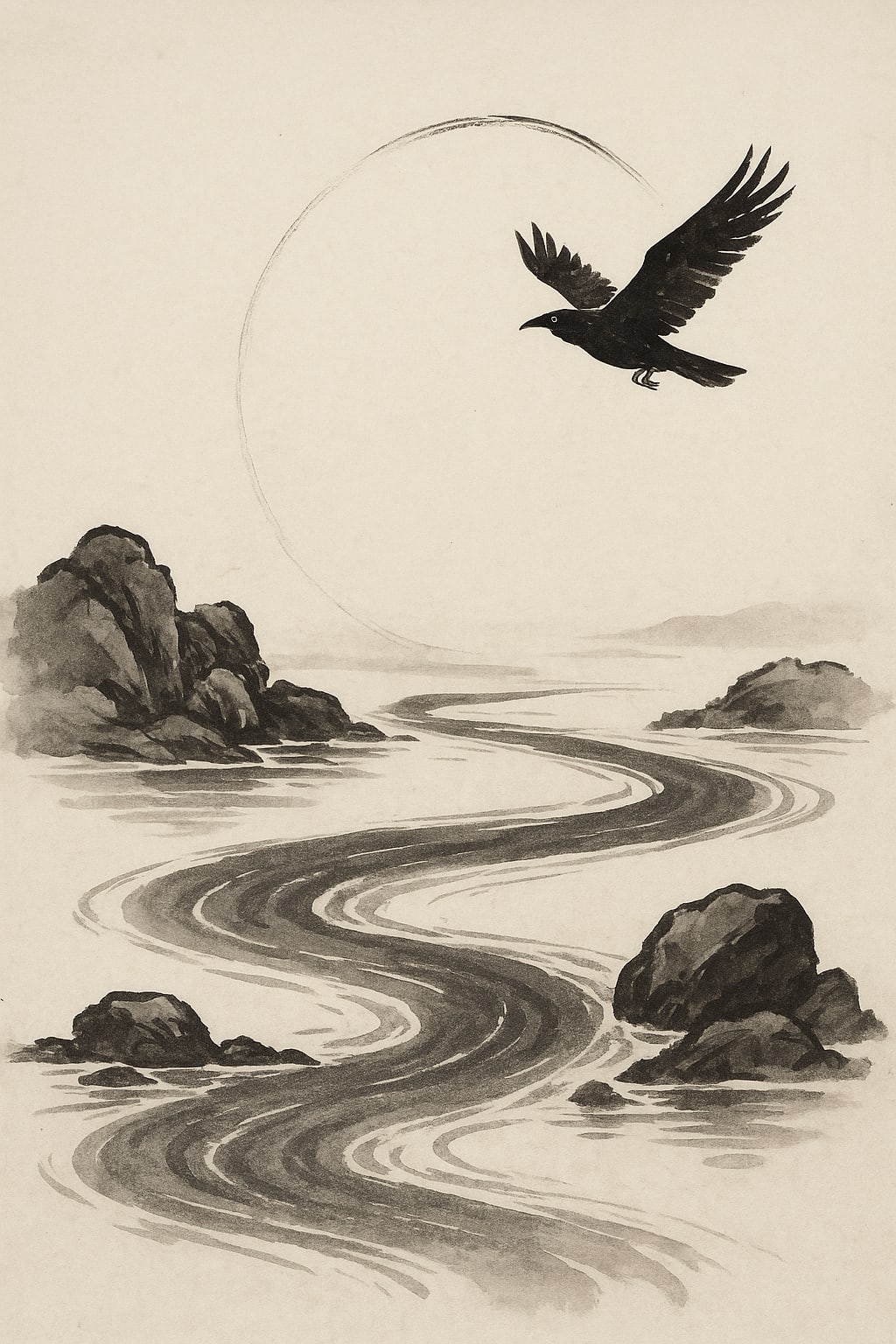
A crow arcs without
effort through the open sky,
singing in concert.
___________________________________________________
Not all wisdom requires effort. Sometimes, the deepest insight arrives when we let go. A Zen story, a paradox from neuroscience, and the Taoist way of doing without forcing.
___________________________________________________
A young and sincere Zen monk once approached his master with a request. He wanted to master archery as a spiritual practice. The master handed him a bow and said nothing. The monk began at once—waking early, practicing until his fingers blistered, through meals and into the evening. Days passed. His aim did not improve. Frustrated, he focused on his form, his breath, his stance. Still no progress. One morning the master stopped him mid-draw and pointed to a gnarled branch looming above the temple gate. A crow, resting there, took flight and arced across the sky. “Did you see it?” the master asked. The monk nodded, confused. “Then for today,” said the master, “you’ve hit the target.”
In most of our lives, the arrow is always mid-draw. We are always exerting ourselves, and we even exert effort to optimize our leisure. We think that all this effort produces better outcomes—that concentration, force, and control are the proper activity of the will. But some things cannot be forced. Insight, peace, and creativity do not respond to pressure. In neuroscience, this is known as the insight paradox: the more you try to force a breakthrough, the more elusive it becomes. The brain’s default mode network, associated with rest and inward drift, often solves problems after we’ve given up trying. The very act of pausing—of letting go—creates the conditions for something new to emerge.
In the Taoist tradition, this paradox is called wu wei—often translated as “non-action,” but more accurately, it means “effortless action” or “action in harmony with the flow.” Laozi said, “When nothing is done, nothing is left undone.” This is neither passivity nor refusing to act. It is refusing to force things. It is intellect pausing before acting so that the action taken leaves no friction behind. Meister Eckhardt said, “The soul grows not by addition, but by subtraction.” What is subtracted is the premature urge to act before aligning with the moment. We can still deliberate, but we stop grasping right away. We wait for the outer situation to harmonize with the inner situation.
But waiting is difficult, especially in our busy minds full of competing voices. The inner overseer hates stillness. The inner planner wants a plan. The inner competitor wants a win. These are fearful voices masquerading as rational advisors. Their actual aim is to keep the arrow drawn indefinitely. And yet, if you've ever sat long enough to watch your thoughts without responding to them, you know their power lessens when you stop obeying them unquestioningly. Silence reveals that their urgency is illusory.
Effortless action is a skill, and like all skills, it must be practiced. It begins with pausing at the moment we’re tempted to push harder and noticing the impulse instead of acting on it. Then comes a little space—a walk, a breath, a moment of not-doing. Then, when the body is calm and the mind has ceased insisting, attention reorients, opening a possible pathway for insight. The prefrontal cortex, no longer clenched in command, gives way to fluidity and pattern recognition. You know what to do—not because you’ve wrestled the problem to the ground, but because the answer has quietly come to meet you.
The young monk never did become an expert archer. But in time, his movements grew precise and his gaze steady. One day, while sweeping the temple path, he paused and drew a perfect arc in the dust with the edge of his broom. It meant nothing and everything. His master, watching from the steps, bowed once and returned inside.
Mastery is not a matter of pushing but of falling into harmony with the rhythm of life’s cycles. To live well is not to seize life and bend it to your will. It is to move with life, to act at the right moment with the right touch, and to know when the time has not yet come. The river does not push. It flows.
About the Creator
William Alfred
A retired college teacher who has turned to poetry in his old age.
Keep reading
More stories from William Alfred and writers in Poets and other communities.
Violence Begets
"Any last words, cowboy?" "None you'd understand, sodbuster." "Funny. That's Marshall Sodbuster to you. But I meant some last nugget that would help us in the adjudication of the myriad offenses counted against you and your gang. I wasn't asking for penitence."
By Adam Diehl5 days ago in Fiction


Comments
There are no comments for this story
Be the first to respond and start the conversation.