
Echoes of Gentle Pens
How a Quiet Community of Poets Transformed Their Town Through Words
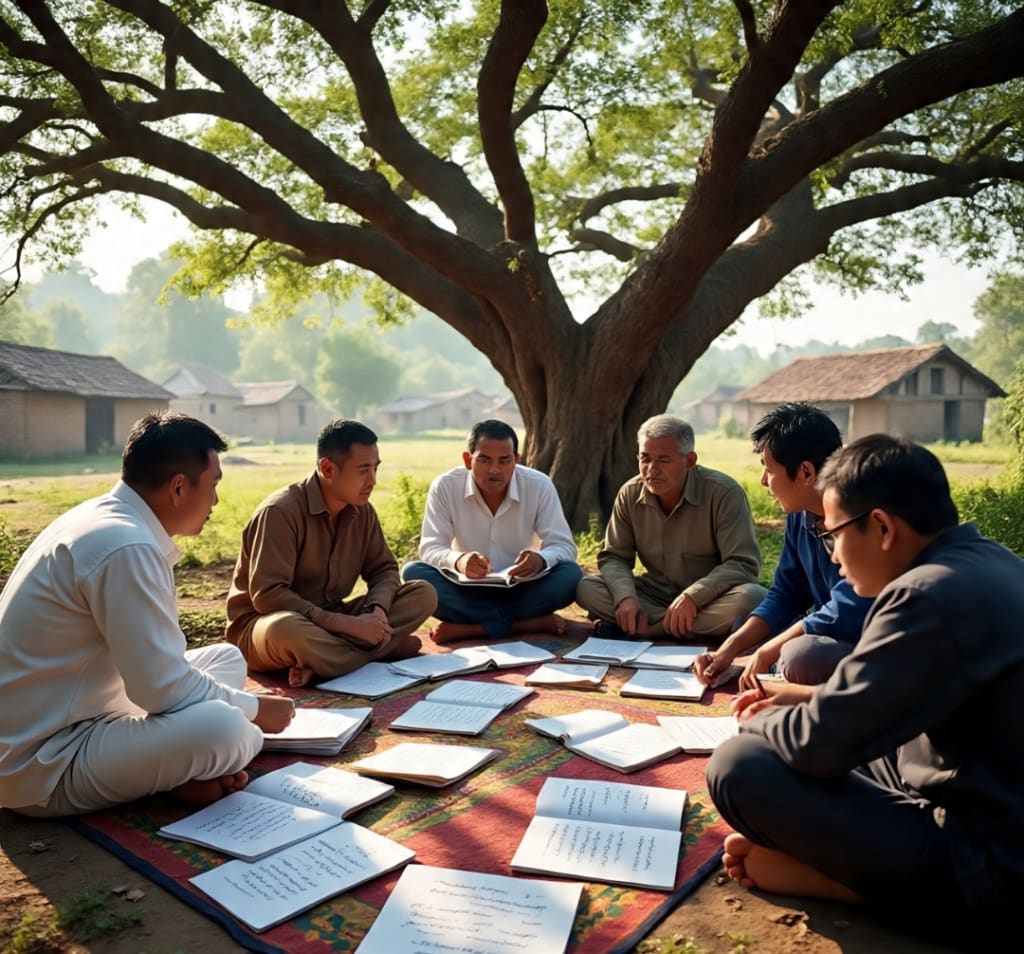
In the small town of Noorabad, life moved at a peaceful, predictable rhythm. The streets were lined with old banyan trees, the evenings were filled with the sound of cricket chirping, and every house knew every other house by name. But among all these familiar sights, there was one place that had slowly become the heart of the town—the Courtyard of Gentle Pens.
The courtyard was nothing special to look at: a large flat stone floor shaded by a huge banyan tree whose roots twisted like ancient fingers. But for the people of Noorabad, it was a sanctuary for the most unexpected reason—poetry.
The Gentle Pens were a group of poets, young and old, who gathered every evening with their notebooks, pens, and hearts full of unspoken feelings. Some came to share, some came to listen, and some came simply to find peace.
Leading the group was Idris, a quiet man with kind eyes. He was neither the oldest nor the most educated poet, but he was the one who believed deeply in the magic of words. “A poem,” he would say, “is a light you create even when the world feels dark.”
Every evening, as the golden light of sunset washed over the courtyard, Idris would open the circle with a simple request:
“Write about something you’re grateful for today.”
At first, the idea felt too simple. But as days passed, something beautiful began to happen. People who rarely spoke began to share. Words that were trapped inside hearts for years finally found a way out. A boy wrote about the kindness of a stranger. An elderly man wrote about memories of his father. A shopkeeper wrote about the peace he felt listening to the river at night.
Soon, poetry became the common language of Noorabad.
But the real miracle came unexpectedly.
One morning, a strong storm swept through the town. The market roof collapsed, several homes were damaged, and fear spread through the streets. People were anxious, frustrated, and tired. The storm had shaken the town physically—but also emotionally.
That evening, despite the chaos, Idris went to the courtyard. He sat alone under the banyan tree, wondering if anyone would come. To his surprise, one by one, people began to arrive—first the shopkeeper, then the schoolteacher, then the farmer, and soon nearly everyone.
The atmosphere was heavy, but Idris didn’t start with poetry.
He simply said, “Let us write about hope.”
At first, no one moved. How could they write about hope when everything looked broken?
Then a young boy wrote two lines on a torn paper and stood up shyly to read:
“The storm took roofs and branches,
But it could not take our sky.”
A silence followed—soft, warm, shifting the air.
Then the shopkeeper read his poem about rebuilding with unity. The farmer read about how even destroyed fields grow green again. An old man wrote about how storms remind us of our strength.
By the end of the evening, people were smiling again—quietly, but genuinely. Something had healed inside them.
Word spread quickly that Noorabad had a poetry circle that could lift the heaviest hearts. Soon, nearby towns began visiting. Students came to learn, elders came to share, and travelers came simply to listen.
The Courtyard of Gentle Pens became more than a gathering—it became a symbol of unity, healing, and resilience.
Years later, Noorabad was known not for its buildings or markets, but for its culture of compassion. When people asked Idris how the town changed, he always smiled and replied:
“We just listened to the words inside us—and to each other.”
And under the old banyan tree, the echoes of gentle pens continued to shape the world, one poem at a time.
About the Creator
Keep reading
More stories from Muhammad Saad and writers in Poets and other communities.
The Echoes of Gentle Pens
In a peaceful town woven with cobblestone paths and whispering trees, there existed a quiet circle known as the Community of Gentle Pens. They were poets—men of calm thoughts, steady hands, and hearts that beat in the rhythm of unsaid verses.
By Muhammad Saad 2 months ago in Poets



Comments (1)
Good