
Digital Reverie
How screens shape our minds and silence our souls

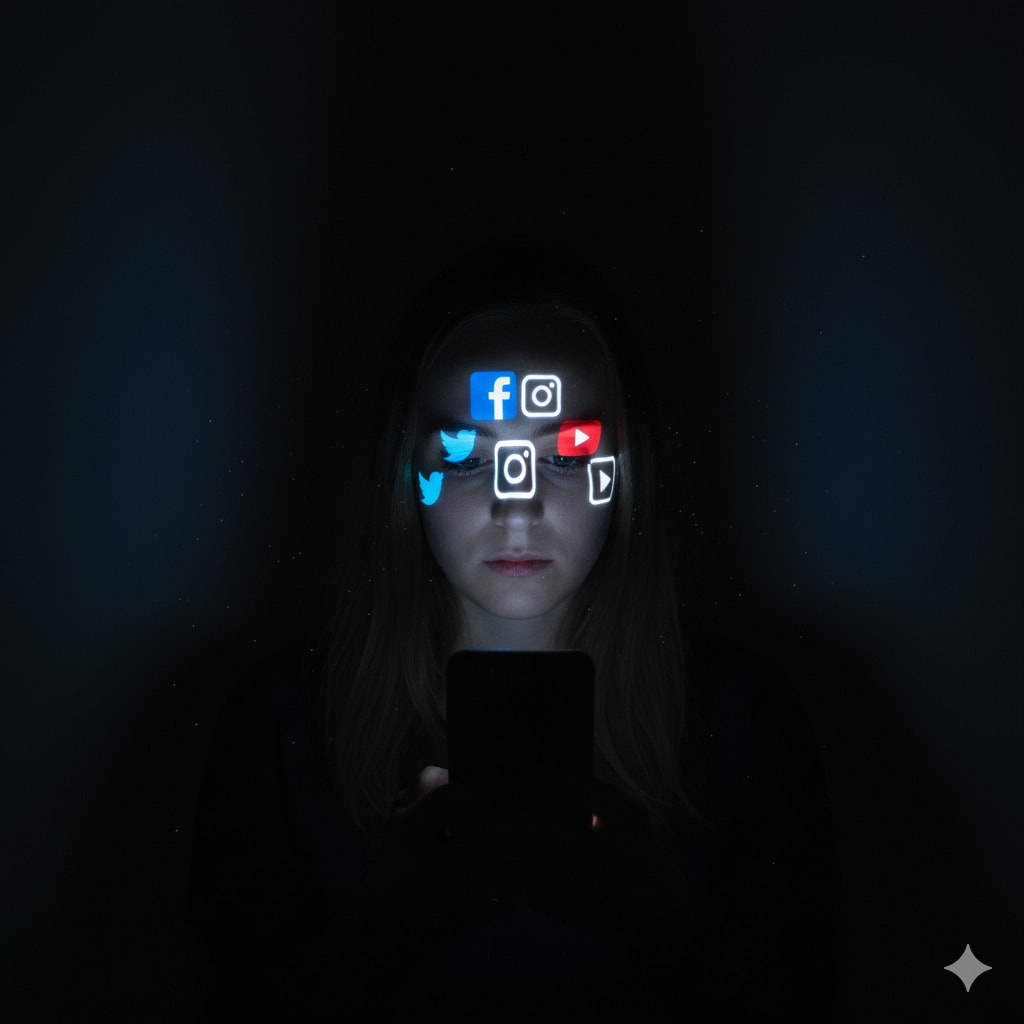
I remember the first time I noticed it—the subtle, almost imperceptible hum beneath the quiet of my room. It wasn’t the air conditioner or the soft creak of old floorboards. It was the pull of a screen, glowing faintly in the dark, calling out not with words, but with a rhythm I could feel in my chest. A rhythm that promised connection, stimulation, and distraction.
I sat on the edge of my bed, smartphone in hand, and watched the screen flicker with endless feeds of images, texts, and notifications. Each tap, each swipe, carried a small thrill, a sense of control. And yet, with every scroll, I noticed the subtle erosion of something I couldn’t name.
Progress hums in circuits, I realized. Silent, relentless. Flowing through our veins like a second bloodstream, digital life began to replace the organic pulses of my existence.
We scroll, we swipe, we tap—mechanical gestures that have become unconscious. Each notification is a whisper of validation. Each like, a tiny anchor tethering our fragile sense of self to an external, often indifferent, world.
And the more I engaged, the more the boundaries between what is real and what is curated began to blur. Images of smiling faces, perfect vacations, lavish meals, and the constant hum of other people’s achievements created a mirror that reflected not who I was, but who I wasn’t.
The digital mirrors multiply us, yet divide the soul. We become observers of ourselves, documenting life for unseen audiences, yet rarely living it fully. Our attention is fractured, scattered across multiple windows, notifications, and updates.
I began to notice changes in the quiet moments: the subtle restlessness in my chest, the twitch in my fingers whenever a notification buzzed. The calm, reflective spaces of my mind—the hours I once spent reading, thinking, and just being—were now occupied by the constant pinging of social media. Even when I closed the apps, the images lingered, playing silently behind my eyelids.
We trade reality for simulation, and the cost is insidious. Moments that once felt rich with presence now seem shallow when experienced through the lens of a screen. Experiences are documented more for consumption than for living. Birthdays are recorded in posts rather than memories. Conversations are fragmented by notifications. Silence itself feels uncomfortable, an anomaly that must be filled.
Yet the most unsettling realization is this: we are complicit architects of our confinement. With every swipe, we build walls invisible to the eye but tangible to the heart. We willingly allow algorithms to dictate our attention, our desires, and, increasingly, our thoughts. The very technology that promises liberation often becomes a cage.
And still, it is seductive. The allure of instant connection, instant knowledge, instant gratification is nearly irresistible. We are trained to crave it, to need it, and to fear being disconnected. Even brief moments away from the screen provoke unease: the sensation that life is happening elsewhere, just out of reach, and we are missing it.
I began experimenting with small acts of rebellion. Leaving my phone in another room for an hour. Going for walks without music, without podcasts, without the constant chatter of digital life. I noticed the difference immediately: the air felt heavier with meaning, the sky stretched wider, the sounds of birds, wind, and footsteps sharper and more resonant. Time moved differently. I remembered what it felt like to exist without an interface mediating every interaction.
Yet, the pull never fully disappears. Even as I write these words, I feel the tug of my phone, the pull of messages, the lure of notifications. It is a constant negotiation, a delicate balancing act between immersion and detachment, presence and distraction.
The phenomenon is not just personal; it is cultural. We live in a society where value is often measured in digital metrics: likes, shares, followers. Influence is quantified, success is broadcast, and failure is quietly filtered out. The effects ripple outward, shaping not just individual behavior, but social norms, expectations, and identity itself.
We are, in many ways, prisoners and pioneers simultaneously. Prisoners of screens and algorithms, yes—but pioneers of a new form of consciousness, forced to navigate a world that blurs reality and simulation. The question is whether we can retain our humanity while doing so.
There are moments of clarity amidst the noise. Moments when the glow of the screen dims, and the world—our real world—comes into focus. We feel the texture of objects, the warmth of sunlight, the cadence of natural sounds. We remember that life is not a feed, not a curated highlight reel, not a constant chase for approval. Life is presence, vulnerability, and authenticity.
Digital life is here to stay. But so is human resilience. We must learn to negotiate our attention, to reclaim our mental and emotional space, and to choose presence over distraction. We must cultivate silence, reflection, and depth amidst the constant hum of technology.
The whispers of screens are seductive, but they are not the only voices. There is a quieter, steadier voice within—our own consciousness—that reminds us what is real, what matters, and what is worth holding onto. Learning to listen is the challenge of our age.
I write this not as a lament, but as a reflection. We are living in an unprecedented intersection of human cognition and digital technology. We are learning, collectively and individually, how to navigate this new terrain. Some stumble. Some flourish. All are transformed.
The digital reverie can be beautiful, exhilarating, and terrifying in equal measure. It is a mirror, a labyrinth, a challenge, and a companion. And perhaps, most importantly, it is a call—to observe, to question, to reclaim the moments that are truly ours.
For in the end, the hum beneath the quiet, the soft glow of a screen in the dark, is not just a tool or a trap. It is an invitation: to see, to feel, and to exist fully, even when the world tries to dictate otherwise.
The challenge, the reward, and the revelation are the same: to navigate the digital reverie and emerge whole, aware, and truly alive.
About the Creator
Keep reading
More stories from ANC TRADER and writers in Poets and other communities.
The Wicked Witch Queen 🩰
Meet the Witch Queen. Entertainer of the upper echelons of society. She is not what she seems. They only see the parts of her which she allows them to see. Just look at them she muses...the coy smiles, the coquettish pretense of interest, fawning over me as if I owe them any loyalty. I see through them...the greed, envy and loathing for one another 's fame and glory - all trying to ingratiate themselves into my circle of trust.
By Antoni De'Leon4 days ago in Poets
Becca
"Everything is so... flat." Denille said stupidly as she looked around her new neighborhood. She looked around at the muted desert where even the smallest sign of life seemed to have given up. The plant life was shrubs that were half cooked by the heat and where there should have been a lawn, a mess of white rocks laid glistening in the sun. Even the sky looked stretched thin, like the sun had ironed it smooth. She’d moved from Riverside, where at least there were hills, but here in Barstow, everything felt baked and brittle.
By Sara Wilson8 days ago in Fiction




Comments
There are no comments for this story
Be the first to respond and start the conversation.