
Cartography of Invisible Scars
Fragments of a map that only the body remembers

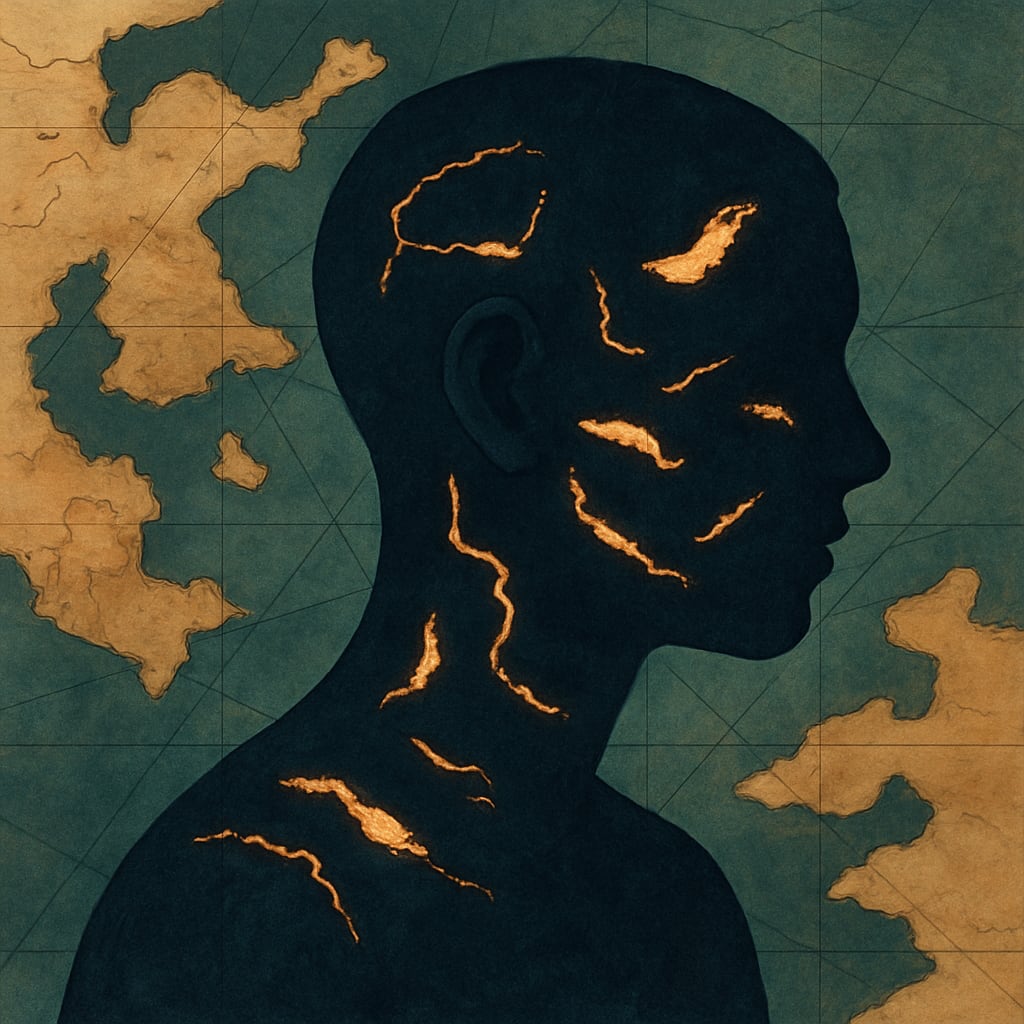
Each scar is an island, unnamed by any atlas,
rising quietly from the ocean of skin.
Some are coral reefs, sharp enough to cut memory,
where waves of recollection break and bleed.
Others are peninsulas, stubbornly clinging
to the mainland of what was lost,
arms of land that refuse to release their grip.
There is a crater lake where silence gathers,
a hollow filled not with water but with unsaid words—
a deep, echoing blue
where sentences drowned and never surfaced.
There is a desert where no touch has crossed in years,
dunes reshaped by the winds of forgetting,
grains of time shifting endlessly,
burying old footprints until only absence remains.
A faint line across my wrist becomes a bridge,
narrow, trembling, but unbroken,
connecting continents of grief and survival.
A hidden scar on my thigh grows into a forest,
thick with shadows and roots,
its canopy sheltering memories too heavy for daylight.
The one on my shoulder is a cliff,
eroded by storms of betrayal,
where trust once fell into the sea
and was never recovered.
Another scar runs diagonally across my chest:
a river delta,
its tributaries spreading like veins into memory.
Each branch carries sediment,
the silt of grief settling in layers.
At its mouth, salt water meets fresh—
the collision of past and present,
bitterness and renewal,
two tides that never truly merge.
Behind my knee, almost invisible,
is a bay where shame once anchored,
a cove hidden from the eyes of others.
Near my ankle lies a chain of small scars,
a broken necklace of islands—
each one marking an accident,
a misstep,
a stumble I tried to forget
but the body would not.
I trace these coastlines with my fingertips,
charting the borders of old wounds
as if drawing new territory.
The map does not lie,
but it never tells the whole story—
it omits the storms, the shipwrecks,
the unnamed bodies carried out to sea.
Every map has its omissions,
its blank spaces,
its “Here Be Dragons.”
Mine are marked not by ink,
but by the quiet ridges of healed skin.
At night, I become a sailor of my own body.
I drift between these lands,
a restless voyager,
searching for a harbor that does not exist.
Sometimes I anchor by the desert,
sometimes by the cliff;
both remind me that survival
is another word for exile.
I light a lantern inside my chest
to guide me,
but even its glow cannot soften
the shape of these shorelines.
Even the smallest scar becomes an archipelago,
a scattering of islets where echoes still live,
each whispering the language of pain
in a dialect no one else can speak.
The sea between them matters too—
not empty, but alive:
currents of resilience,
depths where healing grew unseen,
reefs built of quiet endurance.
Above them, constellations form.
Stars of memory connect scar to scar,
drawing new shapes in the night sky of skin.
Orion bends differently here;
the Pleiades are scattered across a shoulder blade.
Every wound becomes a star,
and together they build a new mythology,
a celestial counterpart to the geography below.
Dawn arrives like a cartographer,
sketching new coastlines in light.
Shadows retreat,
revealing mountains I had not seen before—
ridges formed by resilience,
valleys carved by tears.
I wake ashore still carrying this geography,
a map stitched into the body,
invisible, undeniable,
a language written beneath the skin.
Every scar, more than a wound,
becomes a landmark.
Together they form a country without borders,
a nation of survival,
inhabited only by me.
Its anthem is silence,
its currency breath,
its flag invisible but always waving
just beneath the surface.
When I close my eyes, I see it clearly:
its topography, its constellations, its waters.
An atlas of everything I endured,
and everything I still carry.
Not a land of exile,
but a homeland of persistence.
Not ruins, but monuments—
each scar a testament,
each ridge a reminder
that the body, even when broken,
is still a map worth following.
About the Creator
Alain SUPPINI
I’m Alain — a French critical care anesthesiologist who writes to keep memory alive. Between past and present, medicine and words, I search for what endures.
Reader insights
Outstanding
Excellent work. Looking forward to reading more!
Top insights
Compelling and original writing
Creative use of language & vocab
Easy to read and follow
Well-structured & engaging content
Excellent storytelling
Original narrative & well developed characters
Expert insights and opinions
Arguments were carefully researched and presented
Eye opening
Niche topic & fresh perspectives
Heartfelt and relatable
The story invoked strong personal emotions
Masterful proofreading
Zero grammar & spelling mistakes
On-point and relevant
Writing reflected the title & theme
Keep reading
More stories from Alain SUPPINI and writers in Poets and other communities.
Mastering French Without Losing Your Sanity: A Realistic Guide for Beginners
Learning French can feel like solving a Rubik’s Cube blindfolded. The tricky pronunciation, the never-ending grammar rules, and the surprising exceptions make it seem impossible. But don’t worry—equipping yourself with key expressions and effective strategies can turn frustration into fluency. Let’s simplify French and make learning enjoyable.
By Alain SUPPINIExclusive • 11 months ago




Comments (2)
I felt every word. "Not ruins, but monuments!"
I love how you balance grief and survival, showing how pain reshapes us but also leaves behind strength, resilience, even beauty.