
Voigtlander NOKTON 40mm f/1.2 Aspherical Lens for Nikon Z
Expensive, but I Love It


Voigtlander Z NOKTON 40mm f/1.2 Aspherical is a large aperture manual focus lens authorized by Nikon and released in 2022. The lens features electronic contacts for communication between the lens and the camera body, enabling support for EXIF information, accurate image stabilization, and a green focus confirmation dot after successful focusing. However, it cannot control the aperture through a dial like Nikon's AF-D lenses or Zeiss ZF2 lenses, the aperture can only be adjusted using the aperture ring on the lens.
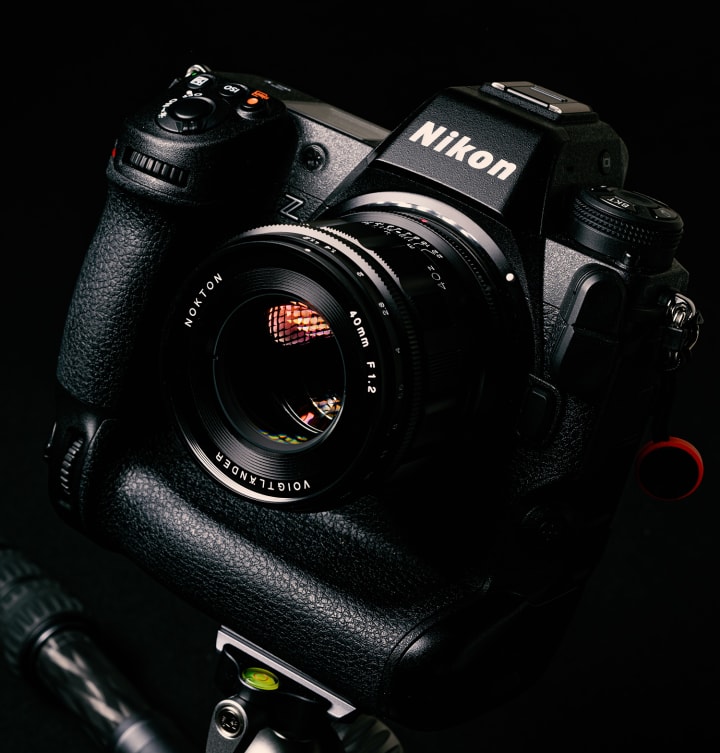
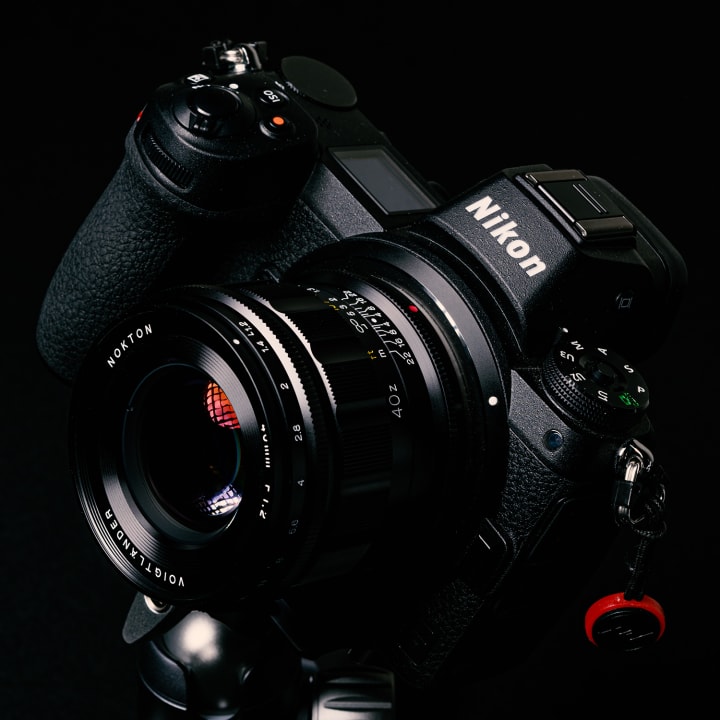
The new lens from B&H is priced at $899, and even with frequent sales, it can still reach up to $799, which is still considered expensive for a manual focus lens. The high price tag, coupled with manual focus, ensures that it remains a niche lens. However, its retro and elegant appearance, excellent built quality, and smooth focus ring damping make it irresistible to me.
As Nikon currently does not have an equivalent lens in their original lineup, the Nikon Z 40mm f/2.8 lacks a large enough aperture and delivers average image quality. While the Z 50mm f/1.2 offers a similar focal length, its size is excessively large. Therefore, I am still willing to carry this compact and lightweight large aperture lens with me for outdoor photography.
This lens's size is perfectly harmonious when paired with the Z7 camera body, and it complements the retro design of the Z fc body even more. 40mm focal length is often considered an interesting focal length. It falls in the range between wide-angle and standard lenses, offering a versatile perspective that can be used for various photography genres. It provides a slightly wider field of view compared to the traditional 50mm focal length, making it suitable for street photography, environmental portraits, and general everyday shooting. Its unique perspective can bring a fresh and different look to images, making the 40mm focal length appealing to many photographers.



This lens features a 6 Groups, 8 Elements design, with ten aperture blades, a maximum aperture of f/1.2, and a minimum aperture of f/22. It has a filter size of 58mm, weighs 315 grams, and has a minimum focusing distance of 11.8 inches / 30 cm. It is a Full-Frame Format (FX) lens that can also be used on APS-C (DX) camera bodies, where it will have an equivalent focal length of 60mm.
In actual shooting, this lens performs quite well in terms of sharpness when used at its maximum aperture. However, there is still a noticeable difference compared to Nikon's Z 50mm f/1.2, which comes at a much higher price. When stopped down to f/1.4, the sharpness further improves, and the in-focus areas of the image become very crisp. At wide apertures, this lens exhibits a charming out-of-focus rendering, excellent colors, and a great atmospheric feel. However, it also reveals some drawbacks, such as significant chromatic aberration and pronounced vignetting. These issues can be partly corrected by stopping down the aperture or through post-processing software.
When the aperture is stopped down to f/5.6 or f/8, the image becomes extremely sharp. However, personally, I prefer to keep the aperture within the range of f/1.2 to f/4, as it better showcases the unique character of this lens.



Overall, I really enjoy this relatively lightweight lens with a large aperture and manual focus capability. It ignites my desire to capture photos. Especially when I'm accustomed to using the camera body's focus magnification and focus peaking features effectively, even shooting with a wide open aperture ensures a high success rate.
It is perfectly suited for leisurely and slow-paced photography during my free time, allowing me to savor the joy that comes with pressing the shutter. If you struggle with manual focus or if you are a photographer who requires rapid shooting and quick results, then this lens may not be suitable for you.


About the Creator
Keep reading
More stories from James Luo and writers in Photography and other communities.
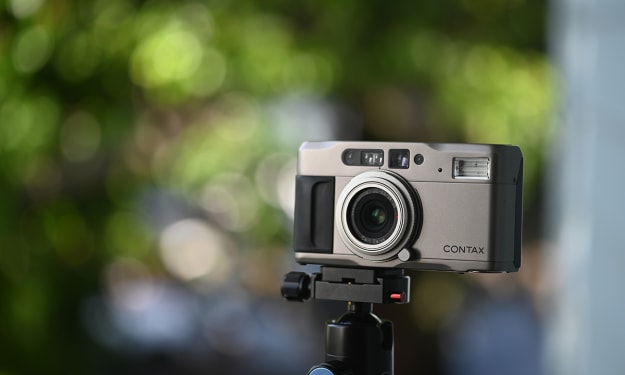
Contax TVS
Contax, a brand that once boasted a glorious history of over 70 years, was a subsidiary of Zeiss in Germany. Alongside Leica and Rollei, it was considered a representative brand of German cameras. However, with the decline of the film era, Contax gradually lost its strength and was eventually acquired by Cosina, a Japanese company. One of Contax's most well-known products is its pocket-sized automatic camera series, known as the "T" series. In the 2020s, models like the T2 and T3 have gained popularity among certain celebrities, leading to a phenomenon known as the "celebrity effect" and causing prices for the "T" series to skyrocket. For instance, the price of the T3 has reached over $2000. It's not just the Contax T2 and T3; various high-end point&shoot cameras from that era, such as the Minolta TC-1, Nikon 35Ti, and 28Ti, have also been subject to extreme price speculation.
By James Luo3 years ago in Photography
My Year, in Prattling and Photos
It's been a year since... last year. Ironically, it seems I've found myself a new tradition of getting sick during the New Year holidays. At least, this year (that is, this inter-year period remarkable for its shiny decorations in the streets and houses, and closed supermarkets and pretty much everything), I'm doubtlessly doing better: I've managed to come visit my friends in Germany for Christmas (which I failed to do last year) and—after having some good quality time eating machanka, playing Munchkin and swinging machetes (the last one obviously crept into this checklist only for the sake of the phonological form)—I came back home via proverbial Deutche Bahn and probably less known Schweizerische Bundesbahnen, my body hosting a family of viruses, virions and who knows what other tiny critters somewhere inside my chest.
By Andrei Z.18 days ago in Photography
A Lifetime of Shakas
For more than three decades as a part-time freelance news and sports photographer in Hawaiʻi, I’ve captured countless moments across the islands — and a few on the mainland. Along the way, almost without realizing it, I built an ever-growing photo archive of people flashing the shaka sign.
By Tim Wrightabout 3 hours ago in Photography
How to Succeed at the Benson Directory®
Congratulations and welcome to the Benson Directory® employee #22391! As our newest call handler, you will have the privilege of speaking with dozens of unique and interesting people on a daily basis as well as the opportunity to earn bonuses for high performance. Contained within this handbook you will find a set of ease to follow instructions designed to help you settle in to your new role and begin paving the way to success.
By S. A. Crawford3 days ago in Fiction



Comments
There are no comments for this story
Be the first to respond and start the conversation.