
Ultimate Guide to Image Enhancement
Ultimate Guide to Image Enhancement


High-quality photographs are crucial for companies, photographers, social media influencers, designers, and all other users in today's digital environment. Clearness, optimization, and sharpness are what make photographs appealing to the eye, captivating, and deserving, regardless of whether one is using them for personal editing, social media promotion, or online product advertising.
Regretfully, not all photos can be shot under ideal settings; some may be too tiny, pixelated, hazy, or too dark to be utilized effectively. However, such tasks can be accomplished with AI help procedures like PhotoCut, a tool that removes a blur, sharpens an image, upgrades low-resolution images to HD, or resizes images without losing quality.
The following topics will be discussed in this guide:
- Image Enhancer – Improve contrast and brightness and uphold overall quality
- Blur Remover – Making blurry pictures clear again
- HD Photo Converter – Upgrade low-quality images to HD resolution
- Image Sharpener – Make details crisper and clearer
- Image Resizer – Adjust dimensions without sacrificing quality
We will also look into how PhotoCut simplifies the work by employing AI tools, hence enabling advanced as well as regular users to maximize image enhancement effortlessly.
Learn to easily remove people from your photos with PhotoCut’s AI People Remover.
1. Bringing Out the Best in Your Photos

What is an Image Enhancer?
An image enhancer is a tool employed to improve photo quality by adjusting various factors of the photo, such as:
- Brightness and contrast
- Color saturation and tone balance
- Sharpness and detail enhancement
- Noise reduction
Advanced AI-based image enhancers go beyond simple adjustments by using machine learning algorithms to analyze and intelligently enhance images.
Why Use an Image Enhancer?
In working with images, there are all kinds of reasons behind enhancement:
- Poor lighting – Images captured under dim light conditions would appear so dark and oil.
- Lack of contrast – Colors may look washed out or too flat.
- Low details – Some images lack clarity and require enhancement.
- Social media optimization – High-quality images attract more engagement.
PhotoCut’s AI Image Enhancer
Using an AI-powered enhancement tool, PhotoCut makes image enhancement very simple with:
- Automatic brightness, contrast, and color balance adjustment
- Improve exposure and detail clarity
- Fix underexposed or overexposed images
- Reduce noise and grain for a cleaner look
With one-click enhancements, you don’t need to manually adjust settings, PhotoCut does it for you in seconds.
2. Fixing Blurry Photos with AI
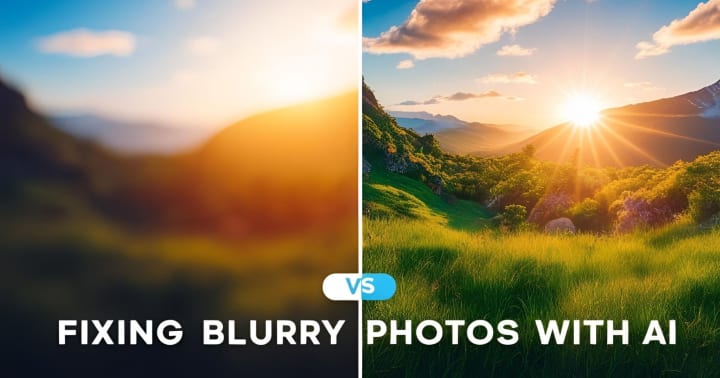
Why Do Photos Become Blurry?
Blurriness can occur due to:
- Motion blur – Caused by shaky hands or moving subjects.
- Out-of-focus shots – When the camera fails to focus properly.
- Low-quality cameras – Some cameras struggle in low-light conditions.
- Compression artifacts – Uploading images to social media often reduces their quality.
How Blur Removal Works
Traditionally, fixing blurry photos was almost impossible, but with AI-based deblurring algorithms, it is now achievable. AI tools can:
- Detect blurry areas and intelligently sharpen them
- Reconstruct missing details using deep learning
- Improve clarity and sharpness without over-processing
PhotoCut’s AI Blur Remover
PhotoCut offers an advanced blur remover that restores clarity to blurred images using machine learning. It can:
- Fix motion blur caused by hand movements
- Recover details from out-of-focus images
- Enhance faces and text in blurry photos
- Improve scanned images and old photographs
Importantly, this tool is best for e-commerce, where sharp images of products mean better conversions and sales.
Create digital art without having expert skills with PhotoCut’s AI Painter.
3. Transforming Low-Quality Photos into HD
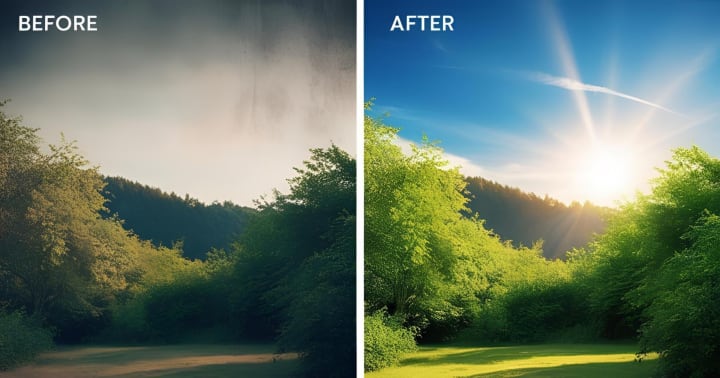
Why Convert Photos to HD?
There are many reasons why you might need an HD photo converter:
- Low-resolution images look pixelated when zoomed in or printed.
- Old photos lack sharpness and need enhancement.
- E-commerce platforms require high-quality images for better sales.
- Social media and digital content perform better with high-definition visuals.
How AI-Powered HD Photo Conversion Works
Traditional upscaling methods often result in blurry, stretched, or pixelated images. AI-based HD conversion, however, uses deep learning models to:
- Upscale low-resolution images without losing clarity
- Reconstruct missing textures and details
- Preserve edge sharpness and natural colors
PhotoCut’s AI HD Converter
PhotoCut offers a super-resolution AI model that enhances images up to 4K resolution. Features include:
- Automatic AI upscaling
- Preserves original details while increasing size
- Noise reduction for smoother images
- Ideal for printing, social media, and digital marketing
Now, you can turn pixelated images into high-definition masterpieces with just one click!
4. Making Photos Crisp & Clear
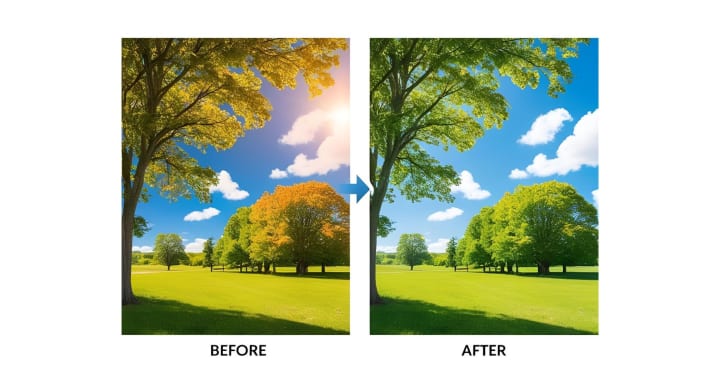
Why Do Images Need Sharpening?
Sometimes, even high-quality photos may appear soft or lacking in detail. Common reasons include:
- Camera limitations – Some cameras don’t capture fine details well.
- Soft focus – Some images lack the necessary sharpness.
- Compression loss – When an image is compressed, it loses sharpness.
How Image Sharpening Works
AI-powered image sharpening enhances images by:
- Identifying soft edges and making them crisper
- Bringing out textures and details
- Enhancing contrast to improve definition
PhotoCut’s AI Image Sharpener
PhotoCut’s AI-powered sharpening tool is perfect for:
- Recovering details in blurry images
- Enhancing product photos for e-commerce
- Improving landscape and portrait images
- Restoring old or scanned photographs
Unlike traditional sharpening tools, PhotoCut doesn’t introduce noise or distort the image.
Give yourself a virtual hair makeover with PhotoCut’s Bangs Filter.
5. Adjusting Dimensions Without Losing Quality

Why Resize Images?
- Web Optimization – Faster-loading pages for websites and blogs.
- Social Media Requirements – Each platform has specific image dimensions.
- Print & Digital Use – High-resolution resizing ensures quality prints.
Common Issues with Resizing
Standard resizing methods often:
- Reduce quality and cause pixelation
- Stretch or distort images
- Make details blurry
PhotoCut’s AI Image Resizer
With PhotoCut, you can resize images without losing quality. It offers:
- Smart AI resizing that retains sharpness
- Automatic cropping for social media sizes
- Batch resizing for multiple images
- Preserves aspect ratio to prevent distortion
PhotoCut provides crisp, professional images, no matter whether one is resizing to suit a website, social media, or screen.
Why Choose PhotoCut?
PhotoCut’s Key Features
- AI-Powered Enhancements – Automatic improvements with minimal effort
- Fast & Easy to Use – No technical knowledge required
- Cloud-Based Processing – No need for high-end hardware
- Supports Multiple Formats – Works with PNG, JPEG, WebP, etc.
Who Can Benefit from PhotoCut?
- E-commerce Businesses – Sharper, clearer product images for increased sales.
- Social Media Creators – High-quality visuals for better engagement.
- Photographers & Designers – Professional-level enhancements.
- Marketers & Advertisers – Optimized images for promotions and campaigns.
Create eye-catching YouTube thumbnails with PhotoCut’s YouTube Thumbnail Maker.
Conclusion
An AI-based online image enhancement tool works without the need for complex software like Photoshop for enhancing, sharpening, or resizing. It has one-click solutions for:
- Blur Removal
- HD Photo Conversion
- Sharpness Improvement
- Resizing Without Quality Loss
PhotoCut makes it simple to produce high-quality photos, regardless of your level of experience.
So why wait? Try PhotoCut today and take your images to the next level!
Recolor your images online for free with PhotoCut’s AI Color Changer.
FAQs
Q1. Define image enhancement. Why would I need it?
Ans. Enhancing a picture's visual quality is the focus of image enhancement. In general, it involves adjusting brightness, contrast, saturation, and sharpness as well as eliminating flaws like noise and blurriness. For better presentation, one may wish to enlarge a photograph, add color, or just make it larger so that it may be printed, distributed, and shown online, or used in a professional setting.
Q2. What are the advantages of using an Image Enhancer/Blur Remover/HD Photo Converter/Image Sharpener/Image Resizer tool?
Ans. The advantages are:
- Better visual quality: produces clearer, cleaner, and more attractive photos.
- Finding Details: Making visible a hidden detail that could otherwise be obscured in a damaged or unclear image.
- Higher Resolution: Turning a low-resolution image into way clearer high-definition images.
- Professional Appearance: Elevates the look of your photographs to appear polished and professional.
- Optimized for Use: Resize images for specific platforms (social media, websites, printing) without losing quality.
Q3. Can a blur remover fix a severely blurred picture?
Ans. Although they have their limits, blur removers may significantly improve the clarity of blurry photographs. Extreme blur or insufficient information in the source image might result in less-than-ideal outcomes. The effectiveness of the fixing mechanism is determined by the severity and type of the blur and the quality of the original image.
Q4. What types of blur can a blur remover typically fix?
Ans. Many blur removers can handle:
- Motion Blur: Caused by movement during the photo being taken.
- Out-of-Focus Blur: When the subject is not properly in focus.
- Gaussian Blur: A general type of blur often used in image editing.
- Lens Blur: Blur created by the lens of a camera.
- Time-Saving: Automate complex editing tasks that would take much longer to do manually.
Q5. Can an HD Photo Converter truly create detail that wasn't originally there?
Ans. Not exactly. HD Photo Converters use algorithms to estimate and reconstruct details that were lost during the original image capture or compression. They don't magically create information from nothing. The perceived quality is improved through intelligent interpolation and detail enhancement.
Q6. What are the HD Photo Converter limitations?
Ans. If the enlargement is done inappropriately, artworks might create artifacts upon up-converting, show pixelation, or just appear 'soft' to the naked eye. Extreme upscaling creates an ugly image. The conversion would involve a more sophisticated algorithm to achieve a better result.
Q7. When should I use image sharpening?
Ans. Image sharpening is useful when:
- An image looks slightly soft or blurry.
- You want to emphasize specific details in a photo.
- You're preparing an image for printing or online display.
- You want to counteract the softening effects of resizing or compression.
Q8. How to know when you have over-sharpened an image?
Ans. Inspect the edges and details of the image. Bright halos, too much graininess or noise, and an appearance that is unnatural-looking-all are indicators of over-sharpening.
Q9. What is the difference between resizing and cropping?
Ans. Resizing is the action of changing the size (width and height) of the entire image while cropping the image cuts away some portion to change its composition and size.
Q10. Does resizing the image influence its quality?
Ans. Yes, the resizing usually affects the quality.
- Upscaling usually degrades quality: The image may get pixelated or appear blurry due to stretching of the existing pixels.
- Downscaling may sometimes enhance perceived quality: Excessive scaling down also carries the risk of losing fine detail.
About the Creator
PhotoCut
AI Photo Editing Tool - Remove or Change your Background & Enhance Product Photos
Keep reading
More stories from PhotoCut and writers in Photography and other communities.
A Guide to Background Removal, Image Editing, and More
In the digital world we see today, every working professional and photo enthusiast requires some serious tools for photo editing. Photographers, graphic designers, social media influencers, and owners of e-commerce businesses must be able to swiftly and capably edit pictures to make a crucial difference in the quality of their output. Among the diverse photo-editing tools we find nowadays, PhotoCut somehow stands up as a pretty strong platform with several APIs for background removal, image editing, and background generation. In this detailed guide, we shall see API-wise Background Removal API, Image Editing API, Background Generating API, PhotoCut API, and also deeply compare PhotoCut and Remove.bg.
By PhotoCut11 months ago in Photography
The Photographer's Code
You decide to visit your local park. You have become a close confidant to the homeless people who gather there most days. While talking to Cleo and Reed, you notice a new face in the crowd. It belongs to a stick-thin, middle-aged woman. She has her hand on her forehead as if taking her temperature.
By Paul Aaron Domenick7 days ago in Photography
The Gold Tone (Orotone) Technique
She picked it up from a dusty shelf at an estate sale, thinking it was just an old frame. Then the light caught it. The image glowed, not like a print, not like a painting, but like something that seemed to carry its own inner warmth. That was her first encounter with an Orotone, and she bought it without asking the price.
By CurlsAndCommas3 days ago in Photography



Comments
There are no comments for this story
Be the first to respond and start the conversation.