
Titanic: 'Based' on a true story.
Where life meets art, in all the worst ways.


Adapting a film from a true story is usually considered to be a difficult subject. It is difficult to collect information and eye-witness accounts on what actually happened during an event, especially if that event occurred multiple generations ago. Another difficulty in developing a film based on a true story is making characters within that film match up with the actual lives of the people they are portraying. Non-fiction films have existed since the beginning of the medium, telling stories of everything from the Civil War, to the sinking of the Titanic, to Pearl Harbor, and even modern films discussing the events surrounding September 11th, 2001. One relatively recent film which was critically lauded for its storytelling and broad scope was the James Cameron romantic drama, Titanic, based around the sinking of the eponymous ship. Released in 1997, Titanic tells the story of Jack Dawson and Rose Dewitt Bukater, two star-crossed lovers who meet aboard the eponymous White Star Line cruise ship on its first and only journey across the northern Atlantic Ocean. Three days into its voyage, the cruise liner hits an iceberg and sinks below the waters, killing over 1500 people. While the film does its best to accurately portray the sinking of the ship itself, the portrayal of the people on board are depicted in an expressively fictional matter. Real-life historical figures are demonized as crooks and murderers, while other events and characters are made up entirely purely to push the action further and tell a story that, for all intents and purposes, was a product of Hollywood.
The characters of Jack and Rose, as well as Rose’s fiancé Caldeon “Cal” Hockley, are fictional people made up by the filmmakers to give the story a focused plot without having to fictionalize people that actually existed. The issue with this is that, since the characters are made up, any interactions they have with people who actually did exist did not actually happen in real life. In one particular scene, Rose is seen talking to the captain of the ship, Edward John Smith, and he mentions reports of icebergs ahead and decides to ignore it and to tell the ship hands to increase the speed of the ship. This conversation could very well have happened with someone who did exist, but it instead happened with the fictional Rose, thus further blurring the lines of fiction and non-fiction. In another scene involving Jack and Rose, the two flirt and kiss on the bow of the ship at night on April 14th, 1912. In doing so, they distract the guards in the crow’s nest who are supposed to be watching for icebergs, and therefore inadvertently cause the ship to strike the iceberg and sink. In the book The Titanic in Myth and Memory: Representations in Visual and Literary Culture, contributor Gaylyn Studlar mentions this scene in particular and writes “[The scene] in which Rose and Jack Dawson distract the lookout and cause the collision with the iceberg may seem ridiculous by our standards of historical reality, but those standards are usually detached from notions of film as a fictional construct that organizes history for its own purposes” (Studlar 158). This means that audiences have come to expect the developers of any historical film to sacrifice real instances in order to put their own fictional or fictionalized characters into the action and give them a story and a purpose.
The film also takes real life historical people and alters them in a way to fit within a closed narrative, even when that alteration is debatable or demonizes the actual person. In the film, Captain Edward John Smith is seen stepping onto the bridge of the Titanic during the midst of its sinking and is killed when water rushes through the windows. This, among other things, is a fictionalized scene. In reality, no one truly knows what happened to Captain Smith, with his Biography.com page discussing the rumors that he either shot himself on the bridge and other rumors saying he died saving children (Biography.com). This is an example of the filmmakers utilizing real-life people in fictional situations when they do not have all the information regarding that person, tying up their particular story to tell a full story. Another example of the film taking liberties with real-life people is the story regarding First Officer William McMaster Murdoch. Murdoch is seen in the film as taking bribes from the antagonist, Cal, to secure him a place aboard a lifeboat. Later on in the film, he throws the money back to Cal shortly before shooting a third-class passenger in a panic, and then turning the gun on himself.
While Murdoch did die aboard the ship, circumstances on the events surrounding his death is debatable, and these circumstances continue to be a subject of great controversy. According to the website encyclopedia-titanica.org, “Murdoch’s death will forever remain a mystery, some say he was washed off the deck while trying to launch collapsible ‘A’, but others say that he committed suicide after shooting two passengers, who were trying to charge a lifeboat” (encyclopedia-titanica.org). Nevertheless, the family of William Murdoch did not take kindly to his fictionalized portrayal in the film. According to a BBC news article from 1998, “Titanic Makers Say Sorry”, the Vice President of 20th Century Fox visited Murdoch’s home town of Dalbeattie, Scotland to personally apologize for “tarnishing the reputation of one of [Dalbeattie’s] heroes”, though Murdoch’s nephew believed the damage to Murdoch’s reputation had already been done (BBC). This act of demonizing real-life people to push a narrative is a common trope in historical fiction. In the 2001 film Pearl Harbor, the Japanese zero fighters attacking the eponymous military base are seen deliberately attacking the base’s hospital area. This attack kills countless medical personnel and completely destroys the buildings, putting the main protagonist’s love interest in peril (Touchstone Pictures). According to the site HyperWar.org, however, the buildings were damaged in the attack but were not deliberately destroyed, and only one medical officer was killed while trying to cross a navy yard (HyperWar.org). Both Pearl Harbor and Titanic are prime examples of taking what actually happened and dramatically fictionalizing it to make a cohesive narrative.
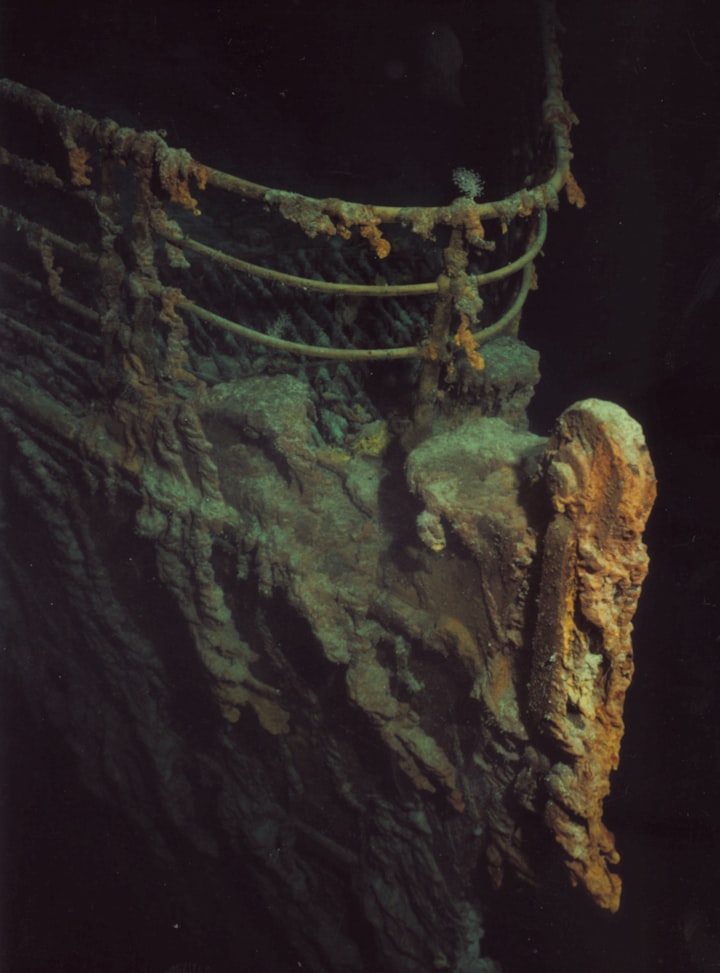
Despite from the fictionalization as well as rumors regarding certain personnel aboard the ship, the film Titanic does portray the actual sinking in an accurate manner based on the theories of the sinking at the time. The film shows the ship striking the iceberg, then slowly sinking at first. As more water fills the interior of the vessel, the sinking speed increases dramatically until the stern of the ship is out of the sea entirely. It is at this point, when the rear of the ship cannot take the stress of staying upwards, that the ship breaks in half at a weak point, then the stern climbs until it is completely vertical before finally sinking below the water. While the film was based around information that was obtained by eye witnesses at the time, new information regarding the sinking since the film’s release has allowed for more of an accurate recreation through current technology. One such recreation was developed for National Geographic’s “Titanic 100” special, and was a computer-generated image (CGI) rendition narrated by James Cameron himself. This new recreation shows that the sinking listed slightly before sinking at an acute angle, climbing almost vertically only when most of the stern was under water (National Geographic). In any case, however, the ship is shown to break in half just above the sea level in its final moments. The breaking was a subject of debate before the discovery of the wreckage, with many believing that the ship fell completely in-tact.
Arguably, it is difficult to accurately portray something that actually happened, especially within the medium of theatrical film. Films of this nature are compressed to fit a stable running time, which at most is usually two to three hours. This is as opposed to a book which is as long as the author needs it to be, or a television or radio serial which can bring new self-contained episodes when need be. Films also take a while to produce when the pre-production, production, post-production, and marketing are taken into account, especially for a film with such a grand as scale as Titanic. Another difficulty when producing a film such as Titanic is fixing the issues that others had with it. An issue on fictional television series, for example, can be retroactively fixed with new episodes and alternate endings to explain things away while films based on real events such as Titanic cannot due to its story. The only possible example of fixing the film is mentioned in an article from 2012, by Discovery News. This article titled “'Titanic' Accuracy Tightened by Neil DeGrasse Tyson” by Ian O’Neill mentions that the filmmakers were able to change the star field above the sky using computer-enhanced graphics to accurately match the one that was visible over the North Atlantic when they re-released the film in theaters for the 100th anniversary of the Titanic’s sinking (O’Neill). The minor change of the sky would be an indication that the developers of the film do care about their product and its accuracy, though it would be impossible to change other events that were wholly inaccurate such as Murdoch’s death scene without extensively deleting scenes and other edits. In any case, Titanic is a prime example of the phrase “based on a true story”, where its basis is the setting, but the story is far from true.
About the Creator
N.J. Folsom
There's a whole universe in my head, just waiting to be written.
If you like my stories, please consider donating to my PayPal to help me keep writing!
Keep reading
More stories from N.J. Folsom and writers in Photography and other communities.
Leavie Scott
ORDER HERE Chicago – A Radiant Urban Masterpiece by Leavie Scott Arts & Culture Review – Feature Story In his striking new work Chicago, photographer Leavie Scott captures the soul of the Windy City with a level of vibrancy and emotional resonance that is impossible to ignore. The image immerses viewers in a dazzling skyline bathed in mesmerizing tones of purple, pink, and gold—a palette rarely seen in traditional urban photography and one that instantly distinguishes Scott’s artistic voice.
By Organic Products 4 days ago in Photography
Curious Photography Tips Every Beginner Should Try
Have you ever wondered why two people using the same camera can produce completely different photos? The answer often lies in how well the photographer understands the camera itself. For beginners, cameras can seem filled with confusing buttons, dials, and settings. But what if those settings are actually the key to better photos?
By Craig Spiesman2 days ago in Photography




Comments
There are no comments for this story
Be the first to respond and start the conversation.