
The journey of an image
Your best images don't come from your camera.
Where does an image come from?
Not from our cameras. All our cameras did was freeze the moment we were interested in. A one-sixtieth of a second in time.
It's not from being in the right place at the right time. A hundred humans can be in the same place, and their photographs can all look completely different.
Where, then?
Our hearts? Sounds kind of cliché, doesn't it?
Our talent? Years of practice and we can just see the right image to take?
Is it relationship? The sparks between humans inspire creative magic that becomes a photograph?
I suppose it's all of these. Over my career (international award winning none-of-it-really-matters-does-it wedding photographer) I drew inspiration from all of those places. The gear, the locations, the humans, the intuition. But ultimately, I came across my best images by refocusing (yep, there's a photographer joke) on something deeper than the image:
Me.
Instead of chasing the best images, the greatest client stories, the prettiest locations, I started chasing myself. I asked myself "who are you?", "what do you believe about life?", "what matters?" I asked "why do these things matter to you?"
And I landed on all these pieces of my identity, messages that I wanted to communicate in everything I created. Whimsy. Magic. Honesty. Love. I realised that whenever I grab a camera, or a pencil, or a paintbrush, I am splashing these identity-pieces onto the medium. I'm not trying to make a photograph at all - I'm just sharing myself with the world, in whatever form requires it at the time.
All this "me" talk is probably sounding borderline narcissistic now, but I think it's still true: if you ever want to make a difference in your work, in your creative endeavors, then you need to make peace with yourself, and acknowledge just how uniquely powerful you are in the world.
You don't have to compete with anyone else. You don't have to try and copy someone's "best image" so that you can feel better about your own. You just have to know yourself, honour your own vision, and whatever is created from that space has the greatest chance of being valued by others.
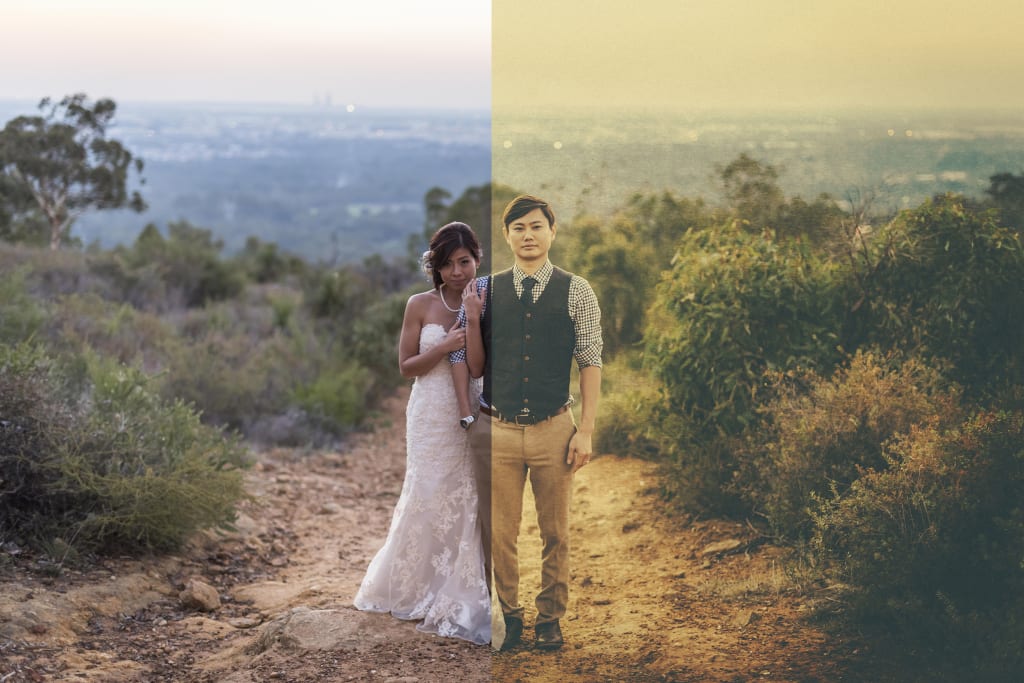
So, with all that in mind, I'd love to take you through the journey of just one wedding image, from concept to completion. Meet Chloe and Matthew:
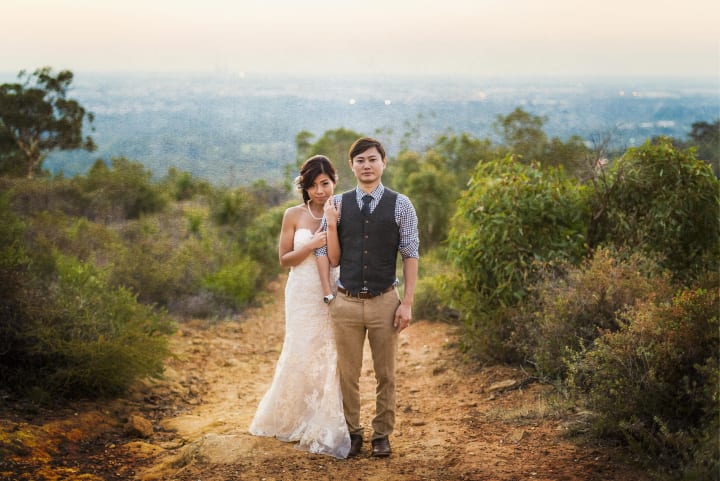
My starting time for this wedding was 5:30am, and this shot was taken at sunset, an hour after I had finished up, free to head home. I had been shooting all day, and was exhausted, but I volunteered to stay - I suggested we head up a hill for this single shot. Here's why:
A strong and authentic idea will drive everything else.
Step one of my process is the idea. Your best images come from your core, your self, what you believe, and for me, I envisioned whimsy and honesty. So a week before the wedding, I set out to explore this idea.
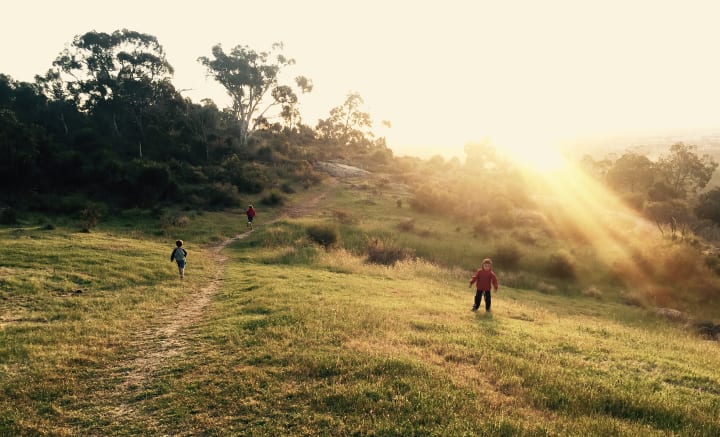
I took the kids, and scouted for a setting that would reflect my vision. "Where is the whimsy that will work for this couple?" was my question. And this is step two of the process:
Find the setting that honours the idea.
It doesn't need to be perfect, beautiful, professional or appreciated by the clients. It does need to serve the idea. Respecting the idea is respecting your own unique creativity.
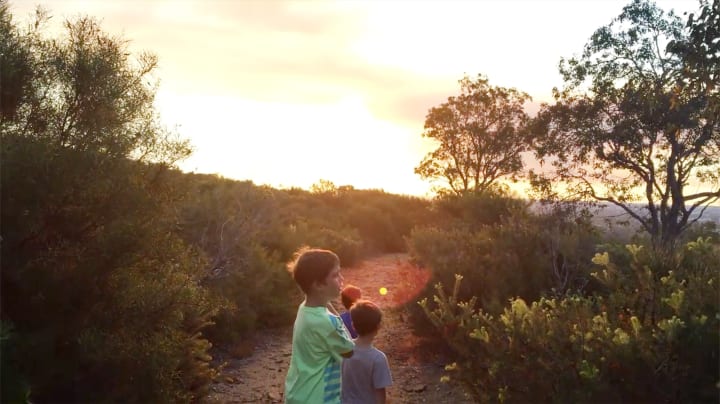
Yep, we found a spot. Dirty gravel and scratchy trees. Bingo.
A week later, and it's the wedding day. The bride and groom are saying their farewells, they are thanking me for shooting all day, and everyone is ready to leave. And I say "Guys, I have an idea."
Like I said earlier, an authentic idea drives everything else, and Chloe and Matthew were excited to climb up a mountain.
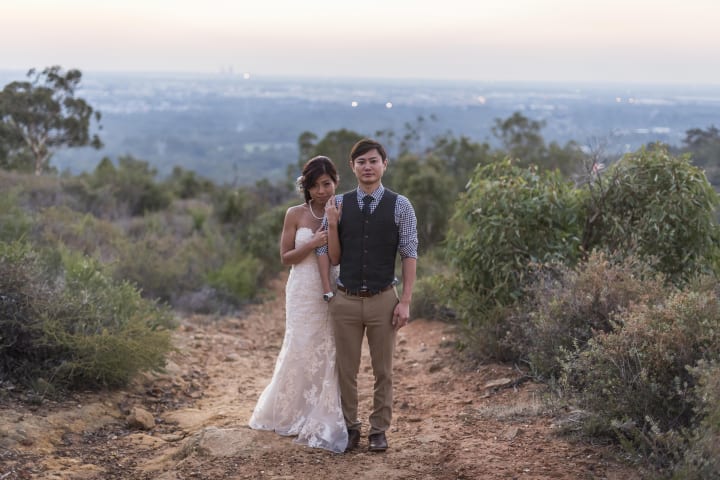
Now, finally, the image gets a chance to be captured on camera. But before that shutter snaps open, we have to consider step three: posing. And I'll keep this short, because it's too huge a subject. For me,
the secret to posing is not in the SHAPING of people, but the TALKING to them.
The words we use, and how much we speak, allow our subjects to relax, move, trust us, and be real.
Be confident, talk a lot. Always encourage them. When you stop talking, it gives them time to think about how awful they might look. Pose body first, leave expression till last. Then shoot quickly: Their awesome expression will only stay for a second.
The talking around this shot was real simple: all about being each other's safe place, and being so proud of each other, and ready to take on the world together.
Aaaaaaaaand... click.
A sixtieth of a second and we're done. Hugs, thankyous, goodbyes. And now we get to work on completing the idea.
Step four: import. I use Adobe Lightroom. It's powerful, doesn't get in my way, and can get me through thousands of images fast. I import files in RAW and export in JPEG. Maximum edit range, maximum share potential afterwards.
Step five: colours and tones.
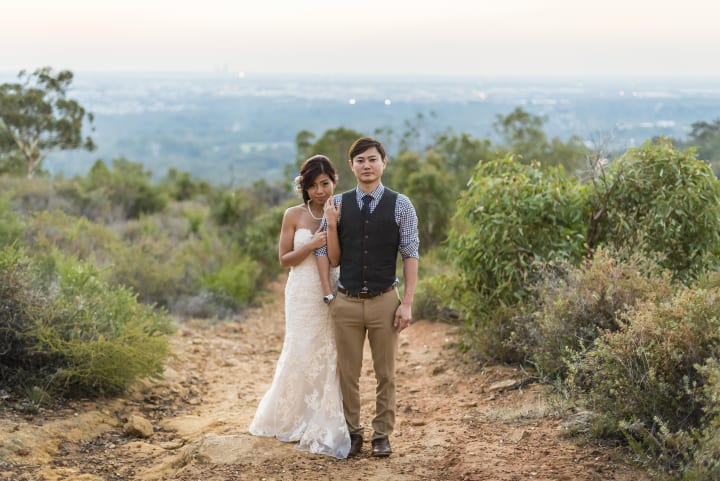
As a general rule, less is more. In Lightroom I simply slid the exposure bar up, the white balance a bit more warm and less magenta, and the lights bar up (It's one of the tone bars, and helps add a "punch" without making everything too contrasty.) You might have noticed I adjusted the crop slightly too, just to straighten up the horizon.
So, are we done now? Is this it? Finished?
It's professional enough, right? Legit. Happy clients. Next job?
This is why having an idea to align to is so important. We must bring it back to the vision, the unique spark. We must ask the question,
"Has this image arrived? Is it truly honouring the idea that birthed it?"
If you cannot answer "yes" then you must keep going.
For me, this image wasn't there yet. I wanted it a bit "richer", and so I went to step six: brushes.
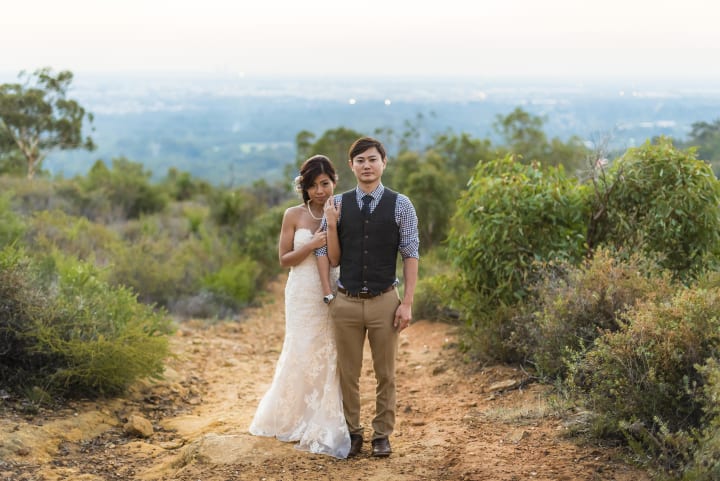
I used the adjustment brush in Lightroom to pull the exposure down and saturation up for all the areas around the couple, without brushing over them directly. Better, but not done. It didn't yet feel like the vintage whimsy that was in my head. Onwards then.
Step seven: texture.
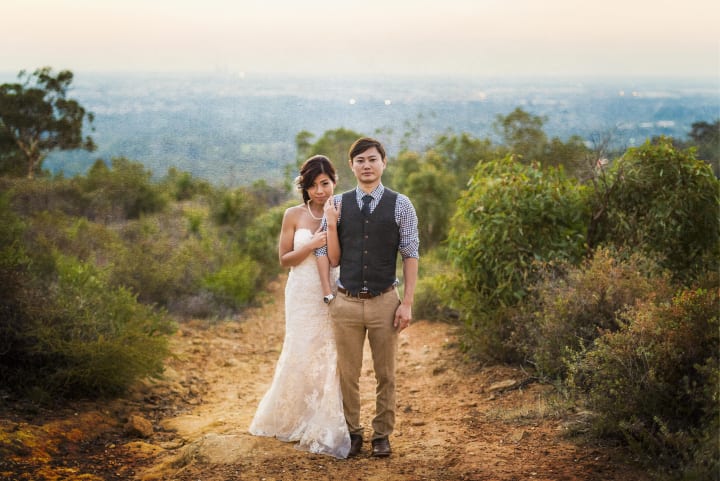
I'm now working in Adobe Photoshop for the textures, as this process requires layers of other images, which Lightroom doesn't do. I had a texture image that I shot a while ago (just a piece of scrunchy paper I think) and essentially placed it over this image, used overlay to blend them together, and them erased any piece that came into contact with the couple's skin.
"Now is it done?" I asked myself.
Nope. It's professional, and honest, but doesn't hit that note of whimsy I'm looking for.
Step seven: Final effects.
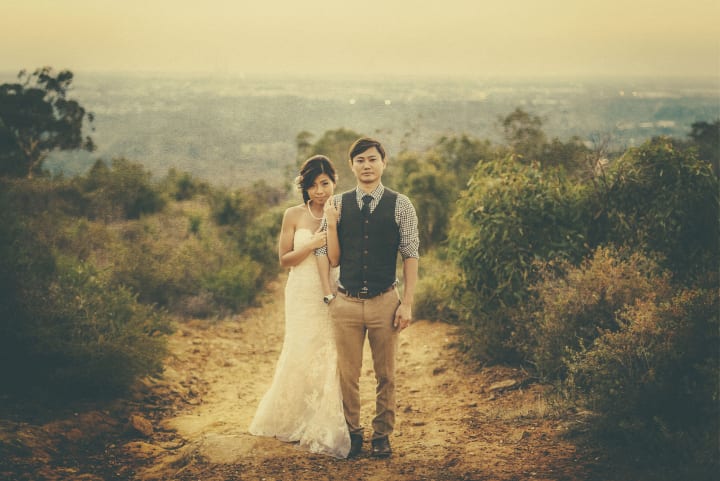
All the work was done, and with this textured image back in Lightroom I just had to find the right preset that felt like "whimsy". I had previously purchased some presets from a company called VSCO, and have modified my favourites to make a handful of filters I love. This one has an old vintage polaroid film feel, and was perfect for the image.
"Now, is it done?"
Yeah. Now it's done.
The idea was whimsy and honesty, it reflected pieces of me, what I thought about love and marriage and magic. I gave my clients a piece of myself, wrapped up in an image of them that they adored, and that made it powerful for all of us.
They felt seen and I felt seen.
It was a sixtieth of a second well spent.
About the Creator
Keep reading
More stories from Nathan Maddigan and writers in Photography and other communities.
Holding Space
Tonight the sky is exploding. Trails of fizzy light erupting in spectacular bouquets of pink and green and blinding white. There's so much smoke, we can’t see the stars anymore. Below our balcony, heavy grey ghost-clouds are just yawning their way through the city, like ancient spectres roused from slumber, and already bored.
By Nathan Maddigan5 years ago in Humans
The Photographer's Code
You decide to visit your local park. You have become a close confidant to the homeless people who gather there most days. While talking to Cleo and Reed, you notice a new face in the crowd. It belongs to a stick-thin, middle-aged woman. She has her hand on her forehead as if taking her temperature.
By Paul Aaron Domenick4 days ago in Photography
The Gold Tone (Orotone) Technique
She picked it up from a dusty shelf at an estate sale, thinking it was just an old frame. Then the light caught it. The image glowed, not like a print, not like a painting, but like something that seemed to carry its own inner warmth. That was her first encounter with an Orotone, and she bought it without asking the price.
By CurlsAndCommasabout 17 hours ago in Photography


Comments
There are no comments for this story
Be the first to respond and start the conversation.