
Tear Gas and Memory: A Protest in Thessaloniki
A Story of Resistance, Repression, and Remembrance.

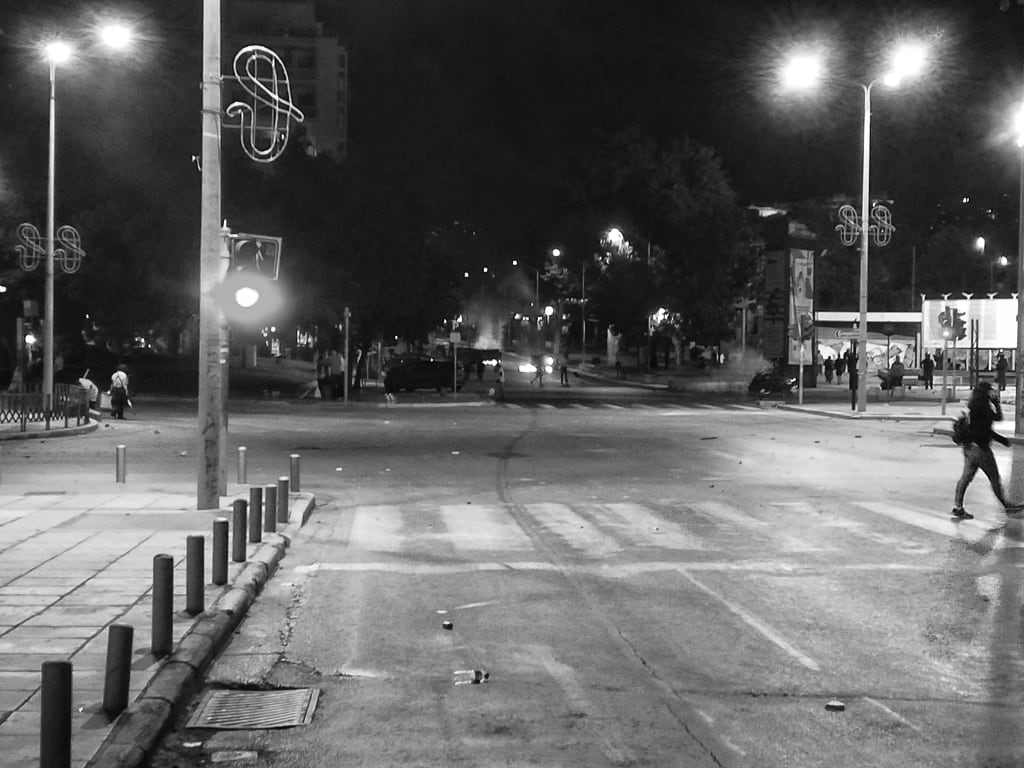
Through travelling, I have experienced different feelings, met really special people and sometimes a few of those experiences made me change my whole mindset. For me, photography started as a way of keeping memories. I was never a professional photographer, and to be honest, I never intended to be one. Nevertheless, some of the pictures I have taken throughout these years ended up having more meaning than others. This might have to do with special memories or people.
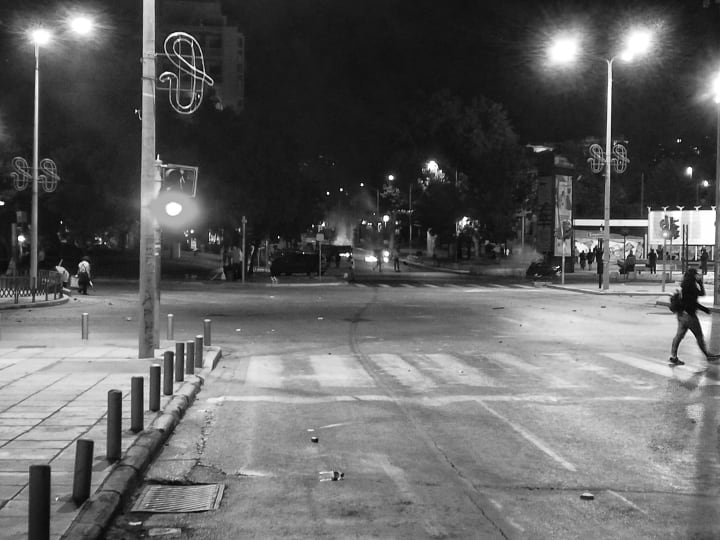
But these pictures I am going to present to you, have a special humanitarian meaning for me. I tried not to process them, by using any sort of filters, but as you will see, all of them are black-and-white.
This started with me wanting to give a sense of film-noir to the pictures and the stories that represent or could represent.
Thessaloniki 17/11/2016
The Anniversary of the Polytechnic Uprising
On November 17, 2016, Thessaloniki's streets filled with protestors marking the anniversary of the 1973 Polytechnic Uprising—one of Greece’s most significant moments of resistance against the Military Junta. What began as a peaceful march quickly turned into chaos, as police forces used tear gas to disperse the crowd.
For years, this day had been one of remembrance and defiance, a time when people marched not just in memory of the students who sacrificed their lives for democracy, but also against austerity measures and rising authoritarianism. That day, I was part of the protest, walking alongside my ex-girlfriend, committed to honoring the past and resisting the injustices of the present.
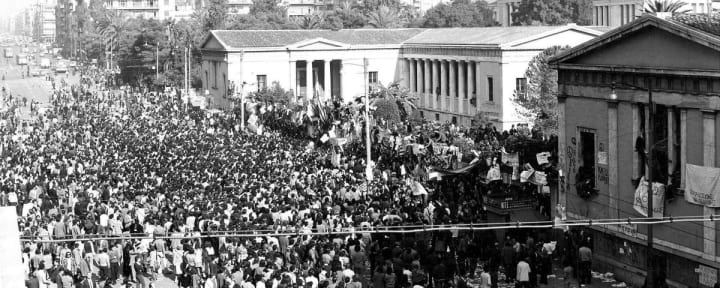
The years before I migrated, away from my homeland, Greece. I was celebrating that day, going to the peaceful protest and marching in the streets of my city protesting against the undemocratic measures of each Greek government and protesting against the austerity measures that were crippling my society and bringing xenophobic and neonazi movements in my society and even in the Parliament. That day I went with my ex. She also wanted to protest against the government and in remembrance of the students that died on that day the 17th.
Chaos and the Crackdown
The march started from the iconic "Camara" and moved toward the Polytechnic Department of Aristotle University. The atmosphere was tense but nonviolent—until one rock was thrown. No one knew who threw it. Some whispered of a provocateur. But that one act was enough.
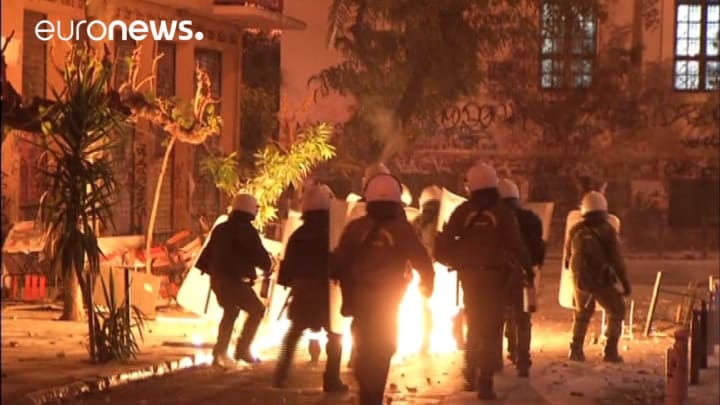
The police, seemingly waiting for an excuse, launched an assault. Tear gas canisters rained down, their acrid smoke burning eyes and throats. One landed near me, but before I could react, a protester kicked it back toward the police. I don’t remember his face, but I remember his smile before he disappeared into the chaos.

The Escape and the Aftermath
I turned to find my ex, only to see her signaling from a distance. We ran, our eyes burning, tears streaming down our faces from the chemicals. We found refuge in a small café, where others had also taken shelter. Outside, the city resembled a war zone—barricades of burning garbage bins, rocks flying through the air, riot police pushing forward.
We waited an hour before stepping outside. The air was still heavy with tear gas, the streets eerily empty except for scattered protesters and officers in full riot gear. That was when I took the photograph—an image of fire, resistance, and the silent resilience of a city used to struggle.
A Pattern of Repression
This was not the first, nor the last time, that Greek police used excessive force against civilians. Each year, the anniversary of the Polytechnic Uprising serves as a stark reminder: democracy is fragile, and its defense often comes at a cost. What should have been a moment of solemn remembrance had once again been met with violence. The same system that students fought against in 1973 still finds ways to silence dissent.
As I reflect on that day, I realize the importance of remembering—not just through protests, but through stories, images, and the collective voice of those who refuse to be silenced.
Written by Sergios Saropoulos
About the Creator
Sergios Saropoulos
As a Philosopher, Writer, Journalist and Educator. I bring a unique perspective to my writing, exploring how philosophical ideas intersect with cultural and social narratives, deepening our understanding of today's world.
Keep reading
More stories from Sergios Saropoulos and writers in Photography and other communities.
Nazim: A Journey Through Ayvalik and Unexpected Encounters
The ferry from Lesvos approached Ayvalik, Turkey, stirring vague childhood memories of market stalls, a woman searching for a lost church. This time, I travelled with a friend, both of us without a plan, just the excitement of wandering. On the ferry deck, I saw a woman short hair, a confident presence, and an air of mystery. She noticed me watching, waiting for me to speak, but hesitation won. She left, and I never saw her again.
By Sergios Saropoulos4 years ago in Photography
The Photographer's Code
You decide to visit your local park. You have become a close confidant to the homeless people who gather there most days. While talking to Cleo and Reed, you notice a new face in the crowd. It belongs to a stick-thin, middle-aged woman. She has her hand on her forehead as if taking her temperature.
By Paul Aaron Domenick5 days ago in Photography
The Gold Tone (Orotone) Technique
She picked it up from a dusty shelf at an estate sale, thinking it was just an old frame. Then the light caught it. The image glowed, not like a print, not like a painting, but like something that seemed to carry its own inner warmth. That was her first encounter with an Orotone, and she bought it without asking the price.
By CurlsAndCommas2 days ago in Photography
Why Didn't Anyone Tell Us
Men, move along. This is not for you. This is for the women. I was forty-five when I began menopause. It is pretty young for that to be going on in a woman’s life, but I had undiagnosed PCOS, my entire life. Thank you to all the gynecologists I had seen my entire life. That in itself should encourage women to keep seeking second opinions, especially when you are not getting correct answers or any at all.
By Alexandra Grant4 days ago in Humans



Comments
There are no comments for this story
Be the first to respond and start the conversation.