
School in the Time of Quarantine
Memories of 2020 from a teacher's perspective

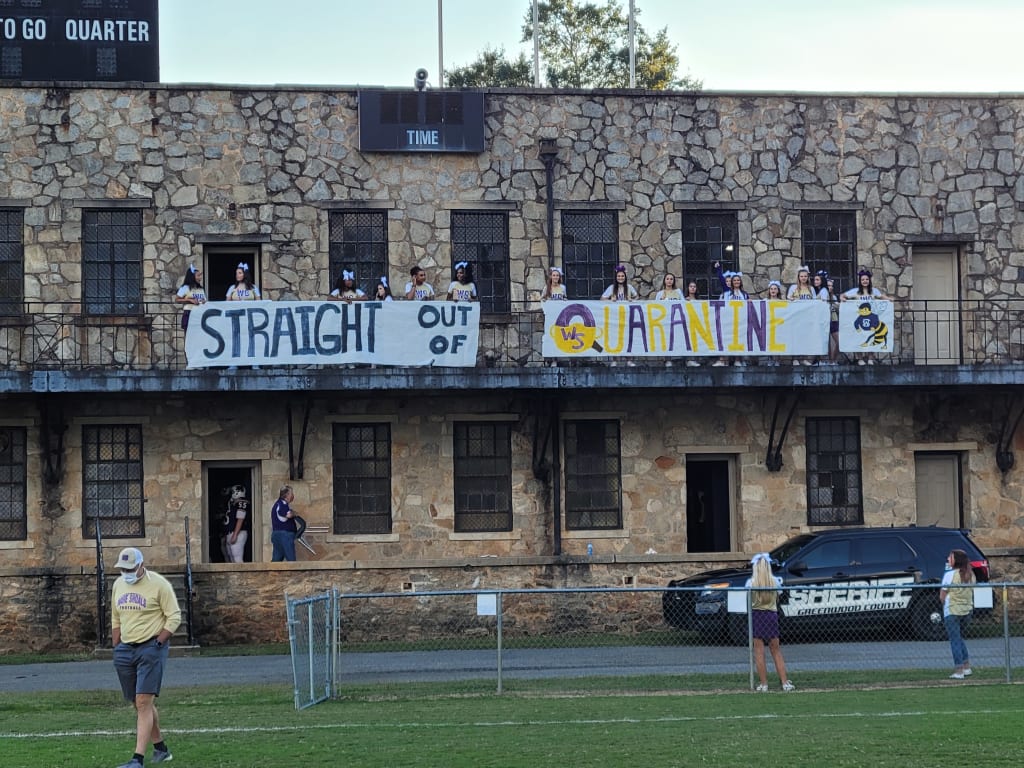
I’ve been an English teacher in the state of South Carolina for the last seventeen years. For the most part, it's been a joy and a pleasure. We’re all aware of the stigma that southern schools have and some of the difficulties we face with the wide variety of ranges between student types, races, religions, socioeconomic statuses, and the like. But as an English teacher and a coach, I’ve had the privilege of experiencing the wide variety of students that each part of the state offers. I’ve taught at giant metropolitan schools in the city. I’ve taught at rough, urban schools, where kids get to school through back alleyways to avoid gangs huddled on street corners. I’ve taught at rural schools where students come to class in the morning having woken up at dawn to feed the chickens. I’ve taught at tiny schools in the middle of nowhere that were 97% African-American. I’ve taught at tiny country schools that were 97% Caucasian. I’ve taught the gamut of students that the great state of South Carolina has to offer, and undoubtedly, I’ve enjoyed it. There have been struggles, but I love the teenagers I teach, I love the teachers and administration I work with, and despite all the horror stories you hear in the media, I enjoy being a teacher.
But there have been trying times.
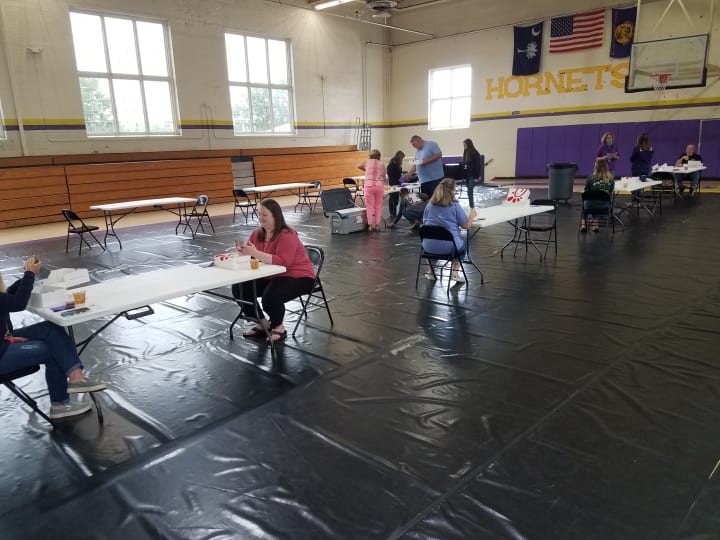
The above picture was taken in May of 2020. It depicts the end of the school year celebration that we as a staff have every year. Every year, we get together, commiserate, compare war stories, laugh, eat, discuss our summer plans. We decompress, together, a staff built by respect and camaraderie. But as we all know: 2020 was different.
This school was Ware Shoals High School, a tiny, rural school in a tiny, rural town on the western edge of the state. The principal was a fantastic man by the name of Paul Anderson, and he was an absolute joy to work for and work with. When Covid-19 hit and the shutdowns began, nobody expected that this small country school would close its doors. But in late March, just a few days before Spring Break, Paul called for a faculty meeting after school. The whole staff met in the first handful of rows in the school’s beautiful, original auditorium, so old it was an antique unto itself. We laughed, joked, some verbally protesting about the random called meeting and whether it could have been an email or not. When Paul came in, his normal stone-faced demeanor had an uncharacteristically somber air to it, and you could get a sense that something was wrong.
He stood on the stage and told us to enjoy our Spring Break, but to make sure we bring any laptops or teaching needs home with us, because in all likelihood, we would be teaching from home for the foreseeable future. He gave us the numbers, the predictions, the details about the emergency board meeting and how the district had come to this decision. He gave us the outline of what to expect, tips on how we could better do our jobs remotely. And he told us he loved us. That he loved the kids. And that, for the time being, loving us meant we couldn’t be together for quite some time.
And we said goodbye.
Spring Break passed. Then our first week of remote learning. Then the next week. And then it was about that time the announcement came that we would not be coming back for the remainder of the school year. Paul called us, checked on us, and then in a school-wide video call, it was explained to us that we were to quietly finish with our gradebooks and make sure that, so long as the student was passing before the shutdown, they would pass regardless of what they did or didn’t do during the remote learning (after much consideration, I ended up agreeing with this decision, as there was no reason to punish a kid because he had no way of adjusting to his learning environment being his own bedroom; this was not the students’ faults).
Near the end of May, Paul called again, and he told us that those who were willing were invited to come up to the school and have an end of the year luncheon, and that we would be practicing “extreme social distancing measures” to make sure everyone was safe. The lunches were pre-boxed, prepared by women wearing what were essentially hazmat suits. We could only eat at the end of tables, ensuring a common six-foot separation. And I went, and there I snapped this photo.
I distinctly remember thinking, “I shouldn’t have come.” I may have said it out loud, unfortunately. I expected joy, fellowship, joyfully regaling one another with what’s been going on. Instead, it was trepidatious silence. Discomfort. Am I too close to her? Am I in his personal bubble? Did that lady just cough? These were friends, close friends of mine, and I sat across from them at a measured distance of six feet and we all said nothing. Nothing. As we quietly chewed on our boxed lunch. Paul said a few melancholic words, we all waved our goodbyes, and we went home not knowing what school would look like when we came back (if we came back) in August.
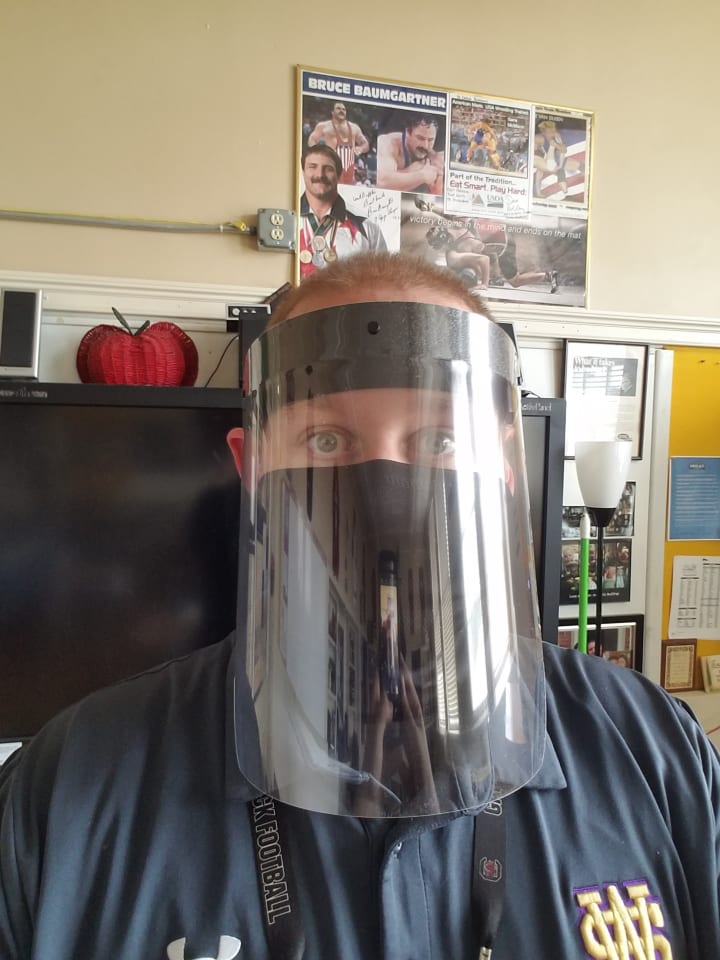
When we finally returned, we had a number of new restrictions that nobody was ready for. We had a few tons worth of plexiglass warped and shaped into barriers created for each desk that were a huge burden to work around (they get dirty quickly, and they break often, clearly built too fast and without any belief that they would last long). For each teacher, we were required to wear facemasks, wear plastic gloves when we wiped down each student desk after each period, and wear giant encumbering face shields that would fog when I started to breathe too hard from all the effort I was putting into WIPING DOWN EVERY DESK AT THE END OF MY SIX DIFFERENT CLASSES. The pictures here don’t do it justice.
The 2020-2021 school year was one complication after the next. Multiple times, we had to go on adjusted breaks and e-learning stints because infection rates grew too high. Even in the times that we were together, individual kids would be removed for periods at a time due to infection or exposure, and a myriad of teachers would also be removed for extended periods for the same reason. It was an atmosphere of doubt and uncertainty, complicated further by recurring problems of the real world that didn’t go away just because we were living through an epidemic: a young man killed himself, a young lady was killed in a car accident, the opioid crisis was still running amok, threats of violence and the like, all of these things amplified by the anxiety caused by a disease we knew so little about until it wreaked us all. I applaud Ware Shoals and Paul Anderson for handling it the best way they could, but that didn’t detract from the pain caused by destroying any sense of normalcy these students relied upon.
Eventually, things returned to normalcy, or whatever they coined “the new normal.” Sports came back. Dances came back. The plexiglass disappeared. But you can ask any teacher today: quarantine killed education for a lot of our kids. The last few years have been wrought with students coming through my classes with huge gaps in their knowledge, most of them 2-3 years behind on what they SHOULD know coming into my class versus what they actually know coming in. And South Carolina was not affected nearly as much as many other states, who suffered through quarantine a whole lot longer than we did.
These kids were stuck at home, often without parents, often without household incomes coming in, sometimes without internet or power. They struggled with mental health, with isolation, with malnutrition, with substance abuse. In video calls, the few who agreed to turn their cameras on showed terrible living conditions, blackout curtains, and sometimes a host of screaming, arguing siblings in the background. And I saw more women in housecoats than I ever hoped to see. When the kids finally came back to school, and after surviving one or more tumultuous school years with Covid-based restrictions and sporadic quarantines, it wasn’t the same.
The kids came back different.
National testing scores tell the story better than I ever could. Across the board, scores in every subject area are down as compared to years passed. Students are ambivalent, unmotivated, scared of what it takes to succeed and even more afraid of what will happen to them if and when they try and fail. There are many reasons for this: the quality of education was low during quarantine, the expectations for students and student work was reduced, the great number of hurdles we had to overcome, and many other clear factors. But that doesn’t paint the whole story.
Years ago, I had a very smart man, a football coach that I worked beside, explain to me the importance of the job we do, and I think it is exemplified pretty clearly by just looking at my average day. I get to school at about 7:30 in the morning, and immediately, football players will begin flocking to my classroom to hang out, finish homework, hang out with their friends. 8:30 comes, and we have study hall, where the football team will collect in my room or in another coach’s room. 9:00 the school day begins, and I will personally teach English to a number of my football players scattered amongst my roster. At 12:30 lunch comes, and many of them will choose to eat lunch in my classroom. 3:30 hits and the football players rush to the field house to dress out and begin practice. They’re with me until practice ends around 6:30, and then I’ll literally have to chase most of them away by 7:00 so I can get home with my family. Any given day, football players will spend anywhere between 6-8 hours with me, talking with me, being influenced by me. These kids may not see their own parents more than 2-3 hours a day. Coaches of other sports, club sponsors, teachers, tutors, administrators: they all have influences over their kids in ways you couldn’t even imagine.
My point is: things are slowly returning to normal, or whatever normal has become. We’ll eventually have to stop using Covid as an excuse for why things aren’t the way they used to be. What this time has taught me is that we (and by “we”, I mean the adults and the kids alike) need to be together, face-to-face, as often as we can. We need to be there for our youth. We need to be there for each other. It may sound completely pretentious, but I don’t know how some of my students, some of my players, survived without seeing me everyday. The smile they would get. The ornate handshakes and slaps I would give them. The Christian side-hugs I would give them. The warm comfort and safety of my classroom. I understand what it means because I receive the same joy and peace from them.
Now, when my principal sends me another email about another faculty meeting that absolutely could have been an email, I don’t complain. I never knew how much I loved and missed my coworkers until I was separated from them six-feet and a million miles at a time. I sit in those boring faculty meetings now and smile, because I’m with people I value and respect. I stand in the front of my class and smile each day.
Because when we all come back together, we can start seeing the beauty again. Despite what some may insist, the world is still a beautiful place.
About the Creator
Bryan Buffkin
Bryan Buffkin is a high school English teacher, a football and wrestling coach, and an aspiring author from the beautiful state of South Carolina. His writing focuses on humorous observational musings and inspirational fiction.
Keep reading
More stories from Bryan Buffkin and writers in Photography and other communities.
More Important Than the Game
Late August, first football game of the regular season. We’re at Carvers Bay, a district rival and a team out for blood. It was my first year as an offensive coordinator here at this lovely school, and this game had a lot of emotional weight on it. My kids were ready, pumped, and the last thing I could show was any sign of doubt. As the opposing coaches stared daggers through us, I looked up and down my sideline at my players’ faces, all lined up, arms locked together, watching the captains slowly march to midfield for the coin toss.
By Bryan Buffkinabout a year ago in Motivation
Curious Photography Tips Every Beginner Should Try
Have you ever wondered why two people using the same camera can produce completely different photos? The answer often lies in how well the photographer understands the camera itself. For beginners, cameras can seem filled with confusing buttons, dials, and settings. But what if those settings are actually the key to better photos?
By Craig Spiesmana day ago in Photography
Leavie Scott
ORDER HERE Chicago – A Radiant Urban Masterpiece by Leavie Scott Arts & Culture Review – Feature Story In his striking new work Chicago, photographer Leavie Scott captures the soul of the Windy City with a level of vibrancy and emotional resonance that is impossible to ignore. The image immerses viewers in a dazzling skyline bathed in mesmerizing tones of purple, pink, and gold—a palette rarely seen in traditional urban photography and one that instantly distinguishes Scott’s artistic voice.
By Organic Products 4 days ago in Photography
Tatt~Master
— Assembly Line Tatt Machine ~ Impressions to Impress — As I begin to understand more about the Tattoo Phenomenon. I've written silly, yet verbatim, dating site anecdotes in 'Frazzled.' So let me ask you: Would you be More attracted to someone slathered with tattoos, or Less?
By Jay Kantor5 days ago in Humor


Comments
There are no comments for this story
Be the first to respond and start the conversation.