
Not a countryside scene
Image and deception


Don't be deceived. The above photograph tells a lie, tells many lies, and is full of deceit, full of falsehoods. Which is exactly why I have chosen it for this article, and for my entry to the Vocal Through the Lens Challenge.
This is not the first time I have used this image for an article published in the Vocal Photography community. As I said in my previous article...
What are photos for: And why do we feel the need to make a visual record of the things that we see?
... its use was purely decorative. I chose a photo I had taken at a summer agricultural event. I find this image quite attractive and was pleased with the results. What do you think?
If you find the image interesting or appealing, can you say why? Does it remind you of a typical rural scene from a landscape painting? Perhaps you have seen such an image adorn a box of treats bought from a tourist shop, or pressed into a jigsaw puzzle. Perhaps it has echoes of a Constable painting. Or am I overstating the point? Here is a painting by John Constable: Horse and Cart.

Photography is more than just capturing images—it’s about freezing moments in time that tell a story, evoke emotion, or reveal a new perspective (Through the lens challenge)
The photograph, taken on my trusty, ancient iPhone, certainly freezes a moment in time. This is what a photograph does. Does it tell a story? Absolutely, it tells a story, or at least part of a story. We can see this is a countryside scene, and it will be no surprise to learn that this digital photograph was taken at a recent country fair. For those interested in detail, the event was the Edenbridge and Oxted Agricultural Show, held in August 2024 at Ardenrun Showground, Lingfield, in South East England.
Does it evoke emotion? You tell me. I would guess that it might evoke a feeling of wellbeing, as images of countryside, trees, grass and blue sky often do. I have discussed the reasons why such images appeal in an article I wrote on a painting by Constable here:
Does my photo reveal a new perspective? I didn't think so when I first saw it or used it to decorate the previous article about smartphone photography, but looking again I now do. Try comparing my chosen photograph with this similar one, taken at the same event, from roughly the same position and perspective.
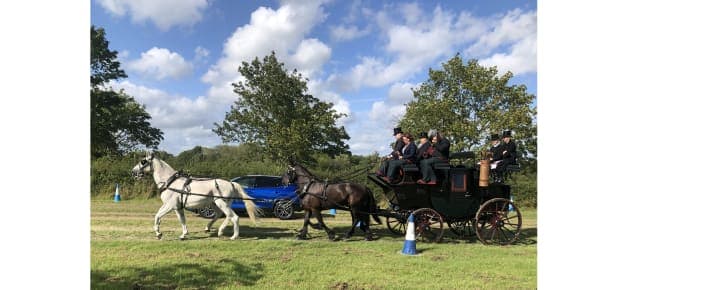
Which do you prefer? Surely the first one, the featured image: why? Both are images of a smartly turned-out carriage and horses, carrying well-dressed passengers in period costume. I really enjoy seeing horse and carriage events at country fairs because such effort it put into preparing the horses, carriages and those participating in the event. Both pictures show (I hope) what I mean. But there is something jarring in the second image. Behind the carriage is a blue car and there are blue traffic cones visible. These things detract from the feeling of authenticity evoked by my chosen photo. This feeling, this emotion (if emotion there is) is all a part of the deceit.
When photography became widely known during the 19th century it worried the art establishment and hard working artists. What was the role of the painter if this newfangled method of capturing a moment ended up being better, more authentic, than painting? Once colour photography became popular in the 20th century, what was the need for painting?
We came to think of photography as providing an accurate record while painting was more... well... artistic. But is it? Is photography accurate? The camera does not lie? Nonsense, the camera, and particularly the digital camera, is a liar supreme. Recent political events have shown how digital images are easily manipulated into misleading stories.
In my case, I hope the deception in the above photograph is no more than playful, a means to provide an image attractive to the eye.
As a photographer, I use my skill and experience to choose my image, my moment to capture. I select viewpoint, framing my picture as I would like to see it in print or on screen. I consider light, focus, foreground, and background. I consider issues of privacy, if there are any people in the photo. With a digital camera, my iPhone camera, I take multiple images in order to allow subsequent selection.
In this case the deceit of the image serves a purpose. The rural scene I am depicting in this picture is clearly and obviously a recent scene at an event staged for entertainment. The carriages are shown in a way that mirrors a picture of a past time of horse-drawn transport. It is a lovely fantasy, and in order to preserve that fantasy I put time and effort into removing or avoiding symbols of a modern, urban, industrial present. Like the blue car and the plastic traffic cones. I would have liked to have taken out the tyre tracks but at least they do not shout 20th century like blue paint and plastic.
If this image is a lie it will fool nobody. The carriage was made with modern methods, albeit by skilled craftspeople. Parts and materials were factory produced, some by high-tech methods. I imagine that on several wrists are wristwatches and in every pocket is a smartphone. Look closer and you will see at least one passenger wearing sunglasses.
Your photo could capture the beauty of nature, the emotion of a candid moment, or the energy of a bustling city. What makes the moment meaningful? Why did you choose to capture it? Let your lens—and your words—showcase your unique vision of the world (Through the lens challenge).
I hope I have captured a little of nature's beauty, if only a bit of grass, trees and a lovely summer sky. This is indeed a candid moment. These carriages were heading towards the arena, presumably to compete for best presentation or best carriage driving. The man in the flat cap is momentarily looking to his left, perhaps having noticed me taking his picture. The moment is meaningful because it is a moment in which the participants strive to recreate a past world of arcadian bliss and to present their skills and love for traditional pastimes and traditional crafts. All in all a wonderful turnout, a fabulous day, and a great show of all the English countryside has to offer, including these beautiful shire horses with their owners and friends.
For me it was a passing moment. I was just leaving, on my way to collect my motorcycle and travel home. I am glad I was able to capture this snapshot of the past and have had the opportunity to reflect on the meaning of the moment and the photograph that represents it.
Thanks for reading
Ray
About the Creator
Raymond G. Taylor
Author living in Kent, England. Writer of short stories and poems in a wide range of genres, forms and styles. A non-fiction writer for 40+ years. Subjects include art, history, science, business, law, and the human condition.
Reader insights
Outstanding
Excellent work. Looking forward to reading more!
Top insight
Expert insights and opinions
Arguments were carefully researched and presented
Keep reading
More stories from Raymond G. Taylor and writers in Photography and other communities.
The Two-Setting Walk That Fixed My Photos (Without Buying Anything)
I used to come home from a photo walk with 200 frames and one “maybe.” The problem wasn’t my camera. It was my brain—spinning through menus, second-guessing every choice, and turning a simple moment into a technical debate.
By Puryear Pebley17 days ago in Photography


Comments