
London-By-The-Sea
Brighton & Hove, Southeast England


The Royal Pavilion captured in the evening with the LED lights, Brighton, East Sussex, England
The image above was taken on a beautiful summer's evening a few birthdays ago; my fella and I were walking past on our way to the cocktail bar my daughter had worked for. She's a talented mixologist.
The building, the Royal Pavilion, was built in three stages from 1787 to 1822. It was the former seaside retreat for George, the Prince of Wales — who later, in 1820 — became King George IV.
Queen Victoria, his successor, despised the premises more because of King George’s ostentatiousness and sold the building in 1850.
Brighton & Hove City Council is now the official owner of the building, and it is managed by The Royal Pavilion & Museums Trust (RPMT).
The LED lights create a beautiful show of colours that transform the rather bland current colour of the museum. I find they highlight the building’s architectural features.


The building above, which is situated a stone’s throw from the Pavilion, was the former Royal Stables and Riding House of the Royal Pavilion.
George, the Prince of Wales — later King George IV was a keen rider. The building later became the Brighton Dome Corn Exchange, which is part of Brighton Arts Centre.
This Centre has shown the likes of Jimi Hendrix and David Bowie to the Philharmonic Orchestra.
Wikipedia quotes: The Brighton Dome is an arts venue in Brighton, England, that contains the Concert Hall, the Corn Exchange, and the Studio Theatre (formerly the Pavilion Theatre). All three venues are linked to the rest of the Royal Pavilion Estate by a tunnel to the Royal Pavilion in Pavilion Gardens and through shared corridors to Brighton Museum. The Brighton Dome is a Grade I listed building.

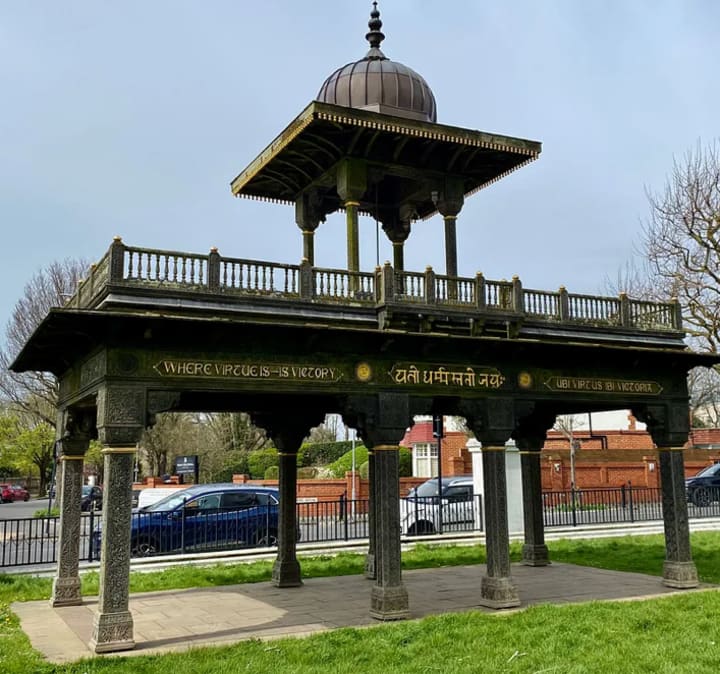
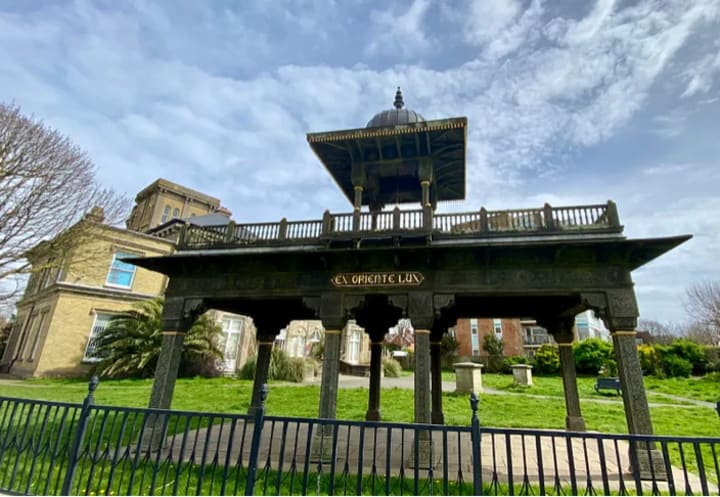
The structure below is the Jaipur Gate, which is exhibited in the Hove Museum gardens. I pass this exhibit when I am walking to the local shops; I find it quite a stark infusion of architecture. It was donated in 1926.
Brighton & Hove Museums quoted:
The Jaipur Gate, in the grounds of Hove Museum, was originally commissioned in 1886 for the Colonial and Indian Exhibition held in South Kensington. It marked the entry to the Rajputana (now Rajasthan) section of the exhibition. The exhibition was opened on 4 May 1886 by Queen Victoria and attracted 5.5 million visitors.


The Ivy and Asian Ivy are situated in the famous North Laine area of Brighton.
North Laine History quoted:
North Laine was Brighton’s industrial suburb for over 100 years, and its charm and character today derive from its narrow Victorian residential streets, its historic buildings, and the strong community living within it. Source
Visit Brighton: Source
Parts of The Lanes date back to the late 16th Century when Brighton was a small fishing town called Brighthelmstone. Some of the alleyways — or twittens as they’re known locally — have an even older feel to them. The Cricketers Arms on Black Lion Street was built around 1545 and is believed to be the oldest pub in the area.
More information on the history of Middle Ages Brighthelmstone here.
Both the South and the North Laines are famous parts of the city and are visited daily by tourists. It’s a stone’s throw from the seafront, and a quirky labyrinthine area of narrow alleyways, hidden squares, exciting shops, legendary jewellers, and plenty of places to eat, drink, and watch the world go by. Source
Thank you for taking a look at some of the pics of my city.
© Chantal Weiss 2025. All Rights Reserved
About the Creator
Chantal Christie Weiss
I serve memories and give myself up as a conduit for creativity.
My self-published poetry book: In Search of My Soul. Available via Amazon
Tip link: https://www.paypal.me/drweissy
Chantal, Spiritual Bad/Ass
England, UK
Keep reading
More stories from Chantal Christie Weiss and writers in Photography and other communities.
Curious Photography Tips Every Beginner Should Try
Have you ever wondered why two people using the same camera can produce completely different photos? The answer often lies in how well the photographer understands the camera itself. For beginners, cameras can seem filled with confusing buttons, dials, and settings. But what if those settings are actually the key to better photos?
By Craig Spiesmana day ago in Photography
Leavie Scott
ORDER HERE Chicago – A Radiant Urban Masterpiece by Leavie Scott Arts & Culture Review – Feature Story In his striking new work Chicago, photographer Leavie Scott captures the soul of the Windy City with a level of vibrancy and emotional resonance that is impossible to ignore. The image immerses viewers in a dazzling skyline bathed in mesmerizing tones of purple, pink, and gold—a palette rarely seen in traditional urban photography and one that instantly distinguishes Scott’s artistic voice.
By Organic Products 3 days ago in Photography



Comments (2)
So nice of you to share your adventures with us. Loved learning about all those places and their photos!
Wonderful photography and a good bit of history thrown in. I loved learning about the place and its past. Thank you!