
Former People Photographer Settles In Golden’s Bridge and Recalls his Career
Storied Career

Please see tip, pledge and subscribe buttons
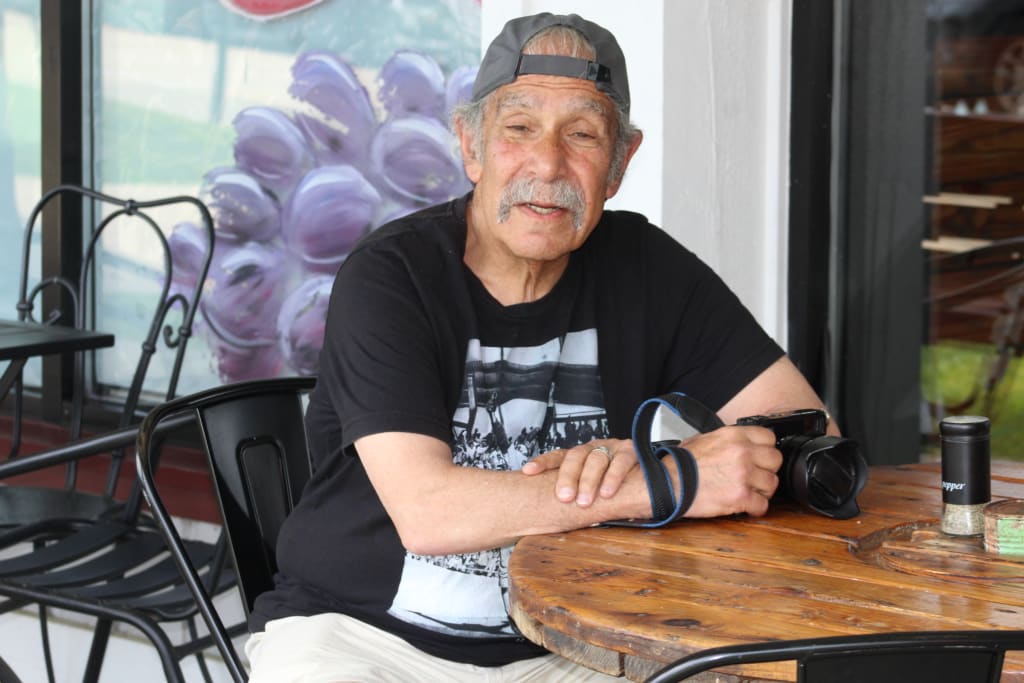
As a kid growing up in Brooklyn, Ira Berger hedged on the left side of his brain. “I was attracted to physics and science because it has an equal sign,” said the Golden’s Bridge resident. Everything quantifiable, he actually became a physicist on a nuclear submarine. But in the late 60s he embarked on a career change and studied on the stoop so to speak.
“I learned photography on the university of the street,” said Berger, and eventually, he become a regular contributor for publications like People and Star Magazine.
Of course, he had to take the road more traveled first. “In those days after Sputnik, anybody who had a pulse got a job,” the former scientist remembered.
In turn, his heart was really pounding on July 20, 1969. “I got to watch the first guys walk on the moon from underwater, “ said Berger.
Mundane was more like it, though, and writing instructions manuals essentially summed up the daily regimen of most in the field. “My take on engineering was about 2% of the people did 98% of the thinking, and I was among the people who made sure there were enough pencils,” he joked.
So the inevitable came due. “The best highlight of my career was quitting my job,” Berger said.
The moment was right too. “There was a 60s vibe at the time,” he recalled. “Do what you want to do.”
Onto the neighborhood, he matriculated a degree. “I looked at people’s work, and if I thought something was good, I tried to define what was good about it,” Berger clarified. “Then I tried to implement that in my work, and if something didn’t come out, I would ask questions.”
Once ready, he started shopping his portfolio and got some straightforward advice. “If we want a story on Telly Savalas or Jackie O, we have staff to do that. But if you want to get something in, find your own story,” Berger relayed.
So the novice broke in with a few, ‘where are they now stories,’ and high-ho Silver, he found a good one. Berger was able to track down Jay Silverheels, who play TV’s Tonto. The actor didn’t stray far from the work that brought fame either. “He became a jockey," Berger revealed.
Another find was Jerry Mahoney, but he went a pretty long distance from the ventriloquism that made him a star. “He patented an artificial heart and did work with solar energy,” said Berger, “He was one of those geniuses who was good at everything.”
With a few in the bag, Berger was on his way. “Editors would trust me, and I was able to get assignments,” he said.
From there, he strung on with Star Magazine. 1976, one of his first shoots made him feel like his new calling came from above. “She was so pretty, I was wondering, do I pay them for this or are they going to pay me,” Berger said of Shelly Hack of Charlie’s Angels.
Even better, the starlet told him that he was the nicest photographer she ever met. But Berger learned that lip service was more likely. “Robin Leech was on the staff, and he burst my bubble,” Berger recalled. “They say it to everyone.”
Almost a decade as a contributor, clicks were a long way from catching on. “In those days Star was selling 3.5 million copies a week, and they were happy to send me anywhere on the east coast,” he revealed.
Dolly Parton, Joe Namath, Andy Warhol, Annie Lennox, Willie Mays and Brooke Shields are among the names he photographed, and best case scenario, Berger would get the chance to put some formal training to use.
He took a class called Psychological Portraiture with Philipe Halsman. So with what’s known about the subject, the idea is to elicit expressions though conversations that tell the story you want, Berger explained.
Time didn’t always permit, though. “Sometimes you go there, and you get only three minutes,” he joked. “You find a nice corner of the room where there isn’t an antennae sticking out of his head and no potato chip bags on the floor.”
Standard stuff, the basics also included darkrooms, and any photographer knew what it meant if a crucial shoot was overexposed. “There would be dead bodies out there,” he deadpanned.
Ultimately, he would get a live one that precipitated his move to People. Star was bought by David Pecker, who is now tied to the Donald Trump hush money trial. “He was a rascal and did all the cash and kill stuff,” Berger revealed.
Although, it was the magazine’s move to Florida that put Berger in motion for the better. Berger did the Star Tracks column for People and loved his colleagues.
He couldn't always say the same for his subjects, though. “Pete Rose wasn’t nice to anyone but his son, because his son could play baseball,” said Berger of the Philadelphia Phillie.
Anyone else was out of play, according to Berger. “This included the rest of his family,” he lamented.
Eventually adding staff editor to his duties, he retired on a Friday in 2010 and was back freelancing on Monday. Two years with the title, Berger would make his official exit. “Now, I’m retired, retired,” he said.
Still, his camera remains ready, and his current focus is on the Chabad Orthodox Jews of Crown Heights. The result is a book called The Bell in the Crown in which photography and accompanying prose provide an inside look at their way of life.
About the Creator
Rich Monetti
I am, I write.
Keep reading
More stories from Rich Monetti and writers in Photography and other communities.
John Jay Falls 3-0 to Lakeland
Please see tip, pledge and subscribe buttons below After defeating Somers on Thursday October 17, Somers hoped to start a winning streak at Lakeland on Monday. So with an extra kick in their step, the Wolves went back and forth with the Hornets. But a penalty late in the first half put the brakes on John Jay’s hopes, and they never recovered.
By Rich Monettiabout a year ago in Unbalanced
My Year, in Prattling and Photos
It's been a year since... last year. Ironically, it seems I've found myself a new tradition of getting sick during the New Year holidays. At least, this year (that is, this inter-year period remarkable for its shiny decorations in the streets and houses, and closed supermarkets and pretty much everything), I'm doubtlessly doing better: I've managed to come visit my friends in Germany for Christmas (which I failed to do last year) and—after having some good quality time eating machanka, playing Munchkin and swinging machetes (the last one obviously crept into this checklist only for the sake of the phonological form)—I came back home via proverbial Deutche Bahn and probably less known Schweizerische Bundesbahnen, my body hosting a family of viruses, virions and who knows what other tiny critters somewhere inside my chest.
By Andrei Z.19 days ago in Photography
A Lifetime of Shakas
For more than three decades as a part-time freelance news and sports photographer in Hawaiʻi, I’ve captured countless moments across the islands — and a few on the mainland. Along the way, almost without realizing it, I built an ever-growing photo archive of people flashing the shaka sign.
By Tim Wrightabout 22 hours ago in Photography
A Dart at Dusk
Seconds ago, the sullen sun set on the two of us… my exuberant furry companion and me. A fresh breeze embraces us, delivering welcome relief from the day’s oppressive heat. His typical stumbling and staggering along — apace with a sloth — has turned into trip-trapping, high-stepping, almost skipping along.
By Angie the Archivist 📚🪶7 days ago in Petlife



Comments
There are no comments for this story
Be the first to respond and start the conversation.