
Communicating With Images
Getting the Message Across Clearly

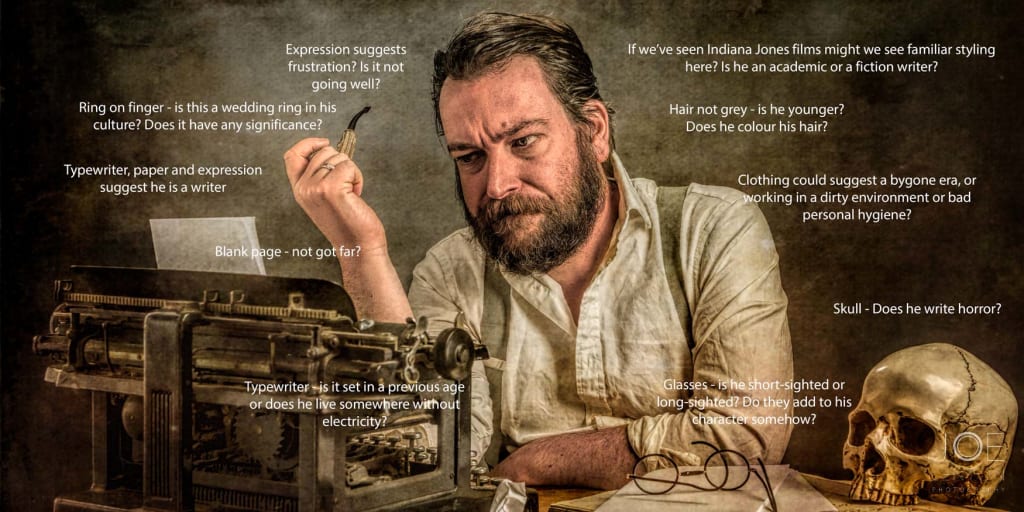
Language and communication are all about words, right? If we want to get a message across, we find appropriate words and put them together carefully. But, what about images? Are they just there to offer support to the words, something colourful to interrupt monochrome text? Most if not all of us will be familiar with the saying "a picture speaks 1000 words". Yet, in practise we often act as if this weren't true. Words and text on a page seem to be valued more highly. But, perhaps a shift is taking place. Online communication commonly includes emojis and Gifs, perhaps indicating that words on their own aren't enough.
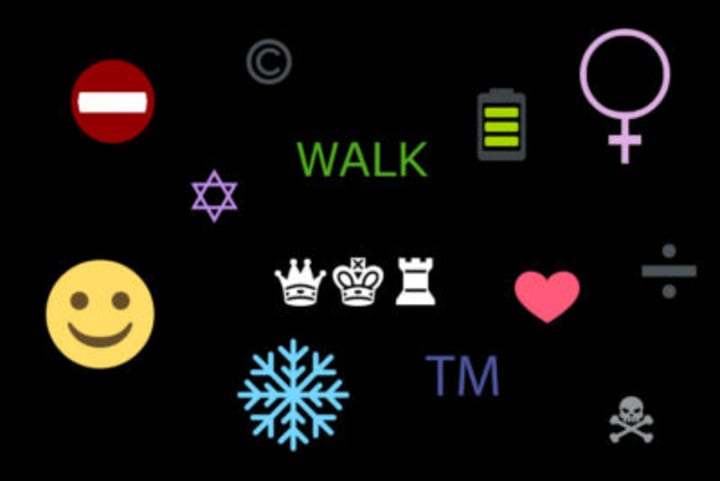
Our senses process far more than words. We build up a sense of the place around us by what we see, hear and smell. Musical notes can carry a mood. Smells can trigger positive and negative memories in an instant. For now, I want us to think more about what we see and how we actually rely on it for much of our communication (apologies to non-sighted people). Words on a page are themselves perceived as a kind of picture. Letters and words are symbols that can carry meaning. They point beyond themselves to something else. Text is a picture or set of pictures containing symbols that we interpret according to the conventions of a language.
Something similar can be said of anything else that we see. Over our lifetime we learn to interpret the signs around us to create a sense of meaning. Just as with a spoken and written language, this follows patterns accepted by groups of people. A language is only useful for communicating if it is shared by others. But, no language is universal. All of our systems of interpretation are limited (and facilitated) by our context. So, just as there is no single unifying language in the world, there is no single unified understanding of images or pictures either. Communities' interpretive frameworks might overlap, but they have their own conventions too.
We can easily forget about the lenses through which we see the world and make sense of it. In fact, it is impossible to take them off completely. So, we are interpreting all the time without even realising it. If we can take a bit of a step back and start to look at how we see things then we can learn how to craft our images better so that they communicate more effectively. It is a bit like learning the grammar and vocabulary of a language in more depth. If we can understand which symbols send what signals then we can more consciously use them to our advantage. With a little work we can find ourselves communicating with pictures as fluidly as we do with words.
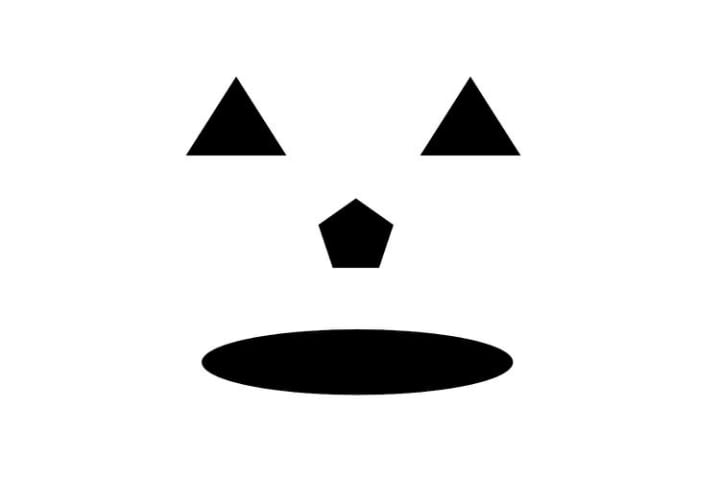
As children, some of the first things we started to interpret and make sense of were pictures (i.e. what we saw). Before we developed a word based vocabulary, we started with images. Babies learn to recognise faces and their mother's face in particular. Faces are such a fundamental type of image that our brains even as adults are quick to interpret patterns as faces. We might see faces in the clouds, for example. When trying to make sense of something new, we fall back on what we already know. Even though we know faces aren't made of clouds, eyes aren't triangles and noses aren't pentagons, we make the association without even thinking about it.
What is going on in the image below? Is it just a few triangles, a circle and a rectangle? Or, do you get a sense of a storyline/narrative?
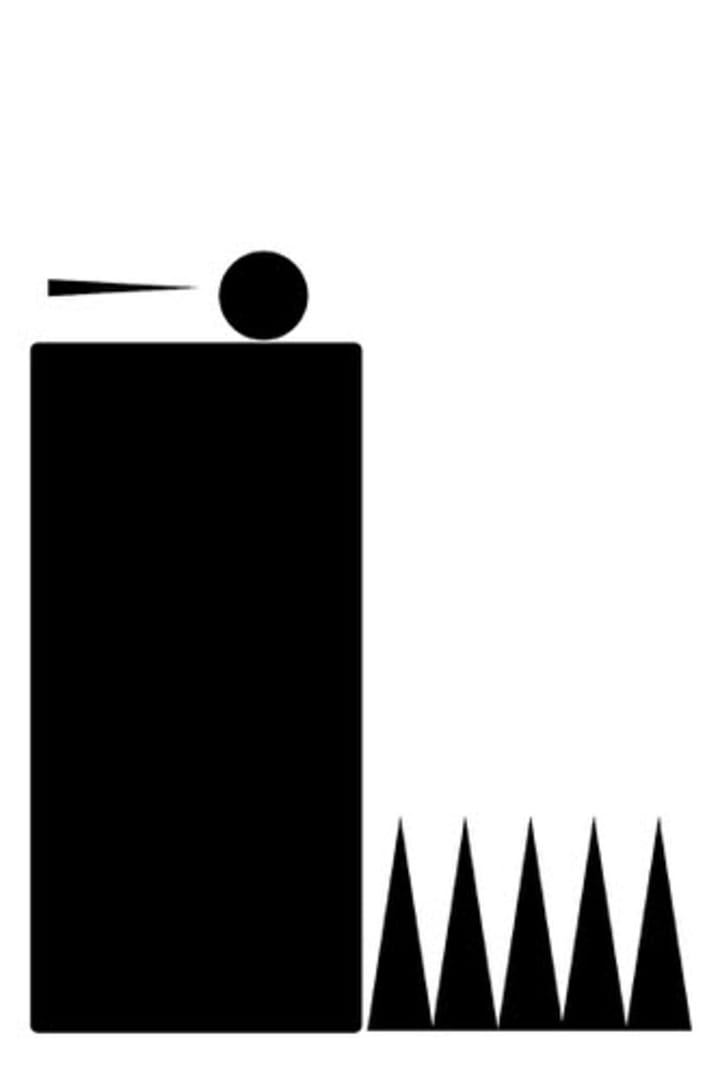
This kind of image, despite how crude it is, can make us think of sharpness, height, danger and being forced to do something we don't want to. We interpret based on our prior experiences and the messages we have grown up with in our culture. These associations are not just limited to shapes. Colours can be very powerful when communicating with images.
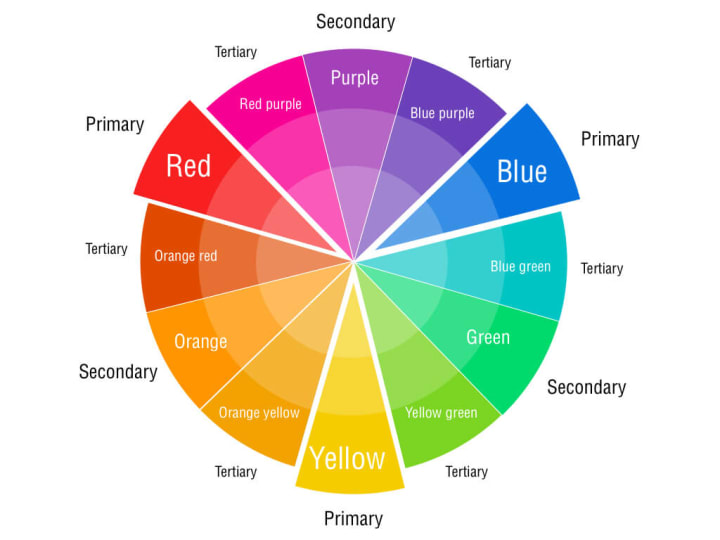
For example, we might associate red with danger, heat or lust. Blue might make us think of something cool or of water. Green may link us to nature, while grey may make us think of concrete buildings. There are many associations that colours can evoke and they do so incredibly rapidly. This is one reason why, for example, warning signs tend to be in red. We can't help notice them and get a feeling that something may be wrong.
(If you want to read more on this topic then please do take a look at my article on communicating with colour and the use of colour in advertising.)
Our memories and our community's understanding of things are the tools we use to make sense of what is before us. We look to what we already know. So, when it comes to communicating with images ourselves, we can use the common associations to our advantage. On a simple level we might tone an image slightly "warm" or "cool" depending on the mood and feeling we wish the viewer to experience.
To communicate well we need to understand the framework that our audience are interpreting with, which may be different from our own. The easiest place to start is, of course, with those we know share an understanding with us. Cross-cultural communication is more complex as we must step outside of what things mean in our own context to discover more of theirs. English speaking countries, for example, read from left to right. Other languages are read from right to left or vertically. This might mean that the way elements in an image are arranged needs to be rethought for other cultures.
I work as an advertising photographer and CGI artist. So, for me images are ways to help brands connect with potential customers. Understanding how images communicate helps to avoid adverts failing to do their job. Although we can never be in total control of how people respond to our pictures, we can at least begin to anticipate what is likely to happen and shape our images accordingly.
Something as simple as the wrong choice of colour in the background could ruin an advertising campaign. The success of an image comes from the various parts of it working in harmony to communicate the message. This means that anything we include in the image can have either a positive reinforcing effect or a negative detracting one. Inappropriate words can mean we fail to be heard, or worse, that we cause offence. We need to learn to take care with our words and our pictures to communicate well.
Inconsistencies cause dissonance that means our message isn't received as well as it could be. This might be body language that suggests the model in the photo isn't confident when the image is supposed to be all about confidence and how the product helps enhance this. For high end products especially, messy compositions and incomplete retouching can be a real problem. If we are suggesting people are aiming at perfection when desiring our products then the images better be near perfect too!
A messy shop window wouldn't entice customers to come in. Our images are a large part of how we present ourselves and our businesses. In the online world, images effectively become our window displays. If we want our customers to be clear about what we offer and what problems we solve for them then it isn't just the text that needs to be clear.
Communicating with images is both an art and a science. Like all forms of communication it can fall short. But, it is something we can work at and improve upon. Clear communication sells. Are our images good sales tools?
Images & words © Joe Lenton, February 2022 - all rights reserved
Joe is an advertising photographer and CGI artist based in Norfolk, UK. View his portfolio and find out more about him at www.joelenton.com
About the Creator
Joe Lenton
Images communicate just as much as words. I am passionate about visual communication, especially in the context of businesses wanting to grow their brands. I combine photography & CGI with an interest in linguistics and hermeneutics.
Keep reading
More stories from writers in Photography and other communities.
The Photographer's Code
You decide to visit your local park. You have become a close confidant to the homeless people who gather there most days. While talking to Cleo and Reed, you notice a new face in the crowd. It belongs to a stick-thin, middle-aged woman. She has her hand on her forehead as if taking her temperature.
By Paul Aaron Domenick6 days ago in Photography
The Gold Tone (Orotone) Technique
She picked it up from a dusty shelf at an estate sale, thinking it was just an old frame. Then the light caught it. The image glowed, not like a print, not like a painting, but like something that seemed to carry its own inner warmth. That was her first encounter with an Orotone, and she bought it without asking the price.
By CurlsAndCommas2 days ago in Photography
A Transparent Look at Vocal Challenges and Top Stories
Almost three years ago, we shared a resource article that served as a place for people to suggest new challenge prompts. We thought it would be a good idea to refresh that thread, and take the opportunity to answer a few common questions about top stories, how challenges are judged and how submissions are reviewed.
By Vocal Curation Team2 days ago in Resources


Comments
There are no comments for this story
Be the first to respond and start the conversation.