
5 Lessons Learned from My First Camera — Humble Beginnings can Teach You More
Lessons learned from an old camera


When I was 14 yrs old, I discovered photography. I saw potential pictures of everyday things even though I didn’t have a camera. I often told my family, “Hey, if I had a camera, I would take a picture of that.”
I was visualizing pictures. I was practicing taking pictures long before I had a camera. I was filling the virtual memory card in my mind.
Finally, my brother bought me my first camera. A “Zenit E” 35mm SLR camera from Sears. It cost $75. It had a Helios 58mm f2 lens and a leather case that smelled like a garage. Russian made and built like a tank. (See the above picture).
Recently, I’ve seen this same camera featured in advertising and stock photos. I guess it’s cool now to have a retro camera like that. I wish I had kept mine.
My first two rolls of film were black and white, and I took pictures of flowers and friends in the backyard. I loved having a camera I could control, and I knew the settings because I read about them and practiced in my mind.
Why did I choose black and white for my first film? It was because of the pictures I’d been absorbing. I’d spent hours looking at classic, old images taken by documentary and street photographers from decades before me. I loved those pictures and wanted to be that kind of photographer.
Strangely, my very first picture was a little experimental. I used a magnifying glass in front of the lens to focus on a buttercup flower — a beautiful yellow flower shot in black and white.
Somehow, I knew how to get the correct exposure. I knew how to focus and shoot a flower and control the shutter speed and aperture. How did I know what I was doing? Practice without a camera.
Here are 5 lessons I learned from my first camera. I hope it will help you think about the lessons you have learned so far.
1) Learn how cameras work — know the theory
I knew how to take a picture because I learned about the principles of light and how a camera works. I understood how to use the light meter, which only looks for middle grey brightness, and I needed to control my settings.
You'll make fewer mistakes if you learn the theory of how a camera works, the shutter speeds, and lens apertures. You'll know what aperture to use when you want more focus from front to back. You'll know what shutter speed to use when you want to stop the action or freeze a baseball in mid-air.
“Light makes photography. Embrace light. Admire it. Love it. But above all, know light. Know it for all you are worth, and you will know the key to photography.”
– George Eastman (of Kodak)

Understanding the basic principles of light and the exposure triangle will open up a world of possibilities. You’ll see photos differently and want to understand the photographer's settings. You’ll want to know what he was thinking. This understanding will prepare you to take similar photos.
2) Practice without a camera
Practice with or without a camera as you learn how to make a good image. See the quality of light and shadows and compose a picture with an imaginary frame. By training your eye to see compositions, you’re learning to see pictures without taking a picture.
You could carry a camera with you everywhere, but that may not always be possible. When you learn to see, the camera becomes a tool you control rather than the camera controlling you.
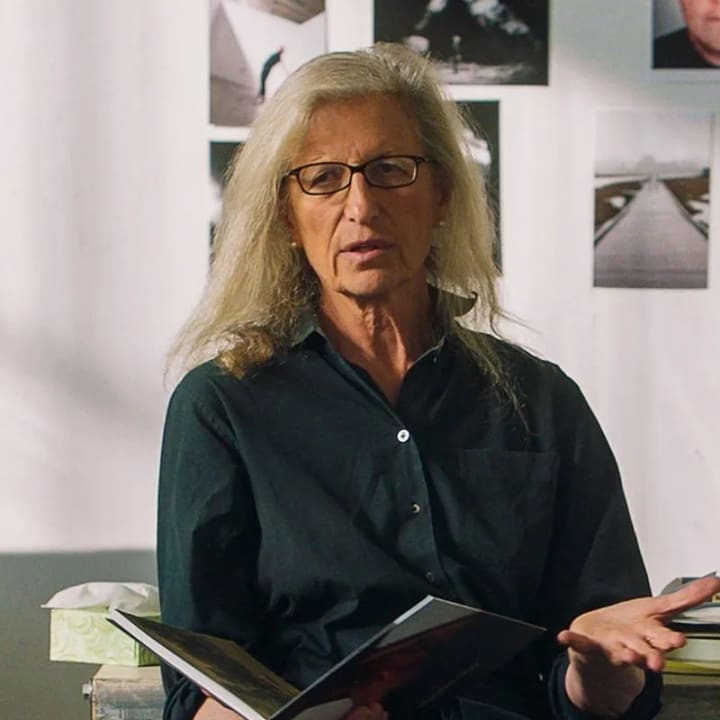
“You can have what you think is the best equipment, and it doesn’t help if you can’t see. It takes years to understand how to see. It just takes doing it over and over and over. One of the reasons I’m still doing it is I love to do it. I love to look.” — Annie Leibovitz on Learning to See (from her Masterclass)
3) Start simple
Some musicians might disagree with me on this, but I believe it's better to learn to play the guitar with an acoustic, not an electric guitar. That’s how I learned. Many people who learn to play an electric first have difficulty playing the acoustic guitar. However, playing an electric guitar is easy if you learn on the acoustic guitar. Acoustic is more work.
In the same way, if you learn photography on a basic camera with a simple prime lens, you can quickly operate a more advanced camera when you get one. Why? Because you know what it’s doing. You’ve learned the principles. This allows you to keep your eye and mind on the picture with less attention to the camera.
It’s not the camera that makes a good picture, but the eye and the mind of the photographer. — Richard Avedon
It’s harder to learn the principles of photography with a camera that does everything automatically. When you’re learning, it’s best to set the camera manually. You may not have this option, but having a shutter speed dial on the top and an aperture ring on the lens is easier than looking down at a digital readout. It’s more tactile and easier to understand the settings.
4) Train your eye
How does a football player improve his game? He watches videos of successful plays. How does a photographer improve his pictures? Look at more successful pictures. Fill your mind with pictures, good ones.
Photography is all about the image you produce. The camera, lens, and other equipment on Amazon or B&H are just tools to make an image.
Many highly recognized photographers began their careers by learning other visual arts, like painting or graphic design. One of the most well-known photographers of the 20th century is Henri Cartier-Bresson. He trained as a painter and became a photographer as an extension of his visual art.
“All I care about these days is painting — photography has never been more than a way into painting, a sort of instant drawing.” — Henri Cartier-Bresson
5) Print your pictures
In the days of film, you had to print your pictures. If you shot color film, it was usually a negative that had to be printed. If you shot black and white again, you had to print it.
The only exception was slide film, also called transparencies. They developed the picture as a positive image and mounted it with a small cardboard frame. Then you either used a slide projector to show your pictures or you would print them.
When you print your pictures, they become real. The picture you took becomes a tangible, physical thing you can touch or hang on your wall.
“The negative is the equivalent of the composer’s score, and the print the performance.” — Ansel Adams
In the history of photography, it was always about making a print for others to see. If you only display your images on a computer, you’ll never know the satisfaction of a finished print, mounted and framed, hanging on a wall for all to see.
Back to the present
Developing your visual voice in photography requires you to know and use your tools creatively.
A painter learns how to use his brushes and paint. He knows about the surface he’s painting. He practices and becomes skilled at using his tools. Then all his attention goes to the painting itself.
To me, learning photography with simple equipment was a gift. Keeping your equipment simple allows your attention to go to your visual art. After all, creating a memorable photograph is what it’s all about.
In closing, meditate for a few moments on the words of a brilliant photographer, Arnold Newman:
“A lot of photographers think that if they buy a better camera they’ll be able to take better photographs. A better camera won’t do a thing for you if you don’t have anything in your head or in your heart.” — Arnold Newman
How do you feel about Arnold Newman's comment?
About the Creator
Gary McBrine
I'm a writer, a photographer, a musician and an ESL English teacher. I have three decades of sales and management experience and run my own Audio Video home technology business. Check out my other articles: https://medium.com/@garymcbrine
Keep reading
More stories from Gary McBrine and writers in Photography and other communities.
Leavie Scott
ORDER HERE Chicago – A Radiant Urban Masterpiece by Leavie Scott Arts & Culture Review – Feature Story In his striking new work Chicago, photographer Leavie Scott captures the soul of the Windy City with a level of vibrancy and emotional resonance that is impossible to ignore. The image immerses viewers in a dazzling skyline bathed in mesmerizing tones of purple, pink, and gold—a palette rarely seen in traditional urban photography and one that instantly distinguishes Scott’s artistic voice.
By Organic Products 6 days ago in Photography
Curious Photography Tips Every Beginner Should Try
Have you ever wondered why two people using the same camera can produce completely different photos? The answer often lies in how well the photographer understands the camera itself. For beginners, cameras can seem filled with confusing buttons, dials, and settings. But what if those settings are actually the key to better photos?
By Craig Spiesman4 days ago in Photography
Worth the Wait: Puerto Viejo, Costa Rica
Beach bumming in a small Caribbean beach town sounded like a perfect way to end our 6-month trip through Mexico and Central America. Or so we thought. The foul, fishy stench of rotten seaweed hit our nostrils as we stepped from the cramped bus and looked out at a rather depressing, empty, and underwhelming black sand beach. It was pouring with rain, and we had to quickly fish out our ponchos. We thought, this couldn’t be it, could it?
By Sh*t Happens - Lost Girl Travel3 days ago in Wander



Comments (1)
This is a wonderful piece! I love the Arnold Newman quote you leave us with. Thank you so much for writing and sharing this!