
The Voice That Broke the Silence
A motivational Story

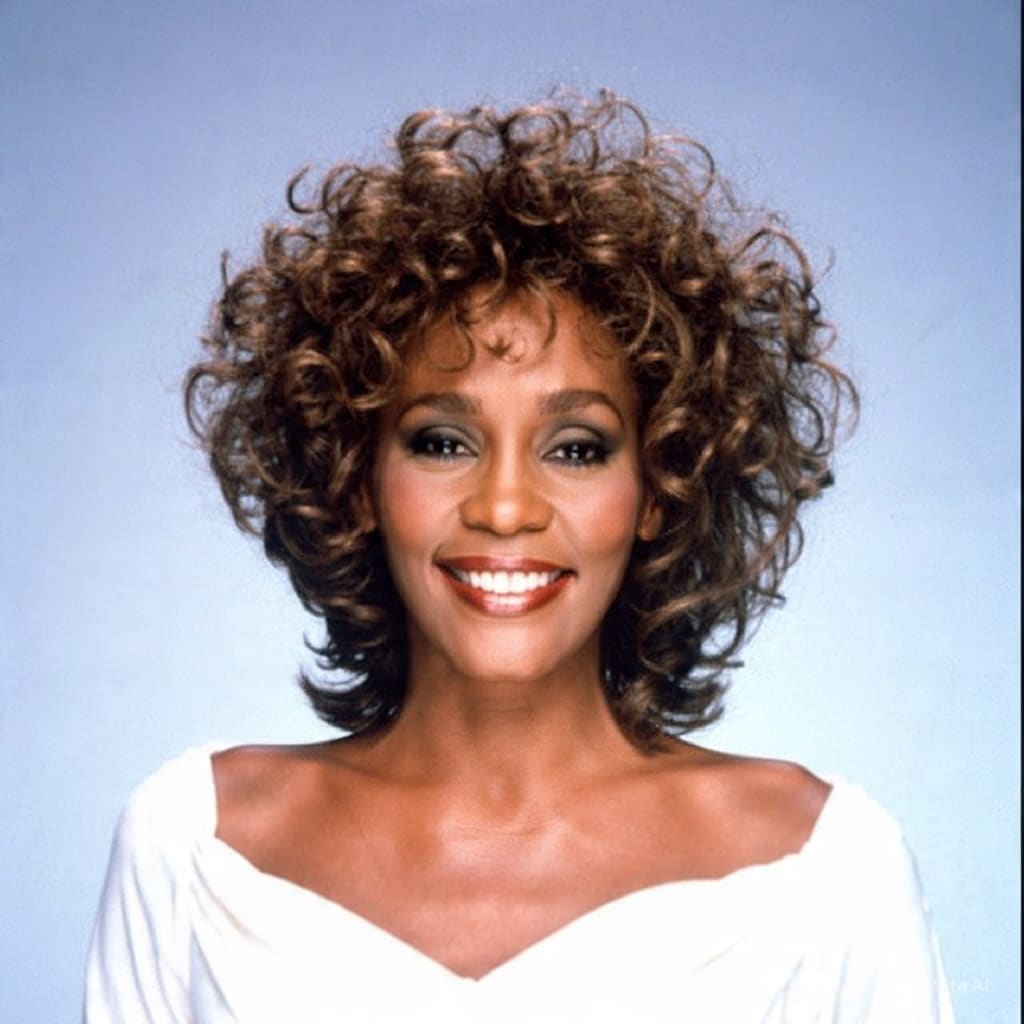
Before the world knew her as The Voice, Whitney Houston was just a young girl from Newark, New Jersey, born into a house where gospel hymns filled the kitchen and faith hung heavy in the air. Her mother, Cissy Houston, was already a respected gospel and soul singer, her cousin Dionne Warwick a star, and her godmother none other than Aretha Franklin. Music wasn’t just in Whitney’s blood—it was in her bones, in her prayers, in every echo that lingered in her childhood church.
But Whitney was different. Even as a child, her voice carried something unexplainable—a weight, a light, a kind of emotion that could silence a room. When she sang, time paused. Cissy knew her daughter’s gift was divine, but she also knew the world would try to take it from her. Fame, as she warned, was both a blessing and a curse.
Whitney’s teenage years were full of discovery and quiet ambition. She sang backup for her mother in nightclubs, absorbing every note, every vibration, every lesson. She watched older singers perform with longing and hunger. By 19, Clive Davis, the legendary head of Arista Records, discovered her singing in a New York nightclub—and the moment changed music history forever.
When she released her debut album Whitney Houston in 1985, the world didn’t just listen—it fell in love. “Saving All My Love for You,” “How Will I Know,” and “Greatest Love of All” became anthems of hope, romance, and strength. She became the first female artist to have seven consecutive No. 1 singles on the Billboard Hot 100—a record still unmatched.
Whitney wasn’t just a singer; she was a force. Her voice had purity and power that transcended race, class, and culture. It was celestial and human all at once.
But behind that golden smile, Whitney struggled with something invisible—the pressure to be perfect. She was polished, elegant, and projected as “America’s sweetheart,” but many in the Black community accused her of being “too white.” That criticism cut her deeply. The same voice that united millions also isolated her. She wanted to be loved, not labeled.
Her love life soon became a headline. When she met Bobby Brown, their chemistry was instant and combustible. He was the bad boy from New Edition—raw, real, and unfiltered. Whitney saw something genuine in him, something that made her feel alive. Against her team’s advice, she married him in 1992. The press painted him as the villain, but Whitney always insisted that they were just two people trying to survive fame together.
That same year, she starred in The Bodyguard—and changed pop culture forever. The movie’s soundtrack, especially “I Will Always Love You,” became one of the most iconic love songs in history. Her voice—vulnerable yet fierce—seemed to pierce every heart. The film made her an international superstar, but the fame brought more eyes, more pressure, and more pain.
By the late ’90s, whispers of drug use, marital chaos, and emotional exhaustion began to overshadow her talent. The tabloids feasted on her downfall, ignoring her humanity. Behind closed doors, Whitney was crumbling under the expectations of being perfect while living through private storms.
Yet, through it all, she sang.
Even when her voice trembled, even when she lost herself, she returned to the microphone as if it were her lifeline. Because it was.
Part 2: Whitney Houston – The Voice That Never Died
When Whitney Houston left the world in 2012, it felt like the end of an era—but in many ways, it was just the beginning of a new chapter. Her passing didn’t silence her voice. It turned her story into a symbol—one of grace, struggle, and resilience that still echoes across generations.
Even after death, Whitney became more than a singer. She became a mythic figure, a mirror reflecting the beauty and tragedy of chasing perfection in a world that often forgets the price of fame.
---
The Woman Behind the Legend
Whitney was never meant to be ordinary. From the church choirs of Newark, New Jersey, to global superstardom, she carried with her the soul of gospel music—raw, emotional, and divine. Her mother, Cissy Houston, was a powerful gospel singer, and her cousins, Dionne Warwick and Dee Dee Warwick, were R&B legends in their own right. Whitney was born into music, but what she did with it transcended bloodlines.
Yet, the woman behind the microphone was often misunderstood. Her smile was radiant, but behind it was a sensitive, deeply feeling soul. Friends said Whitney was generous, funny, and surprisingly humble for someone who had conquered the world. She loved to cook, laugh, and host friends—she wasn’t the diva the media portrayed.
In private, she was searching—for peace, for balance, for herself. Fame had brought her unimaginable success, but it had also taken away her sense of safety. Paparazzi followed her everywhere. Every misstep was magnified. Every rumor turned into a headline.
“I didn’t choose the spotlight,” she once said softly in an interview. “It chose me.”
---
The Comeback That Proved Her Spirit
After years of public scrutiny, Whitney made a heartfelt attempt at a comeback in 2009 with the release of I Look to You. The album was a message to her fans—and to herself. It wasn’t about proving she was perfect anymore. It was about proving she was still here.
The title track was hauntingly beautiful:
> “As I lay me down, Heaven hear me now…”
Those words were more than lyrics—they were a prayer. Listeners could feel the pain, the hope, the surrender. Critics called it a comeback of faith, not fame. And it worked. The album debuted at No. 1 on the Billboard 200, reminding the world that even when her voice had changed, her heart had not.
Whitney toured again, meeting fans who had grown up with her songs. Many wept during her performances, not because she was flawless—but because she was real. She was standing there, imperfect and human, and still giving everything she had. That’s what made her unforgettable.
---
Love, Loss, and Legacy
Whitney’s love life had always been a topic of fascination. Her relationship with Bobby Brown was both passionate and volatile, a roller coaster of love and pain. But even when it fell apart, Whitney never spoke with bitterness. “I loved him,” she once said simply. “And love doesn’t stop because it hurts.”
Her greatest love, though, remained her daughter, Bobbi Kristina Brown. The two were inseparable—singing, laughing, and even performing together. Whitney dreamed of watching Bobbi Kristina follow in her footsteps, but fate had other plans. When her daughter died in 2015, just three years after her, the tragedy felt almost poetic—two souls too intertwined to stay apart for long.
---
The World Without Whitney
After her passing, tributes poured in from around the globe.
Mariah Carey called her “the greatest voice of our generation.”
Alicia Keys said Whitney’s strength taught her that vulnerability could be powerful.
And Beyoncé described her as “the blueprint for what it means to be both beautiful and strong.”
Her influence lives on in every power ballad sung today. Every time a young artist belts out a note with emotion instead of technique, Whitney’s spirit is there.
The Whitney Houston estate later released several posthumous projects, including documentaries like Whitney: Can I Be Me and Whitney (2018), both of which humanized her story instead of romanticizing it. For the first time, fans saw the woman behind the legend—her humor, her fears, her kindness, her exhaustion.
She wasn’t a fallen star. She was a woman who gave too much of herself to the world and forgot to keep a little for her own heart.
---
Faith Never Left Her
Even in her darkest moments, Whitney turned to her faith. Her roots in gospel never left her. When she sang “His Eye Is on the Sparrow” in Sparkle, it wasn’t acting—it was testimony. She was speaking to the God who had been with her since she was a child.
Her final years were filled with a quiet desire for peace. She attended church regularly, prayed with friends, and even talked about releasing a gospel album again.
One of her last interviews summed it up perfectly:
> “I’m still a vessel. God’s not through with me yet.”
Those words, now immortalized, remind fans that Whitney didn’t see her life as tragedy—she saw it as a journey. One of mistakes, lessons, and grace.
---
Why Whitney Still Matters
Whitney Houston’s story isn’t just about fame—it’s about humanity.
It’s about a woman who achieved the impossible and still struggled to love herself.
It’s about how the pursuit of perfection can break even the strongest spirit, and how forgiveness—especially self-forgiveness—can be the hardest gift of all.
Her music remains a time capsule of emotion. Greatest Love of All still inspires millions to believe in their worth. I Will Always Love You continues to echo at weddings, farewells, and tributes around the world.
And every February, when her death anniversary comes, fans light candles, play her songs, and whisper, “We will always love you.”
Because we do.
---
The Voice That Still Heals
Even now, new generations are discovering Whitney through streaming platforms, biopics, and viral videos. Her 1991 Super Bowl performance of The Star-Spangled Banner continues to be hailed as the greatest in history—pure, patriotic, and flawless. That moment captured her essence: strong, graceful, divine.
In 2023, a hologram tour titled An Evening with Whitney brought her back to the stage, giving fans a glimpse of what once was. Some found it emotional, others unsettling—but one thing was undeniable: Whitney’s presence still had power.
When the lights dimmed and her holographic form appeared, the crowd fell silent.
Then, her voice filled the air:
> “I believe the children are our future…”
And for a brief moment, it felt as if she had never left.
---
Forever Whitney
Whitney Houston wasn’t just a singer. She was an experience—a blend of faith, fire, fragility, and fierce love. Her story will forever serve as a reminder that true greatness comes not from being perfect, but from feeling deeply and giving completely.
She lived fast, loved hard, and sang like every breath was a prayer. Her voice was her legacy, but her humanity was her gift to the world.
And though she’s gone, the echo of that voice still rises from radios, church halls, and stages across the planet—soft, powerful, eternal.
Whitney Houston once said,
> “There is a hope that keeps me going, a faith that keeps me singing.”
And so she does—through every note, every heart she touched, and every soul still healed by her songs.
Because legends don’t fade—they transform.
And somewhere beyond the stars, Whitney is still singing…
still smiling…
and still teaching us how to love, live, and rise again. 🌟
About the Creator
Frank Massey
Tech, AI, and social media writer with a passion for storytelling. I turn complex trends into engaging, relatable content. Exploring the future, one story at a time
Keep reading
More stories from Frank Massey and writers in Motivation and other communities.
Tom Hanks: The Everyman Who Became a Legend
When you think of Tom Hanks, you think of kindness. You think of that smile that feels like a warm hug, the voice that feels like a reassuring friend, and the soul that shines with authenticity. What makes him so special isn’t just his filmography — it’s the person he is behind the scenes. The man who can make you laugh in Forrest Gump and break your heart in Cast Away is also the man who can walk through a crowd without an entourage, a man who still writes heartfelt thank-you notes to people who help him, and a man who carries the weight of his fame with unparalleled grace.
By Frank Massey 5 months ago in Motivation
Bomb Scare
It was 2027, and the world never thought it would happen. A missle hit the United States, but it wasn't where they had anticipated. A little town in the northeast was hit by a missile strike, they didn't know why, and they didn't know exactly where it hit, but they did know it was a coastal community, somewhere between Maine and Delaware.
By Gregory Payton4 days ago in Fiction


Comments (1)
There’s so much truth in this. I hope you know how powerful your words are.