
The Last Ride of a Real-Life Hero
He drove thousands to safety and in the end, gave everything for one more life.

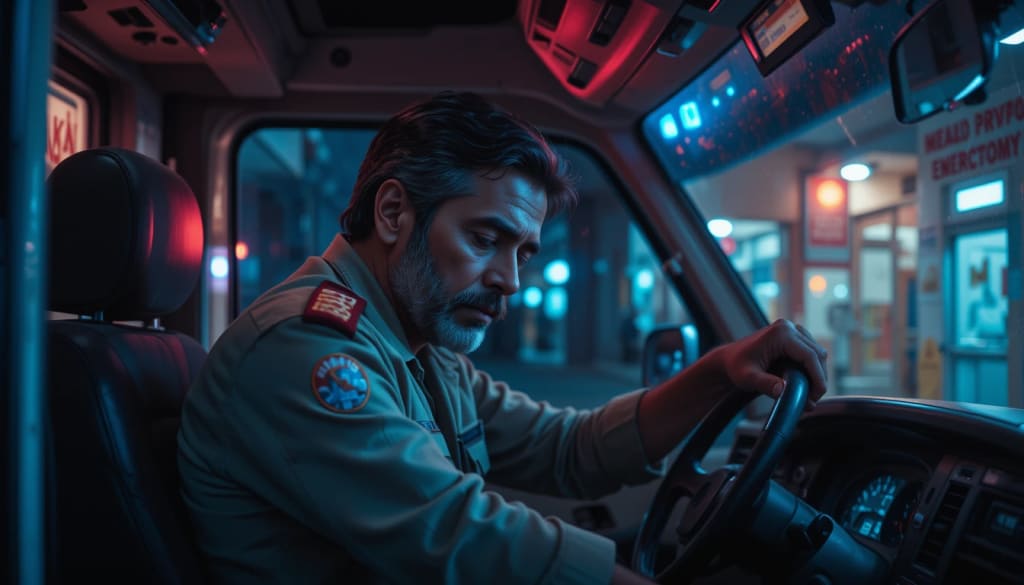
Real-Life Hero Story:
Nobody remembered his full name.
To the hospital staff, he was just “Rafi Bhai” the quiet, grey-haired ambulance driver who showed up early, left late, and never raised his voice. He wasn’t listed on hospital billboards, didn’t wear a doctor’s coat, and his shoes were always covered in dust. But if you ever dialed for help during the worst of the pandemic, chances are he was the one behind the wheel.
No headlines ever mentioned him. But he was always there at the edge of chaos.
Rafi had been driving ambulances for over two decades. He’d seen everything: accident victims, delivery room rushes, cardiac arrests at midnight. But when COVID hit, something changed. He stopped counting how many shifts he’d worked, how many bodies he’d carried, or how many families had cried in his backseat.
There’s no time to think, he once told the nurse who offered him tea. If I think, I’ll stop.
His own family a wife, two kids barely saw him during those two years. He would come home, eat quietly, wash his uniform himself, and lie down for a couple of hours before heading back out. He never told his children what he’d seen. Maybe he was protecting them. Maybe he just didn’t want to speak of the pain.
People called him a driver. But he was more than that.
He would hold the hand of the trembling grandmother being rushed to the ICU.
He would adjust the oxygen mask on a gasping young boy with the same care as a doctor.
He would play soft bhajans or Quranic recitations on the radio, depending on who sat in the back, just to ease their fear.
He became, unknowingly, the last face some people saw.
On a particularly heavy night in May 2021, after 16 straight hours of duty, Rafi was preparing to head home. The hospital’s parking bay was unusually quiet. His thermos was empty, and his eyes burned. That’s when the emergency call came in:
COVID-positive patient in critical condition. Oxygen dropping. Needs urgent transport to city hospital.
The younger drivers hesitated. It was a red-zone location, and that too at midnight. Rafi didn’t.
He washed his face at the tap, slid into the seat, and turned the ignition.
The patient was a middle-aged man unconscious, barely breathing. His wife sobbed from behind a cloth mask. Rafi didn’t speak. He adjusted the straps, monitored the oxygen flow, and kept his eyes locked on the road.
The traffic was thinner than usual, but the tension thicker. Every minute mattered.
Halfway through the 23-kilometer stretch, Rafi’s chest tightened. It started as pressure, then spread like an invisible hand pressing down hard. But he didn’t stop.
He clenched the wheel tighter.
He took a sharp breath and kept going.
They reached the hospital in time.
The nurses rushed out with a stretcher. The man was taken in. His wife turned around, looking for Rafi maybe to thank him, maybe to ask his name.
He was still in the driver’s seat.
Still clutching the wheel.
Unmoving.
Rafi died of a massive heart attack moments after completing the transfer. He never made it inside the hospital. The very hospital whose sirens he had echoed for years.
There was no official ceremony.
The hospital held a brief prayer the next morning. Some nurses cried. A few doctors donated to his family’s fund. His wife received a letter of appreciation from the state and his old ID badge, which still read “Driver - Rafiuddin S.”But his real tribute came quietly.
A week after his passing, the hospital named one of their new ambulances after him.
“Rafi on Wheels” painted in bold blue across the side.
And beneath it, a small line:
For the man who always showed up, even when his heart couldn’t.
Rafi never went viral. He never recorded videos of himself on duty, never wrote motivational posts, and never once called himself a hero.
But every patient who sat in the back of his van every soul who found hope because he pressed the accelerator at the right second, knew exactly who he was.
He was the kind of hero who doesn’t ask to be seen.
He just keeps driving.
💡 Rafi Bhai:
Not all heroes wear capes. Some wear seat belts, hold trembling hands, and drive into danger so that others might live.
Rafi didn’t save the world. But he saved someone’s world. And sometimes that’s enough.
About the Creator
Farooq Hashmi
Thanks for reading! Subscribe to my newsletters.
- Storyteller, Love/Romance, Dark, Surrealism, Psychological, Nature, Mythical, Whimsical
Keep reading
More stories from Farooq Hashmi and writers in Motivation and other communities.
From Dropout to Millionaire: The Boy Who Never Gave Up
Story: The first time Aarav saw a five-hundred-rupee note, he was thirteen. It wasn’t his. He had found it lying on the ground outside the local grocery store, half-buried in dust. For a brief second, he thought of keeping it. But then, remembering his mother’s tired eyes and the unpaid milkman’s daily knocking, he turned around and handed it to the shopkeeper. The man patted his head and gave him a single chocolate in return.
By Farooq Hashmi9 months ago in Motivation
From Field to Table: How Venison Donations Support Families in Need
Each year, many families in Huntsville struggle to keep enough food on the table. Rising costs and unexpected hardships make it difficult for some households to meet basic needs. At the same time, hunters across the region harvest deer during the season. When these two worlds connect, something powerful happens. Through programs that encourage donating venison, hunters can help provide healthy meals to people who need them most. One local partner making a real difference is Manna House in Huntsville.
By Joe Sottolano6 days ago in Motivation
Author’s Advice
If you would’ve asked me 20 years ago did I know I’d become a writer and an author, I would’ve said “nope, ain’t happening”. As fate would have it I did become an author and I can honestly say I’m loving it so far. It really does feel good to be a writer. I’ve learned a lot on this journey and I feel like with even me being as new to this world as I am, there’s some wisdom I need to share with every other aspiring author.
By Joe Patterson4 days ago in Journal



Comments
There are no comments for this story
Be the first to respond and start the conversation.