
The Joy of Immersion
Unlocking the Power of Super-Consciousness
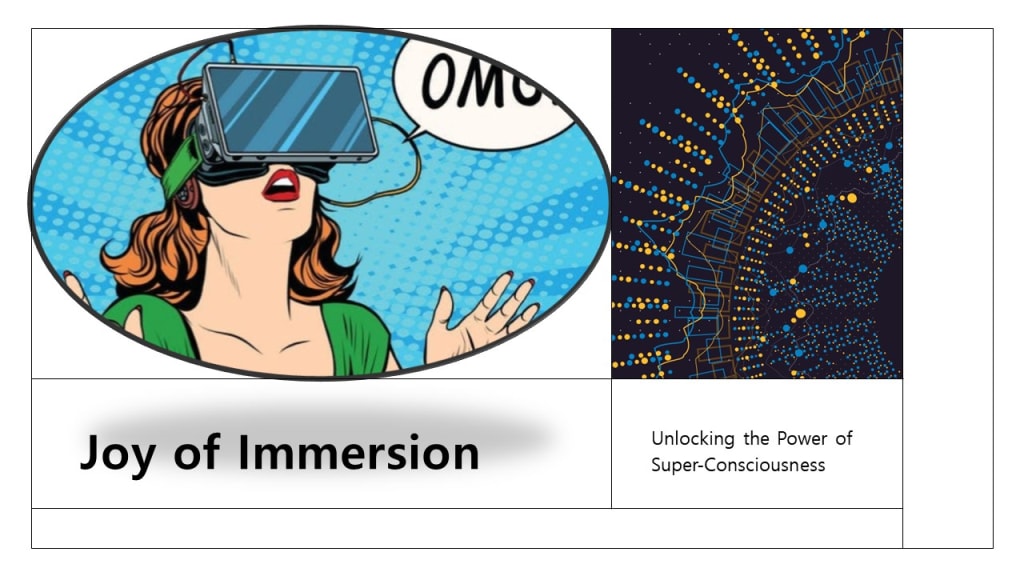
In our pursuit of happiness and personal growth, we often find ourselves caught in a web of negative thoughts and emotions. Despite our conscious efforts to break free, the subconscious mind, with its ingrained patterns, holds us back. But what if there was a way to tap into a higher level of consciousness, a realm that transcends our limitations and propels us towards a better life? Enter the realm of the "super-consciousness."
Unleashing the Power Within (See the Video)
The super-consciousness is a vast reservoir of infinite information and untapped potential. It resides beyond the boundaries of our unconscious mind, and when we learn to access it, our lives can undergo a remarkable transformation. By immersing ourselves in this state of heightened awareness, we unlock the dormant powers of our mind—enhancing our thinking, creativity, and memory.
Embracing Immersion
When we immerse ourselves in a task or an activity, we tap into the power of the super-consciousness. Immersion takes us beyond the confines of our daily worries and negative thinking, allowing us to connect with a deeper part of ourselves. In this state, we become receptive to new ideas, gain clarity about our life's path, and retrieve forgotten memories.
The Transformative Power of Work Immersion
Looking back at the achievements of successful companies and individuals, we often find a common thread—the joy of work through immersion. By fully engaging in their work, they have harnessed the power of the super-consciousness to unlock their creative potential. Immersion has led to tremendous growth, innovation, and success.
Discovering Your Super-Consciousness
If you feel trapped in the repetitive cycle of life, it's time to awaken your super-consciousness and embrace change. Here's how you can embark on this transformative journey:
1. Embrace Positive Thinking
Positive thoughts create positive energy. Make a conscious effort to replace negative thoughts with positive affirmations. Affirm your ability to tap into your super-consciousness and manifest positive change in your life.
2. Practice Mindfulness
Engage in mindfulness exercises to quiet the incessant chatter of the conscious mind. Through meditation and mindful awareness, you can create a space for your super-consciousness to emerge.
3. Immerse Yourself in Meaningful Activities
Identify activities that bring you joy and a sense of fulfillment. When you immerse yourself wholeheartedly in these pursuits, you open the floodgates of your super-consciousness. Whether it's art, sports, writing, or any other passion, find what resonates with you and dedicate yourself to it.
4. Trust Your Intuition
Your super-consciousness communicates through intuition and gut feelings. Learn to trust these inner whispers, as they often guide you towards the right path. By tuning in to your intuition, you'll gain clarity and make more informed decisions.
5. Cultivate Gratitude
Gratitude opens the door to abundance. Take time each day to express gratitude for the blessings in your life. By appreciating what you have, you create a positive mindset that attracts more positivity and unlocks the powers of your super-consciousness.
Embrace Change and Transform Your Life
When you tap into your super-consciousness, you embark on a journey of self-discovery and growth. By immersing yourself in the power of this transcendent state, you can rewrite the narrative of your life. Say goodbye to negativity!
In the world of sports, moments of pure immersion occur when athletes transcend their limitations and achieve an extraordinary level of performance. These moments have fascinated psychologists and researchers for decades, leading to the exploration of a psychological concept known as "being in the zone."
One such iconic example comes from the legendary Brazilian footballer, Edson Arantes do Nascimento, better known as Pelé, during the 1958 World Cup final against Sweden. Pelé's description of his experience captures the essence of immersion, a mental state where self-consciousness dissipates, time becomes irrelevant, and focus reaches its zenith.
Defining Immersion: In a recent publication in "Consciousness and Cognition," Janet Metcalfe of Columbia University utilized Pelé's words to shed light on the concept of immersion. It refers to a state in which individuals become completely absorbed in a task, effortlessly losing track of time and self-awareness. This unique mental state is often associated with peak performance and extraordinary achievements.
The Origin of Immersion: While the phenomenon of immersion has likely been experienced by humans for centuries, it was Mihaly Csikszentmihalyi, renowned author of "Flow," who first brought it into the scientific realm. Csikszentmihalyi and Metcalfe share a common understanding of immersion and its characteristics. They argue that immersion is most likely to occur when individuals are engaged in activities that offer an appropriate level of challenge—neither too easy nor too difficult.
The Balance Hypothesis: Csikszentmihalyi's "balance hypothesis" posits that immersion arises from finding the perfect equilibrium between challenge and skill. When individuals are confronted with tasks that stretch their abilities just beyond their comfort zone, they enter a state of flow. Numerous studies have supported this hypothesis, demonstrating that optimal performance is achieved when the challenge level matches an individual's skill level.
Individual Differences: While the balance hypothesis offers valuable insights, Metcalfe suggests that it fails to account for individual differences in achieving immersion. For instance, professional basketball players face similar challenges throughout the season, yet some games witness exceptional performances while others do not. To understand this variability, a study conducted in 1985 examined the phenomenon of "hot hands," where players experience a higher success rate during specific moments.
The Balance-Reinforcement Hypothesis: Although the study debunked the existence of the hot hands phenomenon, it did uncover an important finding—players reported being in a "special state" on days when their shots were successful. Metcalfe postulated that this connection between success and immersion is central to understanding the phenomenon. She proposed the "balance-reinforcement hypothesis," which suggests that, to achieve immersion, individuals not only require an appropriate challenge level but also a perception of performing well.
Testing the Hypothesis: To explore the balance-reinforcement hypothesis, Metcalfe conducted an experiment involving 45 college students. The participants played a computer game designed for the study and recorded their level of immersion or the "special condition." The results indicated that students reported the highest levels of immersion when the game presented an optimal challenge level, supporting the balance hypothesis. Additionally, they also reported greater immersion in games where they believed they performed well, even if the difficulty level remained the same.
Implications for Training: These findings have practical applications in various fields, including sports training. The balance hypothesis suggests that individuals should be provided with tasks that are appropriately challenging, neither too easy nor too difficult. Simultaneously, the balance-reinforcement hypothesis emphasizes the importance of acknowledging and reinforcing individuals' performance to enhance immersion.
The Complex Nature of Immersion: One might argue that Pelé's experience contradicts Metcalfe's experimental findings, as Pelé's "special state" was triggered by the opposing team's goal rather than personal success. However, upon closer examination, it becomes evident that Pelé's reaction aligns with the balance-reinforcement hypothesis. The Swedish goal served as a wake-up call for Pelé and his team, reminding them of their true abilities and reigniting their motivation.
Pelé described a momentary freeze, as if disbelief had struck them after scoring. The cheering from the stands fell on deaf ears, but soon they realized that the Swedish goal was precisely what they needed to break free from their slump. This surge of realization and renewed determination propelled them into a heightened state of immersion, where their abilities seemed limitless.
The science of immersion unravels the intricacies of human performance and unveils the potential for extraordinary achievements. Whether it be Pele's euphoric experience on the football field or the findings from Metcalfe's experiments, it is evident that immersion emerges from a delicate balance between challenge and skill, reinforced by a sense of accomplishment.
Understanding the factors that contribute to immersion can revolutionize how we approach training and performance enhancement. By providing individuals with appropriately challenging tasks and acknowledging their progress and successes, we can unlock the power of immersion and enable individuals to reach their full potential.
As we delve deeper into the science behind immersion, new insights are likely to emerge, leading to further advancements in various fields. The pursuit of immersion is not limited to sports but extends to creativity, learning, and even everyday activities. By harnessing the state of flow, we can transform our experiences, elevate our performance, and unlock untapped potential within ourselves.
About the Creator
Ahron
The blog is to helping you live an active and healthy lifestyle!
Youtube Channel: https://www.youtube.com/channel/UCrglZ6wWRNyjrtxtcCSTu9w
Keep reading
More stories from Ahron and writers in Motivation and other communities.
5 Ways to make life happy
Living a happy life is a goal that most of us strive for. We invest time, energy, and resources to achieve our objectives and increase our level of satisfaction. However, as we aim for more, we often forget to enjoy what we already have, leading to feelings of discontentment and greed. Here are some tips to let go of excessive greed and embrace contentment for a happier life.
By Ahron3 years ago in Motivation
Why You Should Not Waste Money on Traditional Dropshipping. And What to Do Instead
For years, traditional dropshipping has been marketed as one of the easiest ways to make money online. Social media feeds are full of screenshots showing sales dashboards, rented luxury cars, and influencers promising income with minimal effort.
By Kelmik DT7 days ago in Motivation
When Control Meets Limitation
Obsessive-compulsive disorder is built around control. It is the need for things to feel ordered, completed, resolved. It is the persistent urge to fix what feels unfinished, to organise what feels chaotic, to restore a sense of certainty when the mind insists something is not quite right.
By Millie Hardy-Simsabout 23 hours ago in Motivation




Comments
There are no comments for this story
Be the first to respond and start the conversation.