
The Joy of Breathing
Finding passion in life, even when it presents you with unexpected challenges...
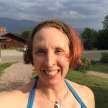
Every day, for hours at a time, I struggle to breathe, and ultimately, keep myself alive. I use my years as a former Acute Care nurse to evaluate my symptoms, determine whether or not I'm stable enough to treat myself at home, or whether I need to call yet another ambulance to take me to the ED. I live my life in 10/10 pain from constant muscle contractions. I administer an Epipen when the muscles in my diaphragm and neck clamp down and I stop breathing...and then I go on with my life.
I'm grateful for every day I wake up breathing, because for me, it isn't a given. I try not to dwell on the repercussions my disease has on my eight year old son, who sometimes asks: "Mama, are you going to die and stay dead this time?" I can't answer him in the moment, of course, as a person can't talk when they're not breathing, and they're jamming a large-bore needle into their thigh. But as soon as the epinephrine kicks in, I hug him tight and assure him I have NO intention of dying any time soon.
Brave words for a person whose neurologists have told them: "Statistically, you should have been dead nine years ago." I look them unflinchingly in the eye, and reply: "You don't know me, or how many things that 'statistically' should have killed me, that I've survived in my lifetime. I won't allow fear to stop me from living my life, so don't put an expiration date on me, like I'm spoiled milk."
I have a natural gift for instinctively sensing pain, depression, anxiety, despair, or simply low self esteem in those in my immediate vicinity. For seeing the inner good within an individual, even if society in general perceives them as being an outcast. I have a special place in my heart for those who are judged and discarded as "not good enough" by the world at large, having grown up with this label myself. Perhaps it's because I'm on the upper end of the autistic spectrum, except no one knew what autism looked like when I was a girl. I just got called a "freak" and a "nerd" and tripped in the hallway and pushed down on the playground a lot.
Because of my own history, I can deeply empathize with anyone who is labeled as "different". This may be due to their having a disability, an addiction, a mental illness, or simply not having the body of a model. It's like having X-Ray vision for any who have been beaten down by life, and the tremendous expectations it places upon them. I find something genuine to compliment them on, and watch as their face lights up in joy, which in turn brings me joy.
A conversation will usually ensue, and the stranger will just naturally start pouring out their life story to me, or the particular stressors that they're currently experiencing. They often say that meeting me, on this particular day, was "meant to be", and that I completely made their day. The reason they give for feeling comfortable confiding in a stranger is always eerily the same.
They say: "I can tell by the look in your eyes that you've been through some hard times yourself, and you've not only managed to survive, but to thrive, with your sense of humor intact. Also, you just radiate positive energy. It's almost like a person can sense it in the air around you. And I know just by looking at you, that you would never judge me." Even before becoming disabled, I heard almost these exact same words on more occasions than I can even recall, from the time I was a child.
I always shrug this compliment aside and reply: "I'm no heroine. I just do the best I can with the hand life dealt me. Ultimately, that's all any of us can do." These strangers will sometimes exchange contact info with me, and pre-COVID, would often ask permission to give me a hug. Now, we do the socially-distanced elbow bump. At every job I've worked, co-workers, patients, clients or those I supervised would often come up to me with the words, "I'm having a rough day. I need a 'Rachael hug' to feel better."
When I obtained my nursing degree later in life, my patients, especially those who were struggling with some type of chronic illness or addiction, would often break down in tears, telling me I was the most empathetic medical professional they had ever met. That most doctors and nurses treated them like they were dirt. I would take their hands and gaze into their eyes and tell them in a firm voice, "An illness or an addiction does NOT define you as an individual. You're so much more, and so much stronger than the world gives you credit for! I believe in you. Now, if you respect me, I need you to do me a favor. Believe in yourself!" Social Workers at the hospital were often amazed when I convinced patients they had known for years to voluntarily enter a detox facility.
Parents of sick infants were also astounded when I would swaddle their child and draw blood or place an IV, and the baby would just stare up at my face without crying, seemingly entranced. I would then hold the baby, rocking and singing to it, and they would smile or laugh. The parents would say, "They usually cry the instant a stranger holds them. You must have the magic touch!"
But I have my greatest success with others who are on the autistic spectrum, as I am. I used to work as a Residential Supervisor at a full time school and home for those on the severe end of the spectrum, who had never developed the ability to speak. We communicated through sign language and their special picture books, that enabled them to select photos of an item they wanted. The other staff were baffled when, almost from the first week I started there, the kids would approach me and make their own particular clicking or chirping sounds, their heads cocked to one side, and I would ask them, "Are you having a hard day? Would you like a hug?" And because they understood what we said, they just couldn't communicate in kind, the child would launch themselves into my arms, laying their head on my shoulder or patting my hair. Now, you have to understand that in general, those with autism can't stand being touched, unless it's on their own terms.
The staff would gape at me, and say, "I've worked here for years, and I've never seen this child communicate their needs so clearly, or what's more, someone else understand them, and then allow themselves to be hugged. How did you know?" Since there was a lot of misperception among the staff about what it meant to have autism spectrum disorder, I never revealed to my co-workers that I also was on the spectrum. I just grinned and replied, "Small, vulnerable things, be they babies or injured animals or anyone in between have always trusted me. I guess the kids can instinctively sense that I would never hurt them."
When I later went on to become a nurse, I used these skills in the Emergency Department for other children on the spectrum. I recall one seven-year-old boy who was verbal, but who his parents told me never talked or made eye contact with strangers. He had all the symptoms of acute appendicitis, and I would have to perform a CT scan on him to confirm the diagnosis.
I could tell he was anxious from the way he was curled up on the stretcher in the fetal position, clutching his blanket tightly. I knelt down on the floor to be at eye level with him, and explained very patiently exactly what we were going to have to do. That he would remain on the stretcher and could keep his blanket with him, but I would roll him down the hallway to this big machine that would take pictures of his insides to find out what was making him sick, and that although his parents could wait in the hallway, that they weren't allowed to be in the room with him, because of the type of test it was.
He looked at me, holding eye contact, and asked, "Will you be there?" I answered that I would help get him settled on the table that rolls into the machine, but that I would have to step into a glass-fronted room while the machine was taking its pictures. I assured him that I would be able to see and hear him the entire time, and that if it would make him feel more comfortable, I could talk to him over the microphone while the machine was taking the pictures. He said, "Okay. I'll go with you."
His parents exchanged wide-eyed glances, and I grinned at them over his head, saying, "I have autism, too. Kids, especially, can sense it." I received the standard response, "We never would have guessed! You make excellent eye contact, you communicate so clearly and you're obviously successful at your job. How did you do it?" I replied that I had started engaging in the performing arts at a young age to teach myself how to overcome social anxiety and to better understand the facial expressions and body language of others, that I was unable to interpret. I said it had taken a lot of work, and that I still struggled with it every day in small ways, but that it was usually only those who knew me best who suspected.
I also told them that my older son, who was also on the upper end of the spectrum, presented exactly as their son did at his age. That he was obviously intelligent, but very shy, and would play for hours alone in his room with his train set. He also had begun acting and singing while quite young, and this had helped him combat his anxiety, and that now he was in high school, he was known for being very out-going and well-liked at his job.
When I asked the boy if he wanted his parents to come with him and wait in the hall during his CT scan, he replied, "No. I'll be okay as long as you're there." The radiologist and I got him settled comfortably on the table, and instructed him that he had to remain as still as he possibly could so we could get good pictures, but that if he needed anything he could talk to us, and that I would be talking to him the whole time. Before I stepped out of the room and behind the radiation-proof sheilded glass, the boy reached out and grabbed my hand, looking up into my eyes and imploring, "Don't leave me, okay?" I assured him that I would be right behind the glass, and that I would take him back to his parents as soon as the test was done. Before she enabled the microphone, the radiologist turned to me with a new sense of respect and said, "That boy has autism, he shied away from me when I tried to adjust his position on the table, and yet he looked you in the eyes and spontaneously grabbed your hand when he was feeling insecure. How did he feel comfortable doing that?" I just smiled and shrugged.
I'm currently friendly with a kind, intelligent, extremely extroverted bag boy who always volunteers to help me out to my car with my groceries, and we chat about our how our week has gone. When I had known him for three weeks, he told me he had autism. I calmly replied, "I know. So do I."
He gazed at me with the sense of amazement I've become accustomed to, and said, "But-you're so outgoing and friendly and smart and funny. And you make awesome eye contact and go out of your way to remember peoples' names. I never would have guessed that you have autism, too!"
I said, "I bet that's what everyone says about you, too, and you're less than half my age! You're going to go far in life. I truly believe you could be anything you set your mind to. You already notice tiny details that others are oblivious to, and that makes you better at your job than most." He looked like he was contemplating something for an instant, then said:, "I guess that's why I felt so comfortable talking to you, and like I had known you my entire life, the very first time we met."
He has since introduced two of his closest friends at the store to me, both of whom have confided that they suffer from anxiety. They say they try their best to confront it by purposefully choosing jobs and social situations that force them to interact with large groups of strangers. I always did the same thing from the time I was a child-facing my fears head-on, instead of hiding from them, until that particular thing no longer caused me fear or anxiety. Their faces always light up when they see me, and they tell me they always feel better, more at home inside their own skin, and that there's nothing wrong with being different, after talking to me. So, I guess I really do radiate a type of positive energy for others who are feeling insecure, even though I still find this kind of hard to fathom.
In line with my innate belief that everything happens for a reason, I guess it's lucky that I chose to get all those extra advanced certifications in Acute Care Life Support and Trauma Nursing, and to specialize in the field that I did, because otherwise I wouldn't still be around. I've been told on many occasions by EMT's and doctors, especially when I need to call an ambulance to go the ED to receive IV meds because I have yet another respiratory infection, and am struggling to breathe, "It's a good thing you have the specialized education and experience you do. You LITERALLY just saved your own life." Again.
Above all else, because I am destined to die before my time, as my elder sister did at age 41, three years younger than I currently am...I am passionate about leaving something meaningful in my wake. I've been writing a true-life memoir for over a year, that I hope to find a literary agent and publisher for, before my demise. I sincerely hope that my book will be an inspiration for all who read it. That it will be a message for those who hail from highly dysfunctional families, as I do, and have managed to NOT repeat the mistakes of their parents. Who have endured unimaginable trauma and neglect, and yet gone on to defy the odds, and find joy and meaning in their own lives, and with families of their own choosing.
You see, I've had what is literally a 1 in a million neuromuscular disorder since I was 30, in 2007, but I haven't let it stop me from pursuing the things I love. With my odd mixture of humor and irony I learned from my deceased older sister, I carry on in the face of whatever life throws at me. No use in worrying about the things you can't change!
I utilize ALL my knowledge of Acute Care Medicine, as a former Lead Emergency Department and ICU RN, to keep myself breathing. Who would have guessed that I would end up in a wheelchair on bad days, considered "totally and permanently disabled", at age 41? Not me. Never in my wildest...
And yes, I was indeed a wild child. One of the many nicknames I've been assigned over the years was "The Naked Wood Nymph" by my older sister. I would streak through the 14 acres my family owned in rural New England, always barefoot, and usually covered in mud, laughing with joy, at age four. I was the fastest girl runner in my school up until 8th grade, when they stopped timing us. However, the main reason I ran for miles without stopping as a child was whenever I was overwhelmed by the injustice of my life, to help me re-focus and gain control of my emotions, which I wasn't free to express in my home. And it worked.
I've been a writer, artist, singer, dancer and actor since the age of five. Once I learned to tolerate clothing, that is! I continue to engage in these passions that my broken body allows me to pursue. I finished acting in two different community musicals I was cast in just before COVID shut down the country. I was trying to land a new role as Lead-singer and Lyricist in an Alternative band, having started my first band at age 19. And I had also won first place in the very first Story Slam I competed in, performing before an audience of six judges that included retired Broadway actors and LA sitcom writers.
This took me as much by surprise as anyone. Who would have guessed that I could compress my history into a five minute block with an assigned topic of "How Music Has Influenced Your Life", projecting my voice to the furthest reaches of the Actor's Studio, sitting on a stool and not betraying any facial cues as both my legs and back went into spasm. Using no script, no "um's" or "aah's" inserted into my dialogue, as I feel most at home in my own skin when I am on stage. And I apparently moved people with my condensed tale. I could perceive tears in the eyes of several of the audience members. I guess I AM a natural storyteller, as my sister was before me.
Ideally, I would choose to monetize my gift for bringing joy to those who need it most by starting a weekly blog filled with inspirational stories and images. However, these would not just be the regular "feel good" quotes that have become so common on social media, especially since COVID began. They would be based on the true life experiences of both myself and my many friends who also struggle with progressive, incurable illnesses, shared with their permission and the names changed, of course. I would base my blog on both reality and the scientific evidence that enabled me to save others' lives on a daily basis, while instilling the traits of resilience, humor and irony that allow all of us to still be passionate about life, to find joy in the little things, and, to the best of our ability, let go of all the things we can't control. Which, let's be honest, is MOST of life.
I would also like to start my own weekly podcast based on the same premise. Especially in these times of uncertainty and anxiety-provoking incidents occuring worldwide, I believe it could benefit anyone who listens to it. But my target audience would be those who are survivors, are classified as having disabilities, or those who just need that extra bump of encouragement to get them through a particularly difficult week. For years now, strangers have been telling me that I should go on Ted Talks to get my name out there, and to share my story of upbeat resilience with the world. Perhaps I could finally pursue that as well!
Although I mourn every day for having to resign from the two jobs where my skill and knowledge allowed me to help save countless lives as a nurse nearly 3 1/2 years ago, I consider myself extremely lucky to have other talents I can still engage in, that bring me joy. I'm only in a wheelchair on my worst days, or when I have to go into a crowd, because even the gentlest shoulder bump will cause me to fall backwards, and I have no control over falling because of the muscle spasms. Although I've gotten used to not having any control to stop myself from falling over the years, it tends to make onlookers anxious. And it's exhausting having to continuously reassure them that this is normal for me, and there's no need to call an ambulance, while I'm lying on the floor.
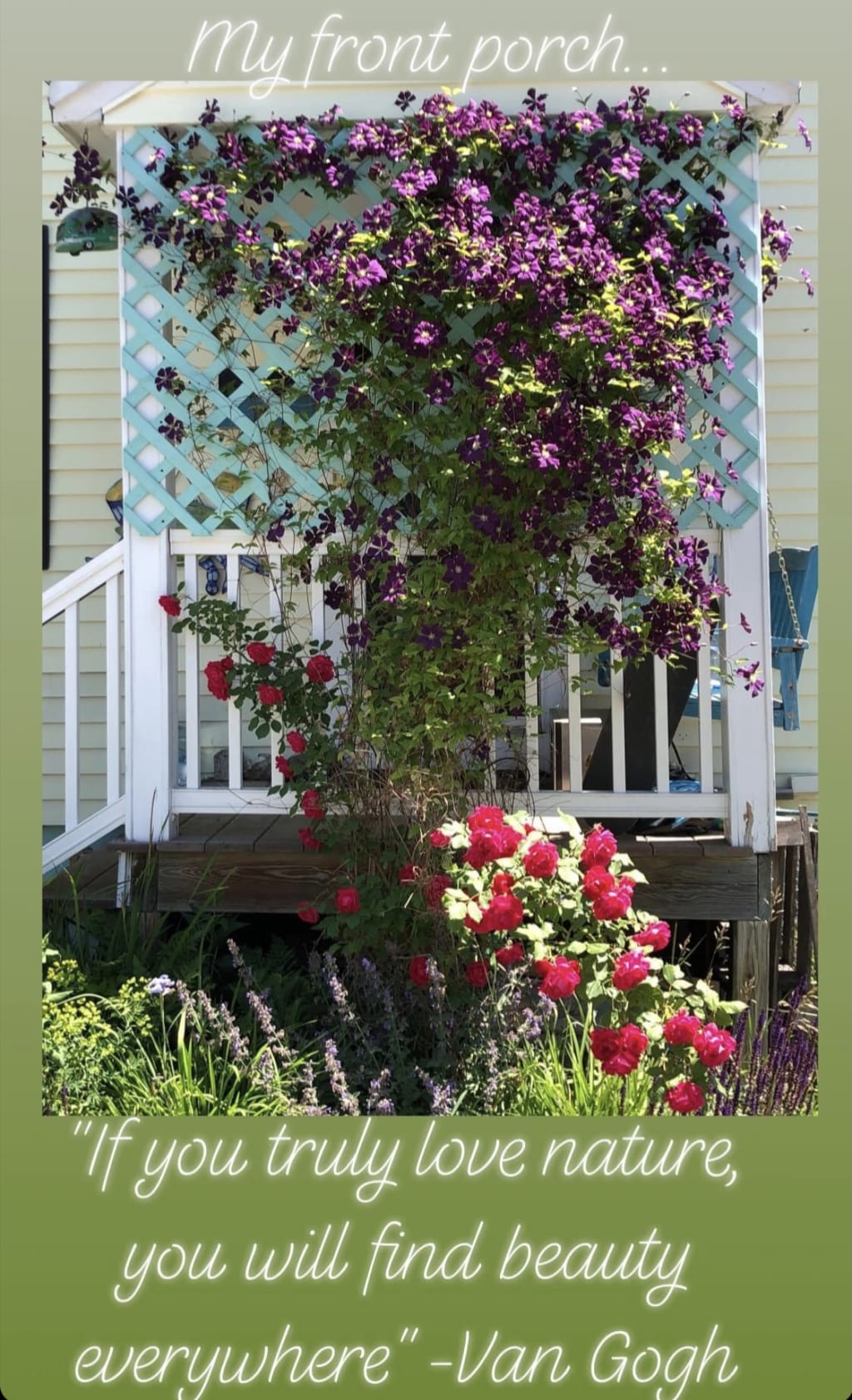
Besides my writing, singing, acting, drawing and painting, I also continue my hobbies of landscaping and carpentry, as my body allows. The photo for my story shows the trellis I attached to my front porch, painted a light turquoise, then trained deep purple, ever-blooming Jackmanii clematis to climb up it, contrasting with the crimson, climbing rose bush. I also found a discarded porch swing, painted it a deeper shade of turquoise, and hung it with new chains. Around the side of the house is a 12 by 24 foot cedar deck I built entirely by myself, off of our walkout basement. I try to leave everything that I touch a little more vibrant than it was before, having an inate love of all things wild and beautiful. And I try to pass these qualities on to my younger son.
I won my first school-wide award in second grade, for the best written and illustrated book in our entire elementary school. I won school-wide awards in every subject each year thereafter, until I graduated from high school at age 17. Although the awards brought me pleasure and a sense of accomplishment, what was far more important was the respsect they won me among my teachers and professors, who stood in place of my dysfunctional parents. I was voted "Most Artistic" in my graduating class. My elder son, aged 21, also a talented singer and actor, who can complete a Rubric's Cube in six seconds, and definitely marches to his own beat, was voted "Most Unusual"...so I guess he learned the lessons I tried to instill!
But most of all, I pride myself on being a non-conformist. Never giving into peer pressure, and actively intervening whenever I see another individual being bullied, even if they're a stranger. In school, and even now, I continue to brazenly confront the individuals doing the bullying, and they know from the barely contained rage burning in my green eyes, that they had better not mess with me. Having endured severe bullying from my peers for being "different" due to having undiagnosed autism from the time I started Kindergarten, as well as being mis-perceived as a snob for my above-grade-level vocabulary due to my extensive reading as a young child, I KNEW about bullying. Also, my mother found sadistic pleasure in making me cry, so by the time I was five, I had taught myself not to betray any emotions that could be viewed as weakness.
26 years after graduation, and I still hold a reputation among my Facebook friends from school for being fearless, kind, smart, creative and, most importantly, someone who would advocate unceasingly for the underdog. My nickname in high school was "Little Trouble Girl", from an old Sonic Youth song thst my guy friends and I used to skateboard to. I would stride down the hallway with my auburn hair flying, wearing my original Woodstock T-shirt from my mom, my army surplus pants, and my knee-high Doc Martin's, singing whatever my favorite song happened to be at the moment. I could have cared less that I didn't wear makeup or try to follow the latest fashion trends. My attitude was, "Love me or hate me, it won't effect my self-esteem. I am who I am." Oddly enough, multiple individuals who used to bully me have since requested my friendship on Facebook, which I've accepted, and they've then sent me personal messages apologizing for their behavior in their younger years, admitting they were intimidated by my ability to defy peer pressure.
I was always friends with my Principals, and they would tolerate my eccentricities, because they told me I was a powerful force for good within the school. As early as sixth grade, my Principal called me into the office and asked if I would unobtrusively befriend an individual who was obviously struggling, but wouldn't open up to the school counselor. This happened on multiple occasions until my graduation.
Inevitably, the student would confide their troubles to me. I was the person who people would call at 3 am when they were feeling suicidal. I would talk them down, and I'm happy to say that despite the higher than average suicide rate within our school district, not a single one of the people I befriended ever followed through, and we remain friends to this day.
The nickname of "Little Trouble Girl" was given to me by my best friend, a guy I would restore VW's with on the weekends, and who taught me how to skateboard. He said I was the only chick he knew who had enough cajones to drop in on the six foot half pipe. Although I can no longer skate or rock climb or be the fastest girl in my school running the mile, I continue to think of myself that way. I will be the kindest, most non-judgmental individual you've ever met. Unless you mess with someone who has low self-esteem.
I still can't tolerate bullying in any form. Even now, even in my wheelchair, I can cause people who are twice my size to take an involuntary step backwards and to stammer an apology to the person they were attempting to intimidate, shaming them for their cowardice merely with my words, without having to resort to vulgar language or sink to their level. They depart the scene quickly. Then, for as long as I can remember, I use my uncanny gift for befriending the outcasts like myself, and teach them the basics of self-advocacy.
The first time I truly felt accepted as a writer and as myself was between my junior and senior years of high school. I was selected by my English teacher to attend The Young Writer's Conference-an intensive 4-day seminar taught by published authors. It was held on Breadloaf campus, that belonging to the small liberal arts college in Middlebury, VT.
350 other writers like myself, those who generally felt like freaks in their own high schools from all over New England, were thrown together, and we formed an instant bond. We knew that we had finally found a place where it was safe to be our genuine selves. We broke off into small groups with our new friends, working hard during the writing sessions, many of which we chose according to our specific interests. We attended live readings by the authors, and imagined ourselves being one of them someday.
The most unexpected honor of all came from the authors who were also judges. Each of us had submitted one piece of writing that we believed to be our best the afternoon of the third day, to be read by the judges. The understanding was that 15 lucky people would be selected after all submissions had been read, and we would then present our writing on stage the following day as the finale to the seminar, in front of an audience of about 500.
I had no suspicion that I would be one of the 15 chosen, but I was. I was notified late that evening, after the 10 pm curfew, when we were all in our dorm rooms. About 10 minutes later, one of the guys from the small knot of friends who I had made there, and who I had an intense crush on, knocked quietly on my bedroom window, and asked me to come out with him. He said the full moon reflecting off the stream was too enticing to miss, and we went down to water, innocently harmonizing on songs together in the moonlight. I found out later, when I had crawled back in through the window well after 1 am, that my kind and patient roommate had written in my journal, "Stay as intensely happy as you are right now. Or at least, keep the memory at your fingertips."
When I stepped confidently onto the stage the next day, to recite my two-page poem from memory, I didn't feel an ounce of stage fright. I felt like I had finally come home. It was the first time I received a standing ovation, or had strangers clamboring for my signature, saying, "You have a gift. You're going to be famous one day." It was all quite surreal. My rock star moment...
So, to sum up, I am passionate about life, about sucking the marrow from it, about enjoying every single moment on this planet that I am granted. I know I will most probably die before my time. I've already outlived my older sister, who was nine years my senior, by three years.
But her words to my five-year-old self echo in my head each day. "We can't control the crazy families we're born into, or the terrible things that are done to us. The ONLY thing we can control in this life is our attitude towards it. NEVER be afraid to be yourself, and you can then extend to others the empathy and non-judgmental love we never received ourselves."
I hope that if I'm successful in finding an audience for my blog and podcast, that I can help instill that same hope, and the determination not to sacrifice the qualities that make you unique, in others. Nothing brings me more joy. And I hope that when my true life memoir is completed, and I'm successful in finding a literary agent and publisher for it, that it will endure as a force for good, and an inspiration for others, even after I have passed on. I face my own mortality each day with as much courage and honesty as I can muster. I am an eccentric, kind, loving, fearless individual who you can call upon in your darkest moments.
But first and foremost, I am passionate about leaving something behind of enduring value, once my life has ended. Although I struggle to keep myself breathing each and every day, my writing will tell my story for me, and perhaps be of encouragement to those who have experienced unexpected obstacles in their time, that there is still joy to be found in the beauty of nature and the enduring resilience of the human spirit. Something that will say, "Rachael was here, and she made a difference in the world."
About the Creator
Rachael Lee Lipson
I consider myself an eternal optimist & have been an artist, writer, singer & actor since the age of 5. I was first published at age 14 in a Journal that circulated throughout New England. I battle a 1 in a million neuromuscular disorder.
Keep reading
More stories from Rachael Lee Lipson and writers in Motivation and other communities.
A More Human Vocal
When we launched Vocal nearly a decade ago, the world was a very different place. LLMs did not exist, and stories were created one at a time by people sitting down to write, revise, and share something personal. Many of our assumptions about publishing, trust, and participation were built for a world where effort and output were inseparable.
By Justin @ Vocal5 days ago in Resources



Comments
There are no comments for this story
Be the first to respond and start the conversation.