
The House Where Silence Lived
Some walls hold more than shadows—they hold the echoes of who we once were.

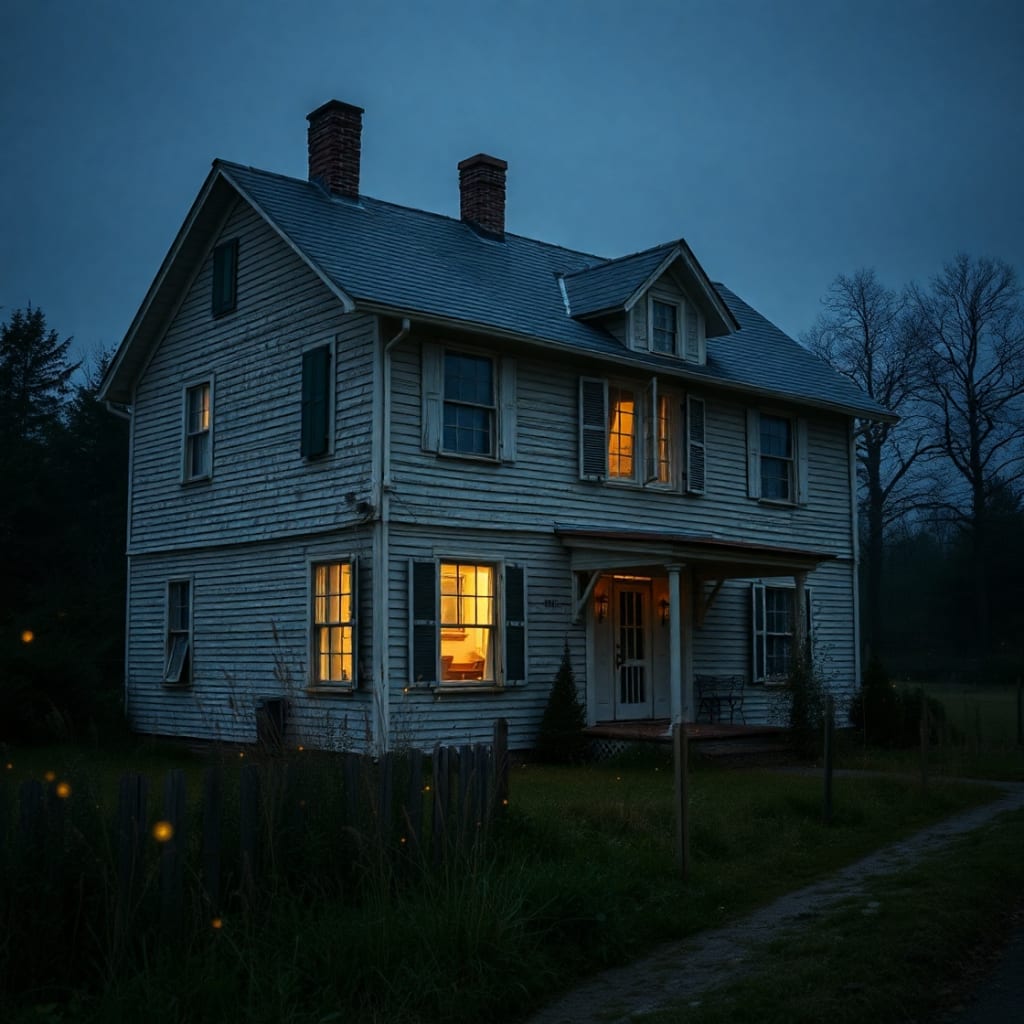
At the end of a narrow lane, there stood a house that most would pass without notice. Its paint had worn thin, dulled into a weary gray that blended with the sky. The shutters sagged as though exhausted, and the garden, once tended, had long surrendered to thistles and wild grasses. It was not the kind of house you photographed or praised. Yet to me, it was a cathedral of quiet. It was the place where silence lived.
Inside, the air was thick with it. Not the gentle silence of peace, but the heavy silence of absence—the kind that presses against the skin, that listens more than it allows you to speak. Conversations, if they came at all, faltered quickly and died mid-air, as though the walls themselves swallowed them. Laughter was rare, flickering and fragile, quickly extinguished. Secrets hid in the corners like cobwebs, visible if you looked closely, but ignored until they became part of the structure.
I grew up believing silence was safety. That to speak was to break something delicate, something already strained. I learned to hold my words in my throat, to bite them back before they could escape. My voice became a stranger to me, an unfamiliar echo I was afraid to hear.
And yet, silence is never truly empty.
It hums. It shifts. It grows until it becomes its own kind of noise. I felt it in the stillness of our dinners, in the long pauses that filled the air heavier than any sentence. I felt it at night, lying awake, listening to the creaks of the house and wondering if they were the building’s way of speaking the words we would not.
But silence gave me something too.
In its shadow, I began to notice the smallest details—the way sunlight spilled across the warped floorboards, golden and alive, defying the gloom. I listened to the sparrows who gathered in the wild garden, their songs bright and unafraid. I watched how rain touched the windows, each drop a fleeting story that slid away before it could be read. The world spoke, even when people would not.
And in the quietest hours, I began to hear myself.
I wrote. At first, only a few sentences scribbled into the margins of old schoolbooks, later entire notebooks filled with thoughts I could never speak aloud. They became my sanctuary. My rebellion. Each page was a crack in the walls of silence. Each word was proof that I existed, that I felt, that I was more than the hush that surrounded me.
Years passed. The house remained the same, but I grew restless. One day, I carried my notebooks under my arm and left. I thought, in leaving, I had escaped silence. I believed it would stay behind, trapped inside those weary walls.
But silence had followed me.
It clung to me like a shadow, whispering warnings in familiar tones: Do not speak too much. Do not share too deeply. Do not reveal what lives inside you. Even in new rooms, surrounded by different voices, I found myself shrinking back, measuring every word before I let it go. I had carried the house within me.
And yet—those notebooks. Those scraps of courage I had once hidden so carefully. They followed me too, their pages waiting patiently. Every time I opened one, the silence loosened its grip. The words I had once written gave me strength to write new ones. Slowly, I began to realize something: silence is not always a prison. Sometimes it is a canvas. It holds space for what is not yet ready to be spoken, a waiting room for truths that will one day demand to be set free.
Now, when I write, I think of that house. I see its sagging shutters, its tired paint, its endless hush. And I thank it. For though it silenced me, it also gave me the hunger to find my voice. It taught me that the absence of sound can sharpen the ear, that the weight of what is unsaid can make us fierce protectors of our own truths.
Every story I release into the world now feels like opening a window in that old house, letting fresh air pour into rooms that were once stale. Each sentence is light spilled across floorboards, chasing shadows into corners until they dissolve. Every word is a rebellion against silence, a reminder that I am no longer confined.
The house still stands, though I rarely return. When I pass by, I see only a building others ignore. But to me, it is alive with memory. Sometimes, in dreams, I walk its hallways again. Only in those dreams, the rooms are filled with sound—the voices of all the stories I had once buried, now spoken freely, echoing like music that had been waiting all along.
I wake from those dreams with a certainty that comforts me:
Silence shaped me, yes.
But it did not define me.
For I have learned this truth: even in the houses where silence lives, voices are born. They may be hidden, hushed, trembling at first—but they endure. And when they are finally set free, they are stronger for having once been caged.
And so I write. I speak. I live louder than the walls that tried to quiet me.
Because silence, though powerful, has no power greater than the courage of a voice that chooses to rise.
About the Creator
Alexander Mind
Latest Stories
Keep reading
More stories from Alexander Mind and writers in Motivation and other communities.
When the River Learned My Name
There was a river that ran near the place I grew up. It curved like a secret kept close to the earth, its waters dark in the morning and silver in the moonlight. To most, it was simply a river—a ribbon of moving water, carrying leaves, carrying time. But to me, it was something else entirely.
By Alexander Mind6 months ago in Motivation
Growing Strong Founders Through Mentorship Networks
Starting a business takes courage, focus, and steady support. Many new founders have bold ideas but lack guidance. That is why mentorship networks matter so much. These networks connect new entrepreneurs with people who have real business experience. As a result, founders learn faster and avoid common mistakes. They also gain confidence because they do not face challenges alone.
By Greg Warnock7 days ago in Motivation



Comments
There are no comments for this story
Be the first to respond and start the conversation.