
The Decision at Midnight
A single night. A single choice. And a life forever changed.

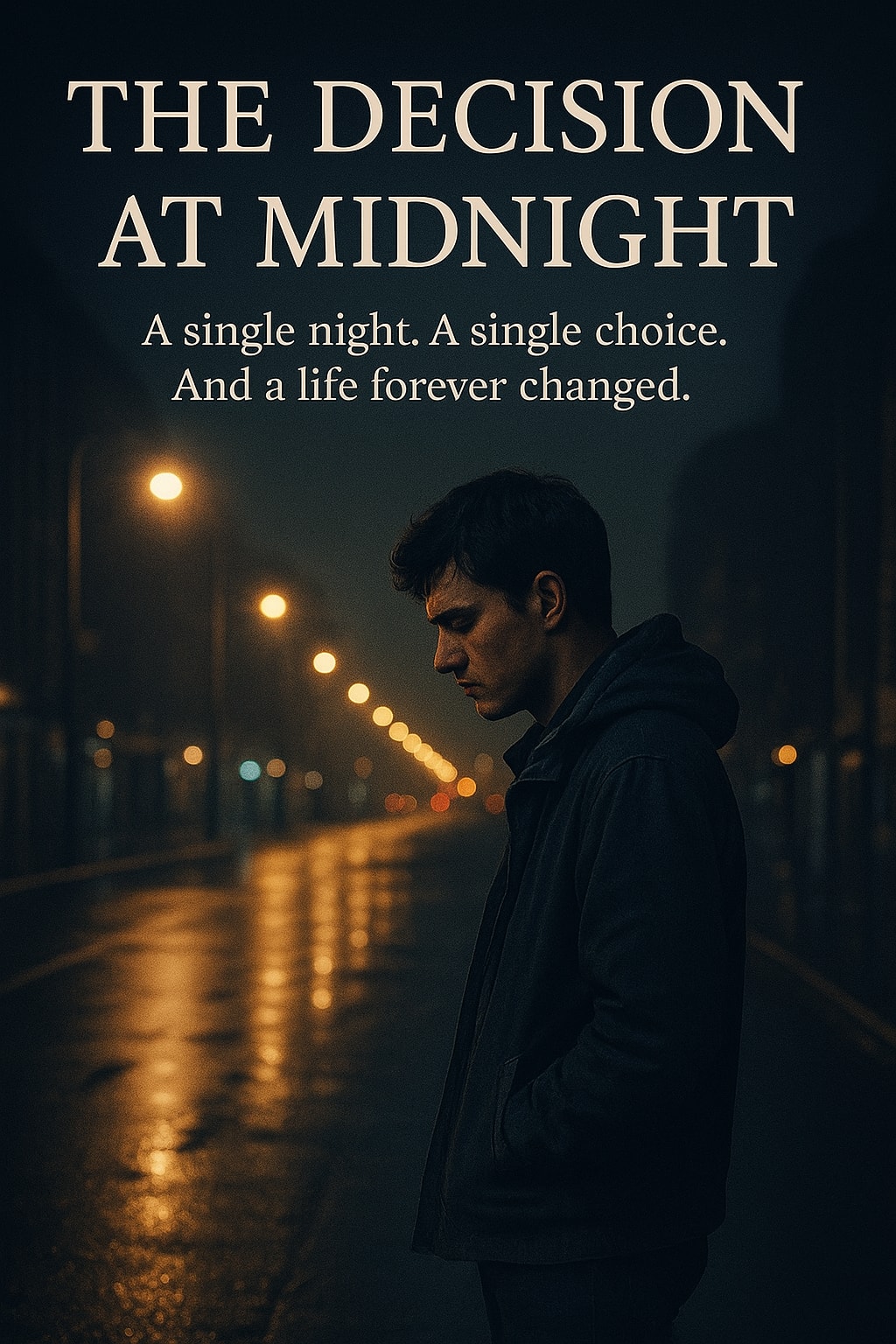
Start writing...Arman stood on the bridge, frozen, as the chill of the midnight wind cut through his jacket. The city behind him pulsed with lights and life, but none of it reached the emptiness inside him. In his hand, he held a small letter — torn, wrinkled, smudged with his fingerprints. It had no addressee. Just his final thoughts.
His bank account was empty. His career in shambles. The business he had dreamed of had collapsed in just six months. His parents didn’t know yet. He hadn’t had the courage to tell them. What would he say? That he failed?
At twenty-nine, Arman had hit rock bottom.
It was exactly 11:47 PM. He had promised himself: if he couldn’t find a reason to live by midnight, he’d jump.
The river beneath the bridge looked calm. Peaceful. That’s what he wanted — not death, just peace.
He looked up at the night sky. No stars. Just clouds, hiding the heavens. It felt symbolic. Like even the universe had nothing to offer him tonight.
And then came the voice.
“You lost, brother?”
Arman flinched and turned. A man, likely in his fifties, stood a few feet away. His coat was old, patched in places. He held a half-empty thermos and a cup in his hand.
“I—no, I’m just thinking,” Arman replied, quickly stuffing the letter in his pocket.
The man smiled gently. “Thinking’s dangerous this time of night. Especially out here.”
Arman looked away. He didn’t want a lecture. But the man didn’t sound judgmental — just… human.
“I come here most nights,” the man said, pouring tea into the cup. “Not to jump, just to breathe.”
Arman stayed silent.
The man held out the cup. “Have some. It’s just tea, not poison,” he chuckled.
Reluctantly, Arman took the cup. The warmth surprised him.
“I used to be a professor,” the man said. “Taught economics. Had a house, a family, students. Then came the recession. Lost my job. My wife left. Depression hit me harder than poverty ever did.”
Arman looked at him. “How did you survive?”
“I didn’t. Not the old me. That version died a long time ago. But this version — the man standing here with a thermos — he survived by making peace with imperfection.”
Arman sipped the tea. It was weak and lukewarm, but it was the first thing he had tasted all day.
“You don’t look homeless,” he said.
“I’m not,” the man shrugged. “I have a shelter I go to sometimes. I work odd jobs now and then. I live differently. But I’m alive. And that matters.”
Silence settled between them. Not awkward — just honest.
“Why did you talk to me?” Arman asked.
“Because I saw myself ten years ago. You looked like a man who needed a voice besides the one in his head.”
Tears welled in Arman’s eyes, but he blinked them away.
“You think it gets better?” he asked.
“No,” the man said softly. “But you get stronger. And the world, surprisingly, offers you new chances — just when you least expect them.”
Arman checked his phone.
12:01 AM
He hadn’t jumped.
Instead, he was holding a cup of tea and talking to a stranger who knew the darkness he was in — because he had lived it too.
Arman slowly pulled the letter from his pocket and tore it into pieces. The scraps floated into the river like falling petals.
“Good,” the man nodded. “Now you begin again. One step at a time.”
---
🌟 Moral:
Rock bottom isn’t the end — it’s a place to rest, reflect, and rise. Sometimes all it takes to change a life is a cup of tea, a human connection, and the courage to face one more day.
life choices, mental health, hope, emotional, survival, struggle, redemption, midnight, urban drama, real life story
About the Creator
Afzal khan dotani (story uplode time 10:00 PM)
“A passionate writer who loves to express feelings through words. I write about love, life, emotions, and untold stories. Hope you enjoy reading my thoughts. Thank you for your support!”
Keep reading
More stories from Afzal khan dotani (story uplode time 10:00 PM) and writers in Motivation and other communities.
The Letter She Never Sent
Emily sat at her kitchen table, the morning sunlight filtering through the window, bathing the room in gold. In front of her lay a single sheet of paper and an old fountain pen. She hesitated for a moment, then took a deep breath and began to write.
By Afzal khan dotani (story uplode time 10:00 PM)8 months ago in Motivation
Stop Drifting: How to Decided What You Actually Want
A surprising number of people move through life without clear direction. They work hard. They stay busy. They respond to responsibilities and opportunities as they appear. From the outside, it might look like progress.
By Stacy Valentinea day ago in Motivation
The Habit That Gave Me Back My Confidence
For a long time, I felt invisible. Not the kind of invisible where people literally can’t see you, but the kind where you slowly begin to believe that your voice doesn’t matter. In conversations, I spoke less. In meetings, I stayed quiet. Even when I had ideas, I kept them to myself because I thought someone else probably had a better one.
By Dadullah Danish7 days ago in Motivation
The Forsyth House Fire
Since 1851, Forsyth House has stood on the corner of Union Street and Gordon Street in the heart of Glasgow. Its iconic, or was... because on Sunday 8th of March, 2026, a fire broke out in a small, seemingly un-named shop in the building and tore all that history down. As I write, the rubble is still unsettled and the street is still blocked off. Central Station is quiet on the upper level, and around 30 small businesses have quite literally gone up in smoke.
By S. A. Crawford2 days ago in The Swamp


Comments
There are no comments for this story
Be the first to respond and start the conversation.